Sabtu, 20 Februari 2016

Posted by Unknown | File under :

The new SsangYong Turismo MPV scores on space, but not a lot else. In entry-level spec, the Turismo deserves another star for its impressive value for money and masses of space. But the four-wheel-drive version is a niche choice here, and despite the decent kit count, there are no curtain airbags and still no Euro NCAP rating. Combine this with ungainly looks, below-par efficiency and poor handling, and you’ll wish you paid a bit extra for a Ford Galaxy. 

The Tivoli may be SsangYong’s star at the moment, but the brand has also updated its huge Turismo MPV with a more efficient diesel engine that complies with Euro 6 regulations. This seven-seater can now be had with a seven-speed auto box, too.


The new 2.2-litre drivetrain boosts economy from 34.9mpg to 36.2mpg in our four-wheel- drive auto test car, while CO2 emissions drop by 7g/km to 205g/km. Power has increased from 150bhp to 176bhp, while torque jumps to 400Nm from 360Nm. It’s a healthy amount, but the 2.1-tonne kerbweight means the Turismo isn’t exactly fast.

It has enough grunt in the lower gears, helped by the smoother-shifting automatic gearbox, yet overtaking needs to be planned well in advance, as the SsangYong feels a bit strained at higher speeds. This is understandable given the car’s sheer size, which in itself makes it difficult to park. and place on the road.


You won’t enjoy how it handles, either, with ponderous steering and lots of body roll evident. The ride is soft, but the bodyshell doesn’t feel very stiff, causing vibrations through the frame over bumpier roads.

Nothing else has changed, so you still get loads of kit, and the 'challenging' exterior styling and oddly designed, cheap-feeling dash also remain. However, the Turismo’s biggest selling point is its staggering amount of interior space. Seven adults can be seated comfortably, and even with all three rows of seats up, there’s a giant 875-litre boot.


Key specs
  • Model: SsangYong Turismo 4x4
  • Price: £24,995
  • Engine: 2.2-litre 4cyl diesel
  • Power: 176bhp
  • Transmission: Seven-speed auto, four-wheel drive
  • 0-62mph: 10.0 seconds (est)
  • Top speed: 116mph
  • Economy/C02: 36.2mpg/205g/km

Jumat, 19 Februari 2016

Posted by Unknown | File under :

The Volkswagen Beetle Dune has been hanging around in one form or another for about 16 years now. It actually started life as a concept car based on the original ‘New Beetle’ in 2000. After a couple more concept cars, the production versions were revealed at the Los Angeles Motor Show in 2015, and now we've been given the chance to drive an almost-ready prototype.

The Dune is pitched as a jacked-up version of the standard Beetle, but with taller suspension (raised by 10mm), a wider stance, and 18-inch alloy wheels. The subtle changes have a cumulative effect, though, and the Dune looks great - the larger sills and stickers on the side does give it a dose of crossover style, and the LED taillights give the rear a fresh look as well. There's a new grille surround and a big rear spoiler, too, and both help give it a sportier stance.

Don't expect to be doing any dune hopping in this Beetle, though - there's no four-wheel drive or even a fancy traction control system like in the Fiat 500X. It tackled the bumpy dirt roads of the Mohave desert on our test drive without any fuss - and because most owners will never leave the tarmac it feels unfair to expect anything more.


It's not too different from the standard car inside, but the striking bronze paint scheme makes its way into the cabin via the doors and dash - and there's matching yellow stitching on the seats and steering wheel, too. The new colour looks good, but it's hard to shake the 'unfinished' feeling that body-coloured interior parts bring with them.

We tried a pre-production US-spec 1.8 petrol model in Cabrio form. When the Beetle Dune comes to the UK it will be available as a coupe and a convertible, but we won't get this larger petrol model - instead there will be a choice between a 1.2-litre petrol or a 2.0-litre diesel with either a manual or automatic gearbox.

The 1.8 petrol we tried had 168bhp, but felt underpowered - we expect that the punchy 2.0-litre diesel that will be available in the UK version will be the one to go for thanks to the extra torque, making overtaking easier. The six-speed DSG is as solid as ever, with quick, smooth gear changes.


On the road the Dune is good to drive, with well-weighted steering and lots of grip. Despite being a pre-production model the Cabrio we tried felt solid, with the vibrations sometimes associated with convertible cars kept nicely in check. The large wheels don't hurt the ride quality too much either. The Dune is composed and comfortable at speed – at least on the American roads we drove it on.

The seats are very comfortable and the driving position is excellent. Even after six hours in the car we felt as comfortable as we did after six minutes. With the roof down in the Cabrio model there's a bit of buffeting, but even without a wind deflector at the back it's still possible to enjoy open-top motoring even on a cold day (plus, the heated seats get rather hot).

The folding roof is the same as on the normal Beetle Cabriolet, so boot space should be the same as well. The details aren't confirmed yet, but with about 225 litres it's much bigger than the MINI convertible. The opening isn't a particularly useful shape, but there’s enough room for a weekend trip or a weekly shop.

 
It's a shame that the Beetle Dune can't quite live up to its sporty looks, though. VW says the Dune is based on the Baja Bugs of the 1960s and 70s, which roared through the desert chasing race wins - but the Beetle Dune never comes close to that kind of excitement.

We expect the Beetle Dune to cost from around £20,500 when it comes to the UK in late spring this year, with the Cabrio we drove likely to be priced at about £23,500. There will probably be plenty of kit included in that price, with the car we tried featuring a Fender sound system, reversing camera, cruise control, auto lights and wipers, DAB radio and smartphone connectivity. There are no UK specification details yet, though.

The Beetle Dune offers something a bit different - on one hand it's not quite as good to drive as a MINI Convertible, but it is more practical. On the other it's not quite as practical as a traditional-but-stylish crossover like the Fiat 500X, but it is definitely better to drive - and we'd argue that it's more stylish than both. 


Key specs
  • Model: Volkswagen Beetle Dune Cabriolet
  • Price: £23,500 (est)
  • Engine: 1.8-litre 4cyl petrol
  • Power: 168bhp
  • Transmission: 6-speed auto, front-wheel drive
  • 0-62mph: 8.5 seconds (est)
  • Top speed: 120mph (est)
  • Fuel economy/CO2: 34mpg/200g/km

Kamis, 18 Februari 2016

Posted by Unknown | File under :

The Ford C-MAX is a stylish five-seat MPV offering a great drive, practical interior and decent build quality. Ford has a strong history when it comes to producing MPV's which offer value for money along with a rewarding drive, and the C-Max continues that trend.

It may not be as stylish as the Citroen C4 Picasso or as spacious but it is one of the best MPV's to drive on today's market. That might not be important to some, but being able to transport a family of five and still have some fun behind the wheel is a real bonus.

Elsewhere, the C-MAX is affordable to run and offers enough space inside for any growing family. And if you need something bigger, you can always turn to the Grand C-MAX 7-seater.

The Ford C-MAX has been one of the best all round small MPVs since going on sale in 2003. The second-generation car arrived in 2011, and a mid-life facelift in early 2015 brought updated styling, new tech and revised engines.

Available with five or seven seats, the C-MAX and Grand C-MAX sit above the innovative B-MAX, but below the S-MAX and Galaxy in Ford’s extensive MPV range. There are loads of practical features, and all models feel built to last. There’s a long list of standard equipment, and as with all Fords, safety is number one priority.

Based on the same platform as the popular Ford Focus, it’s no surprise that the C-MAX is good fun to drive. Sharp steering, sporty suspension and punchy engines ensure this is no ordinary MPV. Whether you’re driving alone or with the family, the C-MAX feels solid on the motorway, but involving on a twisting B-road. It shames rivals like the Renault Scenic and Citroen C4 Picasso, as well as trumping the sensible Golf SV, too.

In terms of engines, there's plenty to choose from. Kicking off the range is a 1.6-litre petrol unit with 123bhp. The highlights, though, are Ford’s award-winning 1.0-litre turbocharged EcoBoost engines, available with either 99bhp or 123bhp. There’s also a choice of 1.5-litre and 2.0-litre TDCi diesels, with the lower-powered 118bhp 1.5 expected to be the big seller. Buyers get a six-speed manual gearbox as standard, with Ford’s Powershift auto as an option.


If you’re looking for a family car that handles as well as most sporty models from other manufacturers, then the Ford C-MAX could be the car for you.

The accurate steering is light enough around town, yet it’s sharp and precise at higher speeds, whether you’re cruising on the motorway or tackling winding country roads. The suspension blends the perfect compromise: it's pliant enough to soften big potholes, but delivers surprisingly engaging handling.

The grippy front-wheel-drive system and intelligent torque vectoring technology – which sends power to the wheel with most grip – provide tonnes of confidence on the road. The only downside is the firm ride – it’s firmer than a Renault Scenic but it’s not unreasonably harsh over bumps.

The two 1.0 EcoBoost models provide plenty of shove, but if you regularly carry a full set of passengers, then the more powerful diesel might be a better option for you.

Our pick of the range is the entry-level 118bhp 1.5 TDCi diesel, offering a decent amount of power but with the prospect of more than 67mpg. If speed is key, though, the more powerful 2.0-litre version offers a decent slug of torque, and feels much more capable with five people on board. The six-speed manual gearbox is fast and precise, while a twin-clutch Powershift automatic gearbox is also available.

If you're only going to be making shorter journeys the small 1.0-litre EcoBoost petrol engine will be ideal. It packs a decent punch for such a small capacity engine and best of all it will return over 50mpg as long as you don't have a heavy foot.

We'd recommend avoiding the aging 1.6-litre petrol engine. It's slow, noisy and because it isn't turbocharged it has to be worked a lot harder to make any progress. As a result, fuel economy won't be great.


With its range of efficient engines, running a C-MAX should prove fairly painless. The most efficient C-MAX in the range is the 118bhp 1.5 TDCi diesel as it has an official fuel consumption figure of 67mpg and CO2 emissions of 110g/km, making it free to tax for the first year of ownership, and £20 every year thereafter. It's worth noting though that the similarly powered Citroen C4 Picasso improves on this with lower emissions qualifying it for free road tax.

If you need a bit more shove, the more powerful 2.0-litre diesel doesn't trail too far behind in terms of efficiency, with Ford claiming 64.2mpg and CO2 emissions of 114g/km meaning £30 a year in road tax.

The tiny 1.0 EcoBoost model returns 55.4mpg and emits 117g/km of CO2, no matter which power output you go for, while the basic 1.6 petrol (only available on the Zetec trim) will do 44mpg and emit 149g/km.

Standard equipment levels are good, so it’s worth steering clear of the options list. It’s long and packed full of desirable kit, but opting for some of it will quickly push the price of your C-MAX sky high. Every C-MAX comes with a three-year, 60,000-mile warranty.

The most expensive C-MAX in the range costs from £26,145, which means you do get quite a lot of car for your money. Across the C-MAX lineup, after three years of ownership and 36,000 miles, the car should retain around 40 per cent of its value.

That figure is around the same as the Citroen C4 Picasso but higher than the Renault Scenic which will only retain around 35 per cent of its value over the same time period.


The C-MAX disguises its MPV proportions well, with a design taking inspiration from the Iosis MAX concept from the 2009 Geneva Motor Show. A 2015 facelift helped smooth lines and bring the people carrier up to date, adding a lightly revised front end and new rear lights.

Following tweaks to the Focus in 2014, the C-MAX has inherited its sibling’s more modern interior, with the same piano-black centre console, smart dials and high-quality materials. Titanium models and above now get the handy SYNC2 touchscreen – though it’s worth noting that sat-nav will cost you extra.

Entry-level Zetec cars come with 16-inch alloy wheels, front fog lights, heated door mirrors, air-con and a DAB radio. Titanium cars get 17-inch alloys, automatic lights and wipers, climate control, a start button and cruise control, while range-topping Titanium X cars add luxuries like xenon headlights, a panoramic sunroof, part-leather seats, heated front seats and a new design of 17-inch alloy wheels.

Options include a Driver Assistance Pack with active city stop, lane departure warning and traffic sign recognition, as well as auto headlights and wipers. There’s also a Convenience Pack with parking aids and powerfold mirrors – but both will set you back more than £500 each.


Despite its relatively compact dimensions, the C-MAX is a very practical car. It has 471 litres of boot space – slightly more than the Renault Scenic’s 437 litres, but way down on the Citroen C4 Picasso's 537 litres. With the seats down, load space increases to 1,851 litres.

The C-MAX can also be ordered with a clever rear bench that splits 40/20/40, which allows you to fold the centre seat and slide the outer seats backwards and inwards to create a more spacious 2+2 layout.

The downsides are that, in three-seat mode, shoulder room is tight in the middle, and although the seats tumble easily, they’re very heavy when you need to remove them. It’s also worth noting that as of 2015, every new C-MAX comes with a space saver spare wheel.

Other notable options are the manufacturer’s Active Park Assist, which automatically parallel parks the car, and a Family Pack, which comes with a powered tailgate and rear sunblinds. The elevated driving position means visibility is excellent, while reach and rake steering makes getting comfy behind the wheel very easy.

At 4,380mm long and 1,828mm wide, the C-MAX is smaller than the Citroen C4 Picasso, which also has a larger boot.

The larger Grand C-MAX measures in at 4,520mm long and 1,828mm wide, around the same size as its main rival, the Renault Grand Scenic (4,573mm long and 1,845mm wide).

Thanks to the high roofline and generous amounts of knee room, the C-MAX offers comfortable family transport. It can be a bit of a squeeze with three adults in the rear but the two outer rear seats slide backwards independently to create more shoulder room.


When it was tested in 2010, the C-MAX received a full five-star Euro NCAP crash rating. Thanks to safety systems such as traction control, electronic stability protection, brake assist and torque vectoring, the C-MAX scored 71 per cent in the safety assist category. It also scored an impressive 92 per cent in the adult occupant protection category.

Every C-MAX also gets driver, front passenger, side and curtain airbags, as well as Isofix child seat fixings. It ranked at an average 62nd place in this year's Driver Power survey, while Ford came a disappointing 25th out 33 in the manufacturer ratings.

The C-MAX comes with a standard three-year/60,000 mile warranty like the majority of new cars on sale today. However, during the first year mileage is unlimited and only once the second year of ownership commences does the 60,000 mile limit come into effect.

The C-MAX will be no more expensive to service than any of its closest rivals. For peace of mind Ford offers all buyers the option to purchase a three-year servicing plan for the car's first three services for £570.
Posted by Unknown | File under :

There’s no denying the revised AMG A 45 is more usable than its predecessor, but it still isn’t quite the driver’s car Mercedes claims it to be. The adaptive dampers make it easier to live with, while the headline figures still ensure this is officially the fastest hot hatchback on sale today. However, despite its all-weather grip and lightning fast responses, front-driven rivals are more fun, more of the time.

We’ve already driven high-power petrol and volume-selling diesel versions of the latest A-Class in the UK, but how does the flagship Mercedes-AMG A45 fare?

This super hatch has been considered fast but a little underwhelming up to now. While the four-wheel-drive system provided plenty of grip, some cheaper, slower, front-driven rivals, such as the SEAT Leon Cupra, offered more smiles per mile.


Clearly perturbed by the introduction of the new 362bhp Audi RS3, Mercedes’ engineers have tweaked the 2.0-litre turbo, which now gives an impressive 376bhp (up from 355bhp). This confirms the new A45’s place at the top of the performance tables and makes it the fastest accelerating hot hatch you can currently buy.

But there’s more to a car than headline-grabbing stats, and while the AMG boasts the most powerful production four-cylinder on sale, it also gets revised gear ratios, adaptive damping and aerodynamic tweaks.

The power boost has shaved 0.4 seconds off the car’s 0-62mph time, slashing it to just 4.2 seconds. Top speed is still pegged at 155mph, but if you regularly commute via the German Autobahn, you can remove the limiter, allowing the A45 to continue to accelerate all the way to 169mph.


To us, the biggest revelation is in the suspension and handling. While the old model was quite insufferable around town, the new £595 optional AMG Ride Control adaptive dampers transform the way the car drives. It allows owners to switch between Comfort and Sport modes, and while you can still feel every contour in the road in the softer setting, it’s more cushioned than before. Even Sport mode isn’t unbearable.

You can choose from a variety of drive set-ups as well, including Race, which gives a sportier setting to the traction control.


Elsewhere, the seven-speed DCT gearbox is as impressive as ever. While it’s smooth when doing day-to-day journeys, the more aggressive driving settings sharpen up changes and help the AMG fire away from junctions. Full throttle upshifts are also accompanied by a pleasing exhaust flutter.

Equipment is generous: all A45s come with LED headlamps, a reversing camera, eight-inch touchscreen sat-nav and AMG wheels as standard. But there’s no getting away from the near-£40,000 price tag.


Key specs

  • Price: From £39,995
  • Engine: 2.0-litre 4cyl turbo petrol
  • Power/torque: 376bhp/475Nm
  • Transmission: Seven-speed dual-clutch auto, four-wheel drive
  • 0-62mph: 4.2 secs
  • Top speed: 155mph
  • Economy/CO2: 40.9mpg/162g/km

Rabu, 17 Februari 2016

Posted by Unknown | File under :

The Volkswagen Touareg is a large, luxurious SUV that's mechanically similar to the Porsche Cayenne, but a lot more affordable. The Volkswagen Touareg appears conspicuously good value for money when you consider that it uses the same mechanical package as the vastly more expensive Porsche Cayenne, as well as the recently replaced original Audi Q7.

Our Choice: 
VW Touareg 3.0 V6 TDI R-Line.
As the big SUV in Volkswagen's range, the VW Touareg rivals the likes of the Jeep Grand Cherokee, Audi Q7, Porsche Cayenne, BMW X5 and Mercedes GLE.

It first appeared in Volkswagen showrooms back in 2002, and this second-generation Touareg arrived eight years later. A light update was carried out in 2014, introducing design tweaks, improved efficiency from the engine line-up and a simplified range of three specifications.

Sadly, the second-generation Touareg has never been available with the 5.0-litre V10 TDI diesel. This engine served up incredible levels of torque and delivered amazing performance for such a big car. Then again, the V10 TDI tended to overpower its brakes a bit too easily with all that weight in the nose, so perhaps it was for the best.

All Mk2 Touaregs come with the VW Group's familiar 3.0-litre V6 TDI diesel, and this engine is reasonably economical and still has plenty of poke. In fact, this model is a bit of an old-school 4x4. In spite of structural connections to the likes of the Porsche Cayenne and Mk1 Audi Q7, it's not especially sporty to drive and is better viewed as a workhorse - albeit a hugely comfortable, luxurious workhorse.

In that sense, the closest rival to the Touareg is probably the upright and sensible Land Rover Discovery. But while the VW has the edge in terms of efficiency and emissions, the Land Rover hits back hard with its imperious off-road ability, as well as its bigger boot and seven-seat layout; the Touareg is strictly limited to five seats.

An unshakeable image gives this car an advantage over most of its rivals, though. Despite the recent headlines surrounding Volkswagen diesel engines, a big, chunky 4x4 wearing the VW badge won't attract the same disapproving stares as one from Audi, BMW or Porsche, for example. This is a big, rugged car that will pass under the green radar. 


For such a big car, the Volkswagen Touareg handles well. It doesn’t have the sharpness of its Porsche Cayenne cousin, but it’s still pleasant to drive and very comfortable, too. You’ll find there’s plenty of body roll even when taking corners gently, but settle into the Touareg’s ways and it won’t let you down. Grip levels are prodigious, so it’ll hang on to the tarmac.

Buyers can specify air-suspension as an option – it costs between around £2,000 and £2,500 depending on whether you’re upgrading an R-Line or an SE model. The set-up sharpens the handling in corners and makes the ride genuinely plush. Plus, it’s worth considering if you’re serious about your off-roading (something the Touareg is surprisingly good at), as the air-suspension allows you to increase the ride height by 300mm for tackling serious terrain.

The car is also capable away from the beaten track. It comes equipped with low-ratio gears and hill descent control to aid off-road ability, although ultimately the limited ground clearance and slightly less impressive approach and departure angles hamper its performance over rough terrain when compared to a Land Rover Discovery or Jeep Grand Cherokee.

Buyers have only one engine to choose from in the Volkswagen Touareg, and it's the same excellent 3.0-litre V6 TDI diesel you’ll find in various Audis, as well as other VW Group models.

Recent revisions have raised power to 201bhp in the basic SE and R-Line models or a significantly more useful 258bhp in the Escape version. That more powerful engine is available as an option in the SE and R-Line trims.

Even the 258bhp diesel may sound as if it’s going to struggle in an off-roader weighing nearly 2.2 tonnes, but the massive 580Nm torque output should provide plenty of reassurance. Go for the lower-powered model and you still get an impressive 450Nm, which should be sufficient in-gear punch for overtaking on the motorway or pulling up a steep, muddy bank off-road.

Whichever version you choose, power is sent to all four wheels through an eight-speed Tiptronic automatic gearbox, and while that shifts cleanly and smoothly, the engine can be a bit too noisy at times. It’s not an aggressive diesel clatter; it’s more of a smooth, low-pitched rumble that really makes its presence known when you want more power. Still, the engine settles down once you’re up to cruising speed, and the Touareg is a refined motorway car.


As you'd expect from Volkswagen these days, the cabin of the Touareg is classy and beautifully made. The doors close with a reassuringly solid clunk and the seats are big, broad and hugely comfortable. All the basics are right too, from the clear instrument dials and neatly arranged switchgear to the widely adjustable driving position.

The thing is, the interior just doesn't look as expensive as that of the original 2002 Touareg. That model shared most of its design inside with the hugely expensive Volkswagen Phaeton saloon (which later turned out to be a massive sales flop) and that meant lashings of fake wood and impeccable build quality.

In contrast, the current Touareg looks and feels more like an upmarket version of the Passat. There's nothing wrong with that, as the large family car has a class-leading interior, and if you've never sat in a Mk1 model you won't know what you're missing. But we can't help feeling a bit let down - although Volkswagen has at least tried to add a bit more of a premium feel inside with its latest round of updates, and the Mk2 Touareg now seems more worthy of its price tag inside than it did when it was first launched.

A big, bright, eight-inch touchscreen takes pride of place in the centre of the Touareg's dashboard. But while it's simple enough to use, there's no getting away from the fact that it's a generation behind the one you'd get in a Volkswagen Golf - a car that costs a fraction of the price.

By way of compensation, the system features a 60GB hard drive pre-loaded with 3D sat-nav, and incorporates an SD card reader. It also includes Bluetooth connectivity, allowing you to make hands-free calls and stream music wirelessly from your smartphone. Plus, drivers and passengers can hook up their mobile to the system using the USB connection under the armrest. In addition to the touchscreen operation, there are steering wheel controls for the infotainment system.


Not many cars can match the Volkswagen Touareg for comfort. Its seats are supremely supportive and on a long journey, the car is probably only beaten by a Volvo XC90 in this respect. This makes the Touareg a great choice for drivers who regularly spend hours behind the wheel.

For a big SUV, this Volkswagen isn't that long - a 4,801mm, it's significantly shorter than some luxury saloons. The Touareg should have few problems with height restrictions at car parks too, as it's just 1,733mm tall.

But some drivers may have trouble getting used to its width - it measures 1,940mm wide, or 2,208mm including the mirrors. That's exacerbated by the driving position, which places you low down and towards the centre of the car, making the Touareg feel even bigger than it is when manouevring in tight spaces. A Land Rover Discovery has similar dimensions, but you just don't feel it from behind the wheel because its sight lines are so much better.

You'll forgive the bulky feel inside the Touareg when driving around town because it's a very, very spacious car. Even on models with the optional sunroof, there's masses of headroom, while six-footers can stretch out comfortably in the back behind drivers or front seat passengers of a similar height. The car's considerable width also means you should be able to get three child safety seats side-by-side on the rear bench, which partly makes up for the lack of a seven-seat option.

The boot is massive no matter how you look at it, but you can adjust it to maximise rear passenger comfort or maximise luggage capacity. The rear seatbacks can be reclined, so boot space effectively expands from 580 litres to 679 litres.

Either way, that should be more than enough space, but of course you can fold the back seats to take really big loads. There's a handy lever in the boot to release the seats (and incidentally, a release for the optional rear tow hitch is found in the same place) and once they're folded the luggage capacity increases to 1,642 litres. That's not as much as in a Land Rover Discovery - which can swallow up to a massive 2,558 litres - but it should be plenty for most people's needs.


Volkswagen has an enviable reputation for quality and reliability, and as the Touareg is one of the brand’s flagship models, you’d like to think it gets that little bit of extra attention on the production line.

The big SUV didn’t feature in the Auto Express Driver 2015 satisfaction survey, as there weren’t enough responses from owners, but the general impression from drivers is that the Touareg is solid and dependable. It was well known in the trade that many Mk1 V10 TDIs ended up with suspension and underbody damage as Volkswagen didn’t fit strong enough brakes to cope with the extra weight of that mighty engine – owners were forced to go straight over grassy roundabouts. There are no such worries with the latest car, but it goes to show that you have to keep your eyes open.

On the safety front, the Touareg should provide exceptional crash protection. It hasn’t been tested independently by Euro NCAP, but the US Insurance Institute for Highway Safety gave the car the top ‘Good’ rating in all its assessments, which should give some peace of mind.

Plus, Volkswagen has fitted the Touareg with a full range of crash-avoidance systems, such as post-collision braking (which brings the car to a stop after an impact), stability control with a trailer-assist function and all-round airbags, including curtain airbags front and rear.

Buyers can specify more safety kit from the options list: active cruise control, lane departure warning, collision alert, city emergency braking and a blind-spot monitor are all available. So is a pre-crash sense system that tightens the seatbelts and closes the windows if it detects an unavoidable accident is imminent. Plus, all-round cameras help you park in tight spaces.


The standard warranty covers the Touareg for three years and 60,000 miles, but buyers can upgrade that to four years and 75,000 miles for £690 or five years and 90,000 miles for a whopping £1,690. Volkswagen’s own in-house roadside assistance package comes as standard for three years.

As with most major manufacturers these days, Volkswagen offers a fixed-price maintenance plan. Service intervals on the Touareg stand at 12 months or 10,000 miles for an oil change, 24 months and 20,000 miles for an interval service and oil change and 36 months and 30,000 miles for an inspection service with oil and brake fluid change.
Posted by Unknown | File under :

The A6 is Audi's classy compact executive car rival for the BMW 5 Series and Mercedes E-Class.
Along with the BMW 5 Series and the Mercedes E-Class, the Audi A6 is one of the most established models in the executive car sector. It’s available as a four-door saloon and as an estate, known as the Avant.

As with all Audis, the A6 has a smart, well built interior, while under the bonnet there’s a strong line-up of engines. This kicks off with the frugal 2.0-litre TDI diesel in the Ultra model – which is aimed at company car drivers with its 109g/km CO2 emissions and 67.3mpg claimed fuel economy – while topping the range is the sizzling 552bhp RS6 Avant.

Sharp looks and the appeal of the Audi badge on the bonnet add to the A6’s desirability and, as you’d expect in this sector and at this price, there’s a generous level of equipment as standard. It isn’t quite as much fun to drive as the 5 Series or a Jaguar XF, but it’s more enjoyable than the E-Class – although the Mercedes has the edge on comfort.

Along with the BMW 5 Series and the Mercedes E-Class, the Audi A6 is one of the most established models in the executive car sector. It’s available as a four-door saloon and as an estate, known as the Avant.

As with all Audis, the A6 has a smart, well built interior, while under the bonnet there’s a strong line-up of engines. This kicks off with the frugal 2.0-litre TDI diesel in the Ultra model – which is aimed at company car drivers with its 109g/km CO2 emissions and 67.3mpg claimed fuel economy – while topping the range is the sizzling 552bhp RS6 Avant.

Sharp looks and the appeal of the Audi badge on the bonnet add to the A6’s desirability and, as you’d expect in this sector and at this price, there’s a generous level of equipment as standard. It isn’t quite as much fun to drive as the 5 Series or a Jaguar XF, but it’s more enjoyable than the E-Class – although the Mercedes has the edge on comfort.


Our Choice: 
Audi A6 Ultra TDI S line S tronic.
In the past, the Audi A6 has struggled to match its biggest rival in the executive car class, the BMW 5 Series. However, the latest version is different. Soon after it launched, we named the A6 Best Executive Car at the Auto Express 2011 New Car Awards 2011, and although it missed out on the top spot in 2012 and 2013, the car won the crown again in 2014 and 2015.

Thanks to the introduction of the new Ultra spec, which boosts performance and efficiency, the A6 has set the class standard even higher. It's a great all-rounder with handsome looks, style and class to match that of its Jaguar XF arch rival. There are few compromises in the way it drives, and it’s a lot more entertaining than the Mercedes E-Class.

The A6 is available in four-door saloon and five-door Avant bodystyles – the latter offers 565 litres of boot space with the seats up and 1,680 litres when they’re folded. That's more than a BMW 5 Series Touring, but less than a Mercedes E-Class Estate.

Audi also sells an A6 Allroad, based on the Avant. This features rugged styling, a raised ride height, special body cladding and quattro four-wheel drive, and competes with the likes of the Volvo XC70.

In the standard A6 range, buyers get a choice of SE, S line and Black Edition trim levels, with six-speed manual or seven-speed S tronic automatic gearboxes. The regular model comes with diesel power only – only the high-performance S6 and RS6 feature petrol engines – and the entry point to the range is a 2.0-litre TDI. From there, customers can move up to a 3.0-litre TDI or a twin-turbo 3.0-litre BiTDI, both of which feature Audi’s quattro four-wheel-drive system.


The A6 was facelifted in late 2014 with new lights, wheel designs and some trim tweaks. While you won't spot the visual tweaks easily, the improvements Audi made to fuel efficiency at the same time will appeal to company car drivers and private buyers alike.

A high-powered four-wheel-drive S6 model joined the line-up in 2012 and is powered by the same twin-turbocharged 4.0-litre petrol V8 used in the brilliant Bentley Continental GT V8. This delivers 444bhp and a muscular 550Nm of torque to all four wheels, and takes the car from 0-62mph in 4.6 seconds.

Sitting at the top of the range is the RS6. It’s only available in Avant guise, so it combines the practicality of an estate with the performance of a supercar. Its 4.0-litre bi-turbo petrol engine produces 552bhp and 700Nm of torque – enough for 0-62mph in 3.9 seconds.

Audi has used lightweight metals in the A6, so even though it’s a big car, it’s agile on the road. The steering doesn’t give you as much feedback as you get with the BMW 5 Series or the Jaguar XF, but it’s precise and more involving than the set-up in the Mercedes E-Class.

The Audi is agile through corners, with direct, responsive steering and decent body control when changing direction. Plus, the cabin is very quiet and refined, so this is a great motorway car.

While its three main rivals are rear-wheel drive, the A6 sends power to the front axle or to all four wheels. As a rule, that makes the Audi safer and leaves it with more grip in slippery conditions (particularly quattro four-wheel-drive models). However, rear-wheel-drive cars are usually more poised and fun to drive, so the A6 loses out as far as enthusiasts are concerned.

Entry-level models get a six-speed manual gearbox, but Audi’s seven-speed S tronic automatic is widely available throughout the range. The top-end 3.0-litre BiTDI models come with eight-speed automatic transmissions, which are super smooth.

The ride is on the firm side, especially on S line models, which have stiffer, lowered sports suspension and larger wheels. These versions really thump and jar over potholes. Buyers wanting smoother progress can select the softer Dynamic suspension from the SE as a no-cost option on S line models. Alternatively, adaptive air-suspension is an expensive £2,000 extra.


The entry-level 187bhp 2.0-litre TDI Ultra model offers the best compromise in terms of performance and efficiency. Surprisingly, it’s more economical with the S tronic gearbox than the manual – and a large executive car like this is naturally better suited to an auto anyway – so if you can afford the £1,500 or so extra, it’s well worth it.

The S tronic gearbox is effortlessly smooth in its changes and the 2.0-litre diesel is incredibly refined, with very little engine noise unless you’re driving it hard. The auto version is also 0.2 seconds quicker from 0-62mph than the manual A6, taking 8.2 seconds.

If you want something with a little more grunt, consider the 215bhp or 268bhp 3.0 TDI diesels; both come with Audi’s quattro four-wheel-drive system as standard and deliver impressive performance. Go for the twin-turbo BiTDI, and you get a whopping 316bhp and vast amounts of mid-range power – this gives the saloon a 0-62mph time of five seconds flat.

Even more extreme performance can be found with the four-wheel-drive S and RS models, which are the only petrol-powered cars in the A6 range. The S6 comes with a 444bhp 4.0-litre TFSI engine, and claims 0-62mph in 4.4 seconds, while the flagship RS6 Avant has a 552bhp version of the same engine and completes the benchmark sprint half a second faster.

The engine line-up of the standard A6 is limited to 2.0 and 3.0-litre TDI diesels. Our pick is the entry-level A6 Ultra, which has a 187bhp 2.0-litre TDI. This claims impressive 67.3mpg fuel economy and CO2 emissions of just 109g/km when it’s hooked up to the S tronic automatic gearbox. It’s the most efficient model in the executive saloon class and sits in road tax band B, which means an annual bill of £20 for private owners.

That also makes the car an excellent choice for company drivers as it gives an incredibly low Benefit in Kind rate for this class, at 19 per cent. Other engine options include the 3.0-litre diesel, available in three states of tune: 215bhp (60.1mpg and 122g/km), 268bhp (55.4mpg and 133g/km) and 312bhp (47.1mpg and 159g/km). All models come with stop/start and a brake energy recovery system as standard.

Running costs are obviously much higher for the petrol-powered performance models: expect 30.7mpg economy and 214g/km CO2 emissions from the S6 and 29.4mpg and 223g/km from the RS6.


The Audi A6 may not be the most exciting car to look at, but it remains one of the most elegant and appealing designs in the executive car class. Sharp lines and stylish touches give it a classy feel. Some people might find it a bit too staid, and you could be forgiven for mistaking the car for the larger A8 or smaller A4 from Audi’s range

SE models can look a bit uniform and bland on standard 17-inch alloy wheels, but move up to S line trim and you get 18-inch wheels, lowered and stiffened suspension and a mild bodykit. All versions feature cool-looking Xenon headlamps with LED daytime running lights, while upgraded full Matrix LED lamps with scrolling indicators are optional.

The class-leading interior is largely shared with the coupe/fastback Audi A7 and takes styling cues and quality hints from the top-of-the range A8 luxury car. Upmarket instruments, Audi's MMI infotainment system and a perfect driving position combine to create a functional, comfortable and premium-feeling cabin.

Audi allows you to upgrade just about everything inside the A6, adding higher-grade leather and wooden dashboard inserts, but it feels like a top-quality product even if you don't plump for expensive options. We would recommend the £1,625 Technology Pack, though. Among other things, it brings a seven-inch colour TFT display between the dials, similar to the one seen in the latest Audi TT sports car.

Entry-level SE versions of the A6 come fitted with cruise control, as well as USB and auxiliary inputs, and Bluetooth. They also feature park assist, automatic lights and wipers, leather upholstery and a Google-powered sat-nav system. S line spec adds special interior trim, sports seats and Xenon lights.

Black Edition models are marked out by 20-inch titanium-look alloy wheels, a Bose audio system, privacy glass and a polished black grille. The S6 and RS6 get sporty but subtle bodykits and upgraded spec lists. All versions have dual-zone climate control as standard.

The sat-nav system itself is quite swish as you can upgrade to a Google Maps street view version, although the standard set-up works just fine.


The latest Audi A6 is shorter than its predecessor, but it's also wider and more spacious. There's plenty of useful storage throughout the cabin, with large door bins and a deep cubbyhole with a lid between the front seats. A £900 Convenience Pack adds a reversible boot mat and ski hatch for long loads, plus sun blinds for rear passengers.

The five-seater A6 saloon isn’t a small car, but four-door saloons aren’t the most practical choices by their very nature. If you need more space, particularly in the boot, then the A6 Avant estate is worth a look. Equally, if you plan on using the car for towing or live down a rugged country track, for example, then the A6 Allroad has a raised ride height and is better able to cope with mild off-roading thanks to its exterior cladding and underbody protection.

Even though it’s shorter than the old A6, the current model is still the longest car in its class. It measures 4,933mm in length, compared to 4,899mm and 4,879mm for the BMW 5 Series and the Mercedes E-Class respectively. The Audi is also 1,864mm wide and 1,468mm tall.

The A6 is a big car and there's plenty of space to get comfortable inside, with heaps of head, leg and shoulder room in the rear, even for tall adults. Plus, it doesn't feel as claustrophobic as some of its rivals, as the big windows let in a lot of light.

The vast 530-litre boot in the Audi compares well to those of its competitors. The A6 has a bigger load bay than the BMW 5 Series, which offers 520 litres, but it’s slightly smaller than the Mercedes E-Class saloon’s 540-litre capacity. As with every four-door, it’s hampered by the small opening and can’t match a hatchback for practicality. Folding the rear seats creates a 995-litre luggage area and they drop in a conventional 60:40 configuration.


The current A6 has been in production since 2011, and last year’s facelift will have hopefully ironed out any gremlins that may have arisen over that time. Euro NCAP gave the car a five-star rating when it crash tested it in 2011, and while the current test is tougher than before, Audi’s latest safety tech should help the A6 maintain that performance.

Standard safety equipment includes six airbags, electronic stability control, automatic lights and wipers, hill hold assist and park assist. However, if you want advanced kit such as night vision and head-up display, they’re costly options.

The A6 finished in 56th place in the top 200 of our Driver Power 2015 satisfaction survey. Owners rated build quality as a particular highlight – the car ranked fifth overall in that category. Meanwhile, Audi finished 13th in the manufacturers chart in Driver Power 2015, which is well within the top half.

These days, Audi is a little behind the pack when it comes to warranties. It offers a three year/60,000-mile warranty, which is about average for the car industry. Its main rivals – BMW, Mercedes and Jaguar – have similar three-year packages, but they all throw in unlimited mileage cover. So if you plan to cover big distances – as many of the business users executive cars like this are aimed at will – you may be better off with a model from one of those brands.

Audi recommends that the A6 undergoes a minor service every 10,000 miles or 12 months and a major service every two years and 20,000 miles. Exact maintenance prices for new cars depend on the dealer, but fixed-price interim servicing for models over three years old starts at £159 for entry-level A6s fitted with 2.0-litre engines, with a major check-up costing £309. That rises to £199 and £399 respectively for cars with bigger engines, which covers most of the A6 range. 
Posted by Unknown | File under :

The Lexus IS is a desirable, stylish and well-built alternative to more mainstream German executive saloons. Rather than copying the competition, Lexus has forged its own path with the IS. It’s brimming with kit, though, and the interior is crafted from sumptuous materials that wouldn’t look out of place in a £100,000 Mercedes S-Class. However, there’s no diesel option, no manual gearboxes and no practical estate model, so if you want one, you may need to compromise.

The Lexus IS is a stylish compact executive saloon, which tears up the German-written rulebook. It rivals cars like the BMW 3 Series, Mercedes C-Class and Audi A4, though there’s no diesel engine, no manual gearbox and no estate model. The IS sits above the entry-level CT 200h hatchback in the Lexus model range, but below the GS executive saloon and LS luxury model. Lexus also offers a pair of SUVs; the NX and RX, as well as a BMW 4 Series-rivalling coupe, called the RC.

There are a variety of trims for IS buyers to choose from, kicking off with the basic SE and topping out with the spectacularly-equipped Premier model. Engine choices are restricted to a 2.5-litre petrol-electric hybrid (the IS 300h) and a 2.0-litre turbo petrol (the IS 200t) – though the latter isn’t available as an entry-level SE. Mid-range F-Sport models look great and come with sporty add-ons, but unfortunately don’t benefit from any engine or chassis tweaks to make the IS more fun to drive.

The previous-generation Lexus IS offered a super-quick IS F model that offered an alternative to the BMW M3, though Lexus hasn’t yet said if there will be a replacement. The larger Lexus GS F has recently gone on sale, though, packing a whopping 5.0-litre V8 petrol engine for scintillating straight-line performance.


The new IS uses an updated version of its predecessor's chassis, which is now more rigid and uses 20 per cent firmer suspension (the F Sport model is firmer still) with revised geometry. The result is excellent stability in the corners, plenty of grip and very little body roll. Well-weighted steering and strong brakes inspire confidence, too - the problem though is the lackluster engine line-up.
The IS 300h is smooth and refined, but attempt to extract any performance and the whining CVT gearbox, lazy throttle response and sluggish acceleration (despite an output of 220bhp) spoil the fun. The IS 200t is more responsive, but never feels particularly sporty. In an attempt to up the fun, there are wheel mounted paddles for both models – but you’re better off leaving the IS to its own devices. A BMW 3 Series is more entertaining on a twisty back road, as is a Jaguar XE.

Lexus IS buyers get a choice of two engines. These comprise the efficient IS 300h hybrid capable of 67mpg, and a turbocharged petrol called the IS 200t. Previously, interested customers were given the option of a V6-engined IS 250, but that has since been removed from the range.

With no diesel on offer, it’s the hybrid we’d go for. It’s not the smoothest ride, and the CVT gearbox can prove frustrating if you’re in a hurry, but on the whole, it’s a capable, efficient and quiet executive car. It has the ability to run on electric power alone around town to help save precious petrol, though you’ll struggle to get more than a couple of miles out of the batteries before it defaults to the combustion engine.

The IS 200t petrol on the other hand, seems like a compromised choice. It’s the fastest model on offer, but the slow automatic gearbox can’t compete with slicker shifting rivals. In F Sport spec the ride is a bit firm, while combined fuel economy can’t compare to its hybrid sibling. It’s pretty quiet on the motorway, though.


If you’re looking for a cost-effective company car, the Lexus IS is a fine bet. The petrol-electric drivetrain in the IS 300h means it doesn’t suffer the same three per cent tax penalty as its diesel rivals, while lower CO2 emissions ensure your annual bills will be over £500 cheaper than they’d be for an Infiniti Q50.

If you go for the entry-level IS 300h SE, you’ll forfeit the larger wheels and stylish add-ons of the better specced cars, but in turn you’ll benefit from rock-bottom 97g/km CO2 emissions. That car will return 67.3mpg, too, while the other models all manage between 61.4mpg and 65.7mpg depending on wheel size.

If hybrid isn’t your cup of tea, the IS 200t turbocharged petrol will return a lowly 39.2mpg and emit a comparatively poor 167g/km. A BMW 320i will do 47.9mpg, while the new Audi A4 beats them both with 119g/km CO2 emissions and 53.3mpg fuel economy. The Lexus’s list price is a little on the high side compared to the alternatives, but it gets you a load of kit as standard.


The Lexus IS goes its own way in the compact executive saloon class, with angular styling that takes some of its inspiration from the LFA supercar. It has similar dimensions to its rivals here, but overall it seems longer and narrower, and the dynamic detailing really sets it apart.

The front end looks best from head-on, and there's a strange mix of angles, sweeps and lines towards the back. The rear light clusters start on the wing and wrap all the way around to the numberplate. It’s a striking design, there’s no doubt about that.

Inside, the Lexus is similar to other models in the range. That means you get a stepped dashboard with a central display screen that’s set well back, decent-quality plastics and a smattering of satin silver trim. Cars fitted with sat-nav add a joystick that’s used to guide the cursor around the screen. It may sound like a good idea in principle, but in reality it’s terribly hard to navigate – and the infotainment graphics are showing their age.

One neat touch in the Lexus is its touch-sensitive heater controls – you simply slide your finger up and down the silver bar to raise or lower the temperature. It adds a touch of class and makes conventional systems – like the one you find in the BMW 3 Series – feel old hat.


There’s lots of space up front in the Lexus IS, and as the new model is larger than its predecessor there's more legroom in the rear, too. The seats are plush and supremely comfortable over long journeys – but if you’ve got a bad back it might be worth avoiding the firmer F Sport models.

The turbocharged IS 200t boasts a decent 480 litres of bootspace (the same as you’ll find in a BMW 3 Series or Audi A4) but the hybrid loses 30 litres to the bulky batteries under the boot floor. On the plus side, rear folding seats do offer plenty of extra space for longer items. Unlike its German rivals, there’s no estate model on offer.

Lexus' new parking navigation service means finding a car park is no longer a hassle, either – it also displays price information so you can easily avoid extortionate prices if you're driving in a busy city.

The Lexus IS is similar in size to cars like the BMW 3 Series, Audi A4 and Mercedes C-Class – though its sharp lines make it look a bit more compact. Inside you’ll find less headroom due to the sloping roofline, and unfortunately there’s no practical estate model. If you want a Lexus with more bootspace, you’ll need to look at the NX SUV.

The current Lexus IS is a big improvement over the old car. It’s bigger inside thanks to thinner front seats – resulting in much more rear legroom. It’s a shame Lexus couldn’t make the transmission tunnel a bit smaller, though, as it makes things a bit tricky for those in the middle seat. There’s more space up front, and plenty of room for you to scatter bits and bobs around the cabin.

The standard IS 200t’s boot is on a par with all its main rivals – matching the BMW 3 Series, Mercedes C-Class and Audi A4’s 480-litre load area. However, if you opt for the fuel-efficient IS 300h hybrid, as many buyers will, you’ll sacrifice 30 of those litres to make room for the bulky batteries. It’s not a deal breaker, but it does dent the IS’s otherwise decent practicality somewhat.

All but the entry-level IS 300h SE are available with split-fold rear seats, though, allowing for easy transportation of longer items. There’s no versatile estate model unfortunately, handing yet another advantage to German rivals.


The Lexus IS is one of the best cars on sale, according to 61,000 UK car drivers. It topped our Driver Power owner satisfaction survey in 2015, beating the Skoda Yeti, Hyundai i10 and SEAT Leon. Owners praised the IS for reliability, build quality and ease of driving – as well as comfort and in-car tech.

The IS uses a variation of the hybrid system from the Toyota Prius, and it’s covered by its own eight-year warranty.

Like its rivals, the IS has a five-star Euro NCAP crash-test rating, and it comes with eight airbags compared to six in the 320d and Q50. But as with those cars, some of the Lexus’ most advanced safety tech is only offered as an option on the top-spec Premier model.


Unlike parent company Toyota, which offers a five-year warranty, Lexus only covers its cars for three years or 60,000 miles. However, buyers of the IS 300h model get their hybrid components and batteries covered for five years or 60,000 miles. In addition to the standard warranty, owners get a 12-year anti-corrosion warranty and three-year paintwork warranty.

Rivals offer similar cover, with both the BMW 3 Series and Audi A4 getting a three-year warranty.

Lexus owners shouldn’t have to spend much time at their dealer, not least because it was voted as one of the most reliable cars in the 2015 Driver Power survey.

Servicing is required once a year or every 15,000 miles – whichever comes first. Necessary work alternates between intermediate and full services, costing £245 and £445 respectively. At 60,000 and 100,000 miles the IS needs a bit more attention, with ‘Full+60’ and ‘Full+100’ checks. Both hybrid and petrol models are covered under the same schedule.

Selasa, 16 Februari 2016

Posted by Unknown | File under :

The Ford Edge has made a strong first impression, as it looks like it could have 
the interior quality and refinement of its premium rivals, but without the price tag 
to match. Crucially, it’s likely to be more practical, too, with a big boot, plenty of legroom and impressive tech inside.

This year will be an important one for Ford, with the brand planning a wider range of upmarket Vignale models as well as finally launching the Ford Edge SUV in the UK. As the largest SUV in Ford's line-up, it's placed as a rival to the Audi Q5 and BMW X3, but without the premium price tag.

It's part of a plan to expand the brand's SUV range; Ford says it expects to sell 200 per cent more models in this part of the line-up by 2016 than it did two years ago. Sales of all-wheel-drive cars are rising as well, and Ford now offers half of its cars and commercial vehicles with a 4x4 system.


We got the chance to climb aboard an EU-spec Edge at Ford's Lommel proving ground in Belgium. The passenger ride was our first experience with the car; we're told this has had quite a few changes over the US version, which has been on sale for two years. Keen to show off the Edge's intelligent all-wheel-drive system, Ford took us for a ride on a muddy track, dubbed the 'soft-road' course.

Rather than dazzling us with off-road prowess, the car impressed with the quality of the ride - even over rougher terrain it felt smooth and composed, with the suspension absorbing large bumps and dips. Later, after a rain shower, the track became far more slippery, but the AWD system tackled the muddy tracks without any problems.

One section of the route featured a short but steep incline and a slick surface, which highlighted that these AWD SUVs aren't all show when you leave the tarmac.


There will be two engine options on offer for the Edge when it launches in the UK next summer - a 188bhp 2.0-litre diesel paired with a six-speed manual gearbox, and a higher-powered 207bhp version with a six-speed automatic. We rode in the more powerful model, and with 450Nm of torque, it took on steep inclines with ease.

It was quiet too, with only a hint of diesel rumble making its way into the cabin. The active noise cancellation tech is carried over from the Ford Mondeo Vignale, which adds ambient sound through the speakers to 'cancel out' engine and wind noise. We'll have to wait until we drive it to find out if it remains quiet inside when at speed, as our first ride was a rather gentle affair.

The upmarket interior did impress, with lots of soft-touch materials around the dash and gloss trim around the gear selector and centre console.


It does an impressive job of bringing the Edge into the realm of the BMW X3, and the large, comfortable leather seats are a particular highlight for all occupants.

There's plenty of room inside, too, including the back seats, where leg and headroom are a strong point, even for passengers over six feet tall. The boot's big, and although there are no official figures as yet, it certainly looks competitive compared to rivals like the Volvo XC60.

Safety kit will be key for the Edge when it's launched later this year, and the current list is impressive - it includes inflatable rear seatbelts, blind spot monitoring, cross traffic alert and a 180-degree front camera to help when pulling out of junctions. The Edge will also benefit from city braking assist, lane keep assist, and adaptive cruise control.
Posted by Unknown | File under :

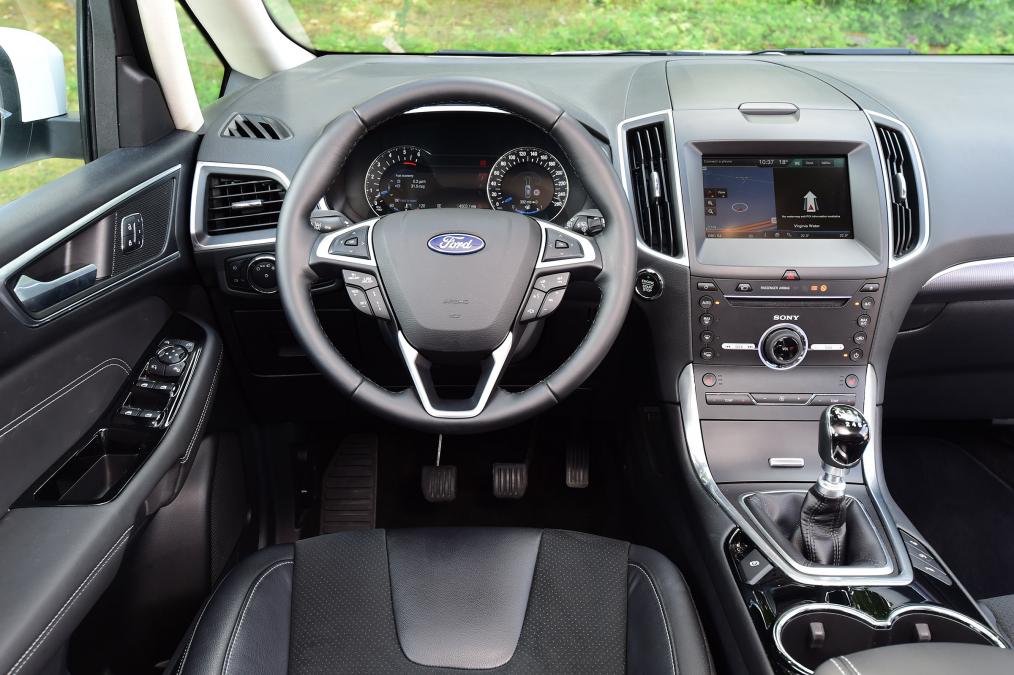
Adding all-wheel drive does little to dent the appeal of Ford’s excellent S-MAX. It’s still good to drive, practical and stylish, and the adaptive AWD system will be useful in the typically adverse British winter. In everyday driving, however, most owners won’t notice the difference between this and the standard car – and with a £1,500 price premium, higher running costs and extra weight to lug around, we would opt for the standard car.

With the British winter already making its presence known, many car buyers will be contemplating investing in something with four-wheel drive. Something like this new Ford S-MAX AWD.

Around 12 per cent of cars sold in the UK have four-wheel drive, and Ford wants to cash in on that by offering family models like the Mondeo, Galaxy and S-MAX with its intelligent all-wheel-drive system.


On the S-MAX, you can specify AWD on the 148bhp 2.0-litre diesel Titanium paired with a six-speed manual gearbox, or the more powerful and pricier 178bhp six-speed automatic Titanium Sport.

The 4x4 version weighs around 60kg more than the standard S-MAX, so our 148bhp version is a bit slower – getting from 0-62mph in 12.1 seconds compared to the front-wheel-drive car’s 10.8 seconds. The engine feels torquey, though, and in-gear response is strong enough that you don’t find yourself changing gear too often.

That means the S-MAX AWD is just as good as a motorway cruiser, with only a bit of road and wind noise at speed. It’s still comfortable to drive on more rutted roads, too, with well judged suspension that has a good balance between comfort and handling. Being a tall MPV, there is some body roll, but it doesn’t feel unstable through faster corners.


Ford’s all-wheel-drive system is adaptive – meaning it sends more power to the front or rear wheels, depending on which requires more traction. It makes the car feel sure-footed, even on the slippery cobblestone section of Ford’s test track – and in the UK, while having the AWD system is not a necessity, it certainly gives you that extra reassurance when dealing with our famously unpredictable weather.

The main trade-off is when you look at the costs, however. The four-wheel drive adds £1,500, and the cheapest S-MAX AWD you can get your hands on is our £29,195 Titanium-spec test car.

Fuel economy takes a slight hit, too, with the AWD model claiming 52.3mpg – that’s 4.2mpg down on the standard model’s 56.5mpg. CO2 emissions also jump from 129 to 139g/km, so you’ll pay an extra £20 per year in road tax.


Nevertheless, opting for an AWD model over the standard front-wheel-drive S-MAX doesn’t change anything inside. You still get the upmarket interior and mid-spec Titanium models come with sat-nav, Bluetooth, cruise control, DAB radio and automatic lights and wipers as standard.

Like the rest of the S-MAX range, the AWD model has plenty of space inside. There’s loads of head and legroom and a decent 285-litre boot with all seven seats in place. Fold the third row of seats and you free up 965 litres; drop the middle row, too, and there’s up to 2,020 litres. That’s a bit bigger than the Citroen Grand C4 Picasso – and you can’t get that with all-wheel drive.

Key specs

  • Model: Ford S-MAX Titanium 2.0 TDCi Intelligent AWD
  • Price: £29,195
  • Engine: 2.0-litre 4cyl diesel
  • Power: 148bhp
  • Transmission: Six-speed manual, four-wheel drive
  • 0-62mph: 12.1 seconds
  • Top speed: 122mph
  • Economy/CO2: 46.3mpg/139g/km

Senin, 15 Februari 2016

Posted by Unknown | File under :

Every new car DS introduces comes one step closer to helping the brand craft its own identity. The DS 4 Crossback is the best model yet, but it shows there's still a long way to go. Rivals from Volvo and Mercedes really show how a premium hatchback crossover should be done, with issues of refinement and ride still clouding the DS 4 Crossback. The compromises are clear to see.

With DS now split from Citroen, the unloved DS 4 has been refreshed, and a new, more rugged Crossback model added to the range. We’ve now driven this more lifestyle-oriented version in the UK for the first time.

The unusual blend of hatchback, coupe and SUV styling cues sets it apart from the regular DS 4. The ride height is raised by 30mm, while roof rails have been added and the front and rear bumpers tweaked. It’s smarter than the awkward-looking original, but it carries a £1,000 premium over the standard hatchback. DS reckons it’s on to something, though, with nearly 30 per cent of premium compact hatchback sales being crossovers. It predicts one in every four DS 4 sales will be the Crossback.


As you’d expect given its new focus, it’s been given a faux-SUV makeover and is now kitted out with darkened front and rear bumpers, wheelarch mouldings and a roof-mounted spoiler. Despite the looks you’ll fare no better at getting up a snowy side street, as the alterations are purely cosmetic – there’s no extra ability to go with the image. The rugged styling puts it in line with rivals like the Volvo V40 Cross Country, Mercedes GLA, and upcoming Infiniti QX30.

Inside, there are no real changes from the regular model, but it only comes in flagship Prestige spec, so the brand’s desire to create a premium product is emphasised by the raft of kit on offer. This includes the typical Citroen extending windscreen, sat-nav, leather and climate control. It’s just a pity there’s no real step up in material quality from the cheaper Peugeot 308, as some of the finish doesn’t come close to anything from BMW, Mercedes or Audi.

What's more frustrating is an awkward driving position for taller drivers, as despite adjustment options all-round the wheel doesn't come far enough towards you and the pedals are oddly high.  Those in the front will be happy with the space on offer, but a bigger issue is the limited access through the narrow rear doors. There’s a feeling of claustrophobia back there due to a lack of headroom, and there’s still no way of opening the rear windows.


Engine options are more limited than on its regular sibling. Where the DS 4 is offered with three petrol engines and three diesels, the Crossback only comes with one 1.2-litre petrol and two diesels, 1.6-litre and 2.0-litre. Our car was powered by the entry-level 118bhp 1.6-litre BlueHDi diesel, which is likely to be the biggest seller. Fuel economy is impressive at a claimed 72.4mpg and the car emits 103g/km of CO2, yet it’s not exactly quick. There’s adequate mid-range power, but rev it out and it becomes a bit noisy and unrefined.

On the road, the combination of the elevated stance and panoramic windscreen gives you the impression of driving something far larger than you actually are. It doesn’t do quite such a convincing impression at a cruise however, thanks to a quite a bit of wind noise.

You’d expect the ride to be the biggest difference between the Crossback and the regular hatch, and it definitely is a touch softer, but not as supple as it should be given the added suspension travel. It still thumps and crashes into potholes at low speeds, and remains unsettled on anything other than smooth motorways. It certainly lacks the cosseting nature of the Mercedes GLA. Combine that with the vague steering that’s heavy at low speeds, and the slack gearshift,  and it’s not a car you’ll really relish driving.


Key specs
  • Model: DS 4 Crossback BlueHDi 120
  • Price: £26,495
  • Engine: 1.6-litre 4cyl turbodiesel
  • Power: 118bhp
  • Transmission: Six-speed manual, front-wheel drive
  • 0-62mph: 12.0 seconds
  • Top speed: 118mph
  • Economy: 72.4mpg
  • CO2: 103g/km