Tampilkan postingan dengan label Mercedes. Tampilkan semua postingan

Jumat, 04 Maret 2016

Posted by Unknown | File under :

The Mercedes S-Class is the ultimate luxury limo and a fantastic showcase for cutting-edge technology. There are fewer relaxing experiences than driving an S-Class - the only thing that can top it is if you're in the back seat, being chauffeured. Vibrations through the pedals and steering wheel are non-existent, and even at motorway speeds you won’t hear any wind or tyre roar.

All the engines are fantastic, but it’s amazing that Mercedes can offer a diesel-electric hybrid offering more than 60mpg, and even the standard V6 diesel returns 50mpg. For the ultimate in speed there are high-performance S63 V8 or S65 V12 AMG versions, or if you want an S-Class that emits less CO2 than a Toyota Prius there’s the S500 Plug-in Hybrid.

In short, the Mercedes S-Class has set the standard for luxury and cutting-edge technology for over 40 years - and the latest sixth-generation car is the best yet.

Our Choice: 
Mercedes S350d L AMG Line.
Until the mid-1990s it was famously the case that money was no object when Mercedes engineers developed successive generations of its flagship S-Class saloon.

Even after Daimler and Chrysler amalgamated in the late-1990s and the bean-counters reigned in their ‘over-spending’ engineers, the flagship Mercedes S-Class has remained at the pinnacle of automotive engineering technology. Each new model has introduced ground-breaking systems that have cascaded down into lesser models as they become more affordable.

The tech highlights of this latest model include Magic Body Control that uses cameras to scan the road ahead for undulations and potholes, then adjusts the suspension to suit. There’s also a new high-definition TFT display as part of the instrument cluster, and a highly advanced Driving Assistance package that keeps the car in its lane and in train with the vehicle ahead when in cruise control mode.

While the latest S-Class continues to showcase the brand’s hi-tech developments, sleek new looks means the Mercedes S-Class is more desirable than ever, plus it has benefitted from a completely overhauled cabin design.

With a range of powertrains, options and finishes, it’s a package that competes with cars such as the Audi A8 and BMW 7 Series at one end of the scale, and the Rolls-Royce Ghost at the other.
Under the bonnet, the S-Class is available with 3-litre V6 diesel power in the S350, or a 5.0-litre V8 petrol engine in the S500.

There's also a trio of greener options, namely the S300 which is a 2.2-litre 4-cylinder diesel hybrid with a small electric motor, the S400 h which is the 3.5-litre petrol-powered hybrid equivalent, and the S500 e which is a 3.0 V6 petrol-powered ‘plug-in’ hybrid.


The 6.0-litre V12 of the S 600 is also available if you’re feeling particularly plutocratic, while the Mercedes-AMG S63 and S65 models are monstrously powerful 5.5-litre V8 and 6.0-litre V12 machines honed by Merc’s motorsports division.

Trim levels are relatively straightforward, including an SE ‘standard’ spec and a more dynamic-looking AMG Line. There’s an Executive spec package bringing more luxury features for rear passengers, along with a host of additional upgrades and bespoke trim options as befits a flagship Mercedes model.

Even ‘standard’ SE models are pretty lavishly equipped though, with LED headlights, air suspension, sat-nav and full leather upholstery all included. AMG Line cars get more aggressive body kits and larger 19-inch alloy wheels outside, and alloy pedals and AMG logos among the highlights inside.

Despite its focus on luxury and refinement, the S-Class is still one of the most engaging executive limousines on the market. Standard air suspension gives a wonderfully cushioned ride, while buyers wanting even sharper driving dynamics can opt for the £4,340 Magic Body Control system, which reads the road ahead and adjusts the car's set-up accordingly.

There’s barely any wind or road noise, while the standard air-suspension effortlessly smooths out bumps – although the 19-inch wheels can crash into potholes.

Yet this comfort doesn’t come at the expense of agility. The steering is quick and well weighted, plus there’s lots of grip. Selecting Sport mode stiffens the standard adaptive dampers to reduce body roll.
On the road, the new S-Class doesn’t feel as urgent as the Audi A8, but it still packs plenty of overtaking punch across the spectrum of powertrains. The brakes are strong, too, with a positive and progressive pedal feel.

Charge it up for two hours through a household socket, and driving the S500 Plug-in on electric power is one of the quietest and most refined experiences anywhere. But flex your right foot and the V6 engine wakes up to deliver effortless overtaking power when you need it.

The high-power AMG models give this limo supercar-rivalling performance. They come in long-wheelbase form only, and while they're not the last word in sharp handling, you'll be surprised by how well they corner considering the car's sheer size.

The S350 diesel will make up the majority of S-Class sales, and it's our pick of the range, thanks to its super smooth and quiet engine combined with seriously quick in-gear acceleration that proves refinement doesn’t come at the expense of performance.

Despite a hefty 1,975kg weight and the seamless seven-speed automatic box’s lengthy gears, 0-60mph takes just 6.8 seconds for the S350 but it genuinely feels much faster than that.

The other diesel option is the S300 BlueTEC hybrid, which combines a frugal four-cylinder diesel and electric motor to blend the effortless performance limousine buyers expect with supermini running costs.


The S300 hybrid nudges just over 2,000kg due to the added weight of the battery but performance is still brisk, hitting 0-62mph in 7.6 seconds. While its real-world performance is impressively punchy, the S300’s hybrid system can’t run in electric-only mode for long, and even a small squeeze on the throttle pedal will cause the diesel engine to rumble into life.

If you can stretch to it, the S500 Plug-in is a remarkable machine, letting you travel up to 20 miles on electric power alone before the 3.0-litre twin-turbo V6 cuts in. With both power sources working together, performance is almost on a par with the V8-powered S500. The hybrid does 0-62mph in 5.2 seconds, while the V8 powered car knocks it off in 4.8.

If you want a limousine with real supercar credentials, the AMG S63 has a twin-turbo V8 and can manage 0-62mph in 4.4 seconds, while the V12 twin-turbo S65 is a tenth of a second faster.

With prices starting in excess of £65,000, the S-Class isn’t exactly cheap to buy and if you get a bit friendly with the options list, the price can rise to well over £100,000. However, despite the price tag the S-Class won’t cost you the earth to run.

The S300 BlueTEC Hybrid boasts fuel economy of 61.4mpg and CO2 emissions of 120g/km. However, the frugal diesel hybrid plays second-fiddle to the S500 Plug-in Hybrid, which returns 100.9mpg and 65g/km under the official testing regime.

Depending on how you use it, of course, those figures could be much higher – or indeed lower. For example if your commute is less than 20 miles and you’ve somewhere to charge the car at either end, you can get to work and back without needing a drop of fuel. Use it for longer journeys though and the economy will plummet, especially if you delve into the available performance.

Offering the best blend of economy, performance and price is the S350 BlueTEC, which feels seriously quick while still emitting just 146g/km. The new S63 AMG is more efficient than ever, but still only manages a meagre 27mpg combined as a consequence of its enormous power and two-tonne bulk, even though it does have a carbonfibre boot liner as a nod to weight-saving.

Externally, the S-Class benefits from imposing styling with neat design details. Yet despite its vast external dimensions, the Mercedes disguises its bulk well thanks to its sweeping roofline and carefully sculpted lines cut into the flanks.

A bold grille, topped by the brand’s trademark three-pointed star, swept-back all-LED headlamps and tastefully applied chrome trim add a dash of glamour, while AMG Line trim brings racy looking 19-inch alloy wheels and a subtle bodykit.

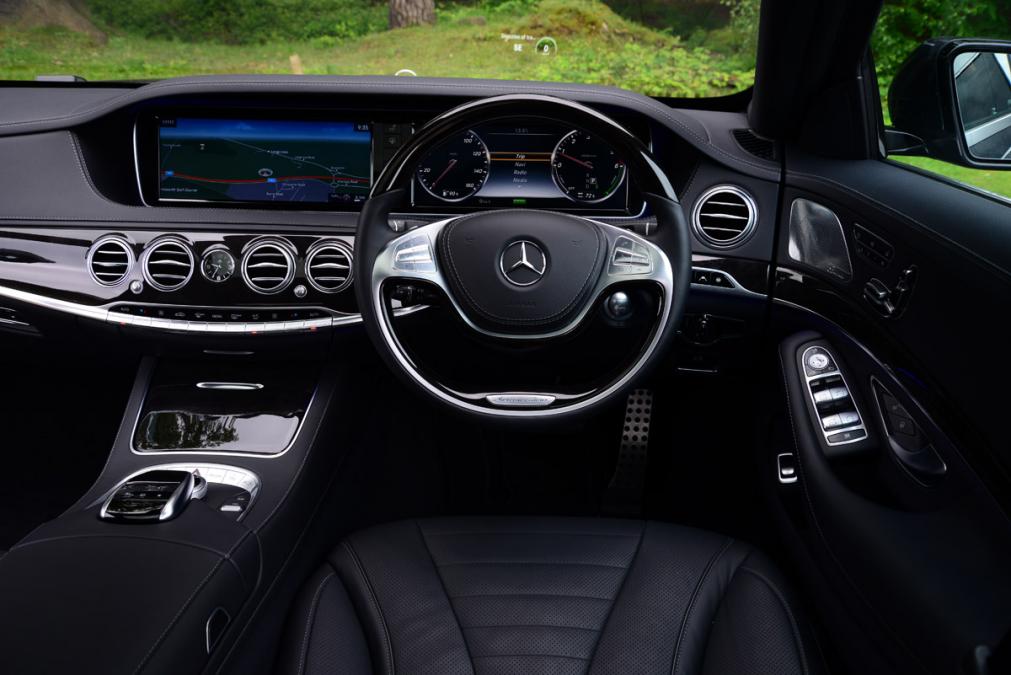
The Mercedes’ interior is even more impressive as it’s beautifully built, supremely comfortable and plushly appointed. The wide dashboard features a pair of 12.3-inch TFT screens – one for the sat-nav, infotainment and energy use, the other for the speedo, rev counter, trip computer and optional night vision display.

Other highlights include the metal-finish eyeball vents for the air-conditioning, the precise action of the switchgear and the intuitive COMAND rotary controller.

As you’d expect, the fit and finish is flawless, while the materials are all top-notch. Lustrous Black Poplar wood trim covers the dashboard, centre console, door trims and steering wheel, plus there's a £1,740 soft Nappa leather trim option for lower spec cars.

As you’d expect, quality is the watchword for the S-Class infotainment systems.

All models come with the 12.3-inch high definition screen, sat-nav, digital radio and single CD/DVD drive as part of the COMAND Online system.

You also get Bluetooth and a WLAN hotspot facility, but if you want to use Facebook and various on-board apps via the Connect Me package you’ll need to tick an option box. Other options include a rear seat entertainment system with a pair of 10-inch screens, and of course a TV tuner.

If you really want to push the boat out on the audio front, try the Burmester high-end 3D Surround Sound System which has 24 speakers, a 24 channel amplifier and a total output of 1,540 watts.

It’s hard to imagine a car that’s actually more comfortable than a Mercedes S-Class, although more rarefied brands like Rolls-Royce and Bentley can provide a more genuinely bespoke luxury feel.

But for comfort the big Merc is near peerless, with superlative on-road refinement, a silken ride quality, a living-room-sized cabin with superlative seats that will even massage you if required, plus fabulous entertainment systems and internet connectivity so driver and passengers want for nothing.

If you have to drive it yourself, then an array of sensors and cameras take care of close quarter manoeuvres in town, while out on the road you can let the clever cruise control and other aids share the load.

The S-Class in standard length is 5,116mm long, but there’s a long-wheelbase version with a 13cms extension in the rear passenger compartment. That said, unless you’re after the best-selling S350d you can’t pick and choose, so which body you get depends on the model. Apart from the S350d, only the AMG S63 and S65 come with the shorter body, so all the other versions come in the L guise.

In case you are compelled to have the biggest car in the car park, it’s worth noting that the S-Class in standard length is 15cms shorter than an Audi A8, and 28cms shorter than a Rolls-Royce Ghost. It beats the BMW 7-Series by 4cms though.

Given the S-Class’s luxury car status, it’s no surprise to find most of the space in the cabin is reserved for rear seat passengers. There’s a trio of three-point belts for the rear bench, but most buyers will treat this car as a four-seater, and Mercedes offers an optional two-seater rear seating set-up for even more luxury.

Rear head and legroom is generous, while the £4,335 Executive Rear Package adds a reclining function, powered blinds for the side and rear windows and ventilation for the seats. There’s also plenty of storage space, including the fold-down rear armrest that includes a pair of cup-holders and neat lidded cubby, while fold-out tables make the car the perfect office space.

The Mercedes features a useful 510-litre boot – although the optional £1,130 fridge compartment reduces capacity by 40 litres. Without it, the Merc’s luggage space is a little bigger than the Rolls’ and BMW’s, and matches the Audi’s exactly.


Mercedes has forged a strong reputation for building durable cars, and this is backed by an impressive 11th place in our Driver Power 2015 satisfaction survey, although the brand has dropped a place since 2014.

More worryingly perhaps, at least as part of a bigger picture, is the manufacturer’s score for reliability alone, which is rumbling along at 26th out of 30-odd contenders.

For build quality, the Mercedes brand is rated 10th. Not bad, but worth noting Lexus, Jaguar, Porsche, Audi, BMW and Volvo are all luxury or premium brands that do better. Skoda, Honda and Subaru are not luxury brands, and they score better too.

It’s the lesser Mercs that seem to be letting the side down though, so we’d be amazed to hear of anyone picking fault with the build quality of an S-Class.

The latest S-Class hasn’t been tested by EuroNCAP, but the last one scored a maximum five stars and we’d be amazed if Merc’s technology flagship failed to do the business this time around.

As you’d expect, there's plenty of standard safety kit, including eight airbags, a traffic sign recognition camera, a driver drowsiness monitor and a stability control system which incorporates Curve Dynamic Assist and Crosswind Assist.

The S-Class can also be fitted with the £2,300 Driving Assistance Package, which adds blind spot monitoring, lane keep assist and adaptive cruise control, plus a £2,250 night-vision camera and novel £1,230 rear seatbelts that feature integrated airbags. If you want unbeatable safety – and can afford to pick up the bill – then the big Merc has it covered.

The standard Mercedes warranty applies to the S-Class, which means three years cover and no mileage cap.

Mercedes’ Service Care pack guarantees the cost of routine maintenance for up to four services. The plan is flexible depending on mileage, but if you drive between 15,000 and 30,000 miles a year Mercedes will cover you for £55 a month – including 4 services over three years.

If you simply want an annual service once a year for two, three or four years, there’s another monthly plan that costs £41. Either way, it’s not a bad deal considering the price of the car, especially when you consider a three-year deal for the smallest Mercedes A-Class is £32 per month.

Kamis, 18 Februari 2016

Posted by Unknown | File under :

There’s no denying the revised AMG A 45 is more usable than its predecessor, but it still isn’t quite the driver’s car Mercedes claims it to be. The adaptive dampers make it easier to live with, while the headline figures still ensure this is officially the fastest hot hatchback on sale today. However, despite its all-weather grip and lightning fast responses, front-driven rivals are more fun, more of the time.

We’ve already driven high-power petrol and volume-selling diesel versions of the latest A-Class in the UK, but how does the flagship Mercedes-AMG A45 fare?

This super hatch has been considered fast but a little underwhelming up to now. While the four-wheel-drive system provided plenty of grip, some cheaper, slower, front-driven rivals, such as the SEAT Leon Cupra, offered more smiles per mile.


Clearly perturbed by the introduction of the new 362bhp Audi RS3, Mercedes’ engineers have tweaked the 2.0-litre turbo, which now gives an impressive 376bhp (up from 355bhp). This confirms the new A45’s place at the top of the performance tables and makes it the fastest accelerating hot hatch you can currently buy.

But there’s more to a car than headline-grabbing stats, and while the AMG boasts the most powerful production four-cylinder on sale, it also gets revised gear ratios, adaptive damping and aerodynamic tweaks.

The power boost has shaved 0.4 seconds off the car’s 0-62mph time, slashing it to just 4.2 seconds. Top speed is still pegged at 155mph, but if you regularly commute via the German Autobahn, you can remove the limiter, allowing the A45 to continue to accelerate all the way to 169mph.


To us, the biggest revelation is in the suspension and handling. While the old model was quite insufferable around town, the new £595 optional AMG Ride Control adaptive dampers transform the way the car drives. It allows owners to switch between Comfort and Sport modes, and while you can still feel every contour in the road in the softer setting, it’s more cushioned than before. Even Sport mode isn’t unbearable.

You can choose from a variety of drive set-ups as well, including Race, which gives a sportier setting to the traction control.


Elsewhere, the seven-speed DCT gearbox is as impressive as ever. While it’s smooth when doing day-to-day journeys, the more aggressive driving settings sharpen up changes and help the AMG fire away from junctions. Full throttle upshifts are also accompanied by a pleasing exhaust flutter.

Equipment is generous: all A45s come with LED headlamps, a reversing camera, eight-inch touchscreen sat-nav and AMG wheels as standard. But there’s no getting away from the near-£40,000 price tag.


Key specs

  • Price: From £39,995
  • Engine: 2.0-litre 4cyl turbo petrol
  • Power/torque: 376bhp/475Nm
  • Transmission: Seven-speed dual-clutch auto, four-wheel drive
  • 0-62mph: 4.2 secs
  • Top speed: 155mph
  • Economy/CO2: 40.9mpg/162g/km

Jumat, 12 Februari 2016

Posted by Unknown | File under :

The Mercedes GLS may be one of the largest and most practical SUVs on the market, but you need to have more than just sheer size on your side to be competitive in this sector.

As relaxing and comfortable transport for seven people the GLS matches its closest rivals from Audi and Volvo. The 3.0-litre V6 diesel engine is smooth and powerful, while air suspension gives a pillowy ride quality.

Unfortunately, up against the Q7 and XC90 the Mercedes’ flaws are highlighted. A dated looking cabin and inflated price tag count against it. Both the Audi and Volvo can seat seven people too, and at fraction of the cost.

The new Mercedes GLS – previously called the GL-Class – is the German brand’s flagship SUV and a rival for the likes of the Audi Q7, Volvo XC90 and Range Rover.

Mercedes is so confident in its abilities it calls the GLS ‘the S-Class of SUVs’ – something that is now reflected in its new name. It’s hugely spacious, comes as standard with seven seats and has an upmarket cabin but there’s a high price-tag to match. This new facelifted model gets some reshaped front and rear bumpers, more efficient engines and a new nine-speed gearbox.

However, the minimal changes reflect the fact that this car meets the needs of its customers – who are usually based in the US or Middle East - extremely well. Like its predecessor, it's built in America where it’s been the most popular seven-seat SUV for many years.

The GLS remains extremely comfortable, thanks to its air suspension and incredible refinement. The diesel entry-level 255bhp 350d CDI is smooth and powerful enough, while the high-performance 580bhp GL63 AMG model boasts performance that no car this big should be capable of.

Prices start under £70,000 and rise to over £100,000, making the GLS considerably more costly than any of its closets rivals – all of which also offer seven seats. 


Mercedes offers the GLS with a choice of two engines – a 3.0-litre V6 diesel in the GL350 and a twin-turbo 5.5-litre V8 petrol in the Mercedes-AMG GLS63. The latter boasts incredible performance for such a large car, despite the fact that it weighs a formidable 2,580kg. The GL350 CDI is the sensible choice for its 37.2mpg fuel economy, yet it's still a refined and strong performer with a claimed 0-62mph time of 7.8 seconds.

Fitted with Mercedes' excellent Airmatic suspension as standard, the GLS is not only refined, but has a very relaxing ride. Even more impressive for a vehicle that weighs nearly two-and-a-half-tonnes is the body control. It feels solid and stable, and the air suspension maintains great composure in corners.

The steering is smooth and progressive but not exactly geared towards sports car handling, even on the AMG model. However, given its vast dimensions, the GLS boasts remarkably neat and tidy handling.

The new nine-speed gearbox is also very impressive and a perfect match for the 3.0-litre V6 diesel. Changes are super smooth and well-timed, making it a very relaxing car to drive. You’ll also never have any worries off-road, with four-wheel drive as standard and two optional off-road driving modes.

Only two engines are on offer in the GLS. The entry 350d is powered by a 255bhp 3.0-litre V6 diesel, while the range topping GLS63 AMG uses a 580bhp 5.5-litre twin-turbo V8. Mercedes predicts of the 1,000 models to be sold in the UK each year, around 90 per cent of buyers will opt for the sensible diesel model.

The diesel 350 CDI is definitely the one to go for if you're keeping an eye on running costs. But that's a relative statement, as the GLS isn't going to be a cheap car to run. Even the diesel will result in you digging deep in your pockets, as claimed returns are 37.2mpg and it emits 199g/km of CO2.

For the petrol-powered GLS63 fuel economy worsens to 23mpg and CO2 emissions are 288g/km. And with a 100-litre fuel tank, fill-ups will always be a very expensive affair.


The rather brash, blocky design of the GLS is more in keeping with North American and Middle Eastern tastes, but it still looks quite classy. AMG Line trim for the 350d adds beefier bumpers and larger alloy wheels, while a new Designo trim adds a more luxurious feel inside with plusher leather seats but costs a further £9,000.

The high performance GLS63 AMG is identified by its sports exhaust, upgraded brakes and discreet 'V8 BITURBO' badges on the front wings. The cabin design feels upmarket but it can feel a little dated compared to the new slick Audi Q7 and Volvo XC90 which set the standard in the luxury SUV class. As you'd expect from Mercedes, build quality is excellent and top-notch materials are used throughout.

The GLS features Mercedes’ latest-generation COMMAND infotainment system which is operated through an eight-inch colour display and touchpad controller. It’s a very intuitive system and easy to operate, with clear graphics and simple navigation menus.

The Mercedes GL is such a huge car – 110mm longer than a Range Rover – that it boasts a really spacious cabin. It's a seven-seater as standard, but even with all those seats in place there's still a usable 295-litre boot.

Both of the rearmost seats fold flat electrically, making the process of increasing the load area a breeze. If you fold down the second row of seats there's a van-like 2,300-litre boot. The problem with having such a large car is that it is difficult to negotiate tight city streets, and there are very few UK parking spaces that are both long enough and wide enough to fit into. At least all versions of the GLS come with parking sensors as standard, which help take the strain out of slotting the big Mercedes into tight spaces.


There's no escaping the sheer size of the GLS. The 350 CDI measures 5,141mm long, 1,982mm wide and 1,850mm high - making it bigger than both the Range Rover and Audi Q7.

There’s certainly no shortage of space inside the GLS, with even 6ft adults able to sit in the third row of seating. There aren’t many vehicles that can seat seven adults in comfort but this is certainly one of them.

With all seven-seats in place the GLS still has a 295-litre boot, which increases to 680 litres with the third row folded. In van mode there’s an enormous 2,300 litres of boot space.

Euro NCAP hasn't tested the GLS yet but the Mercedes SUV comes with a whole host of safety systems and airbags that would most likely lead to it receiving a five-star rating. What's more, the GLS is so big, it's likely to intimidate most other road users out of the way.

Pre-Safe, ABS and ESP will all help keep you out of trouble while driver, passenger and side airbags will all minimise injuries in an accident. Reliability has been pretty solid since the old GL was introduced in 2006 so buyers should have a pretty hassle-free ownership experience. Better still, Mercedes dealers finished a respectable 11th out of 32 in our 2015 Driver Power satisfaction survey.


Every new Mercedes comes with a three-year/unlimited mileage warranty. Three years is fairly standard across the industry but the unlimited mileage is a little better than we might expect.

Mercedes GLS buyers can make a one-off payment to cover a list of service items. Service plans are available from 12 months right up to 48 months.

Selasa, 09 Februari 2016

Posted by Unknown | File under :

Mercedes’ new C-Class Coupé has already impressed us with its sleek styling and quality interior, but we were expecting this mid-range petrol car to be a bit more refined than it is. It’s powerful enough, yet could be quieter and smoother. We’d go for the diesel or wait for the V6-powered C 450 AMG coming later. The overall package is still super desirable, though.

We’ve already driven the diesel-powered C-Class Coupe and bonkers Mercedes-AMG C 63 S version, but what if you haven’t got £66,910 to spend on an AMG and still want petrol power?


Further down the C-Class Coupe range you’ll find the C 200 and C 300. Both are powered by a 2.0-litre turbocharged four-cylinder petrol with the C 200 pushing out 181bhp and the C 300 offering a sizeable 242bhp. We drove the latter here, with the 7G-Tronic seven-speed auto gearbox.

On paper, it all looks good. Enthusiasts will lust after six-cylinder rivals, but the four-cylinder C 300 does 0-62mph in a very respectable six seconds, with top speed limited to 155mph. Fuel economy is quoted at 44.8mpg, while CO2 emissions of 154g/km mean VED isn’t too bad, either.


In reality, it’s not quite as satisfying as the figures suggest. The 2.0-litre engine doesn’t make a particularly pleasant noise, favouring a drone rather than a sporty sound. Press the throttle to overtake slower traffic and the noise turns harsh – made all the worse by sports exhaust. Progress is not as smooth as you’d expect, either, with power delivery suffering from a little turbo lag at lower revs.

Unusually, we’d opt for the gruffer diesel or even wait for the V6-powered C 450 AMG Sport, coming a little later next year. But while the engine falls a bit short, it’s more than made up for by the rest of the package. It’s arguably the most stylish four-seater coupé in its class, thanks to the fact it shares several distinct cues with the larger, super-exclusive S-Class Coupé.

Inside, the quality and ambience are first rate. The cabin is lifted straight out of the C-Class saloon and Estate, so it’s nicely styled and beautifully made. Two passengers can squeeze into the rear and have a clear view thanks to inboard-mounted seats. The boot is slightly smaller than a BMW 4 Series’ but is well shaped.

Standard kit on this entry-level version includes sports seats, LED headlights and a parking camera. For an extra £1,495, the AMG Line model provides bodykit, 18-inch wheels and 15mm-lower suspension.

Key specs

  • Model: Mercedes C 300 
Coupé Sport
  • Price: £36,990
  • Engine: 2.0-litre 4cyl petrol
  • Power/torque: 242bhp/370Nm
  • Transmission: Seven-speed auto, rear-wheel drive
  • 0-62mph: 6.0 seconds
  • Top speed: 155mph
  • Economy/CO2: 34.5mpg/154g/km
Posted by Unknown | File under :

For some buyers, the mere fact that the A-Class has a Mercedes badge on the nose will be enough to seal the deal. But, while this car is a great-looking premium hatch, it comes up short in many areas. This A 200d Sport isn’t as much fun to drive as some rivals, while the gruff diesel engine and sluggish automatic gearbox aren’t an inspiring combination. At least you get some luxury touches for your money, yet this still isn’t enough for it to earn more stars.

When it was launched in 2012, the third-generation Mercedes A-Class marked a sea change for the German brand’s smallest model. Gone were the upright MPV lines of its predecessor, replaced by swoopy, low-slung bodywork designed to attract buyers away from rivals such as the Audi A3 and BMW 1 Series.

On the whole, the latest A-Class has proven a hit in showrooms, but as Mercedes is updating and revising its entire range with a new naming policy, the car has been given a bit of an update to keep it competitive. We’ve already tried the A 250 AMG, and now we’ve got our hands on the A 200d Sport. Under Mercedes’ new naming structure, the A 200d is a diesel-powered car featuring a 2.1-litre four-cylinder engine under the bonnet. It delivers 134bhp, and when paired with a seven-speed automatic gearbox, can sprint from 0-62mph in 8.8 seconds. It’s also pretty efficient, with CO2 emissions of 108g/km making company car costs reasonable.


Unfortunately, the diesel unit is noisy, and while there’s plenty of sound insulation to keep the cabin relatively quiet, the engine’s metallic noise isn’t particularly pleasant. In most situations, the seven-speed auto shifts smoothly, with no jerkiness when kicking down. But the gearbox can get flustered if you suddenly press the throttle – when pulling on to a roundabout, for example. It causes some hesitation when accelerating, while the long throttle travel compounds the problem.

Mercedes’ Dynamic Select driving mode system is standard, with Eco, Comfort, Sport or Individual modes for the throttle and steering to choose from – the car only really comes alive in Sport mode, though. Only then does it feel responsive, but whichever driving mode you choose, you’re stuck with the same fidgety ride from the suspension.


This Sport model is sporty in name alone, because, while the suspension is on the firm side, it doesn’t make for sharp handling. The car feels heavy and slow to respond in corners, tending to understeer when you push on. The gearbox exacerbates things, as it kicks down all too readily, and while there are paddles for you to take manual control, the car’s electronics will override if it thinks you’ve stopped concentrating.

At least you’re afforded plenty of luxuries on board, as you get artificial leather, climate control and a reversing camera as standard. Features such as the illuminated door sills and chequerboard dash trim add an upmarket touch, while the £1,695 Premium Package is worth the extra money. It brings sat-nav, heated front seats, LED headlamps, 12-colour ambient lighting and more to make the A-Class feel more classy. 


Key specs

  • Model: Mercedes A200d Sport
  • Price: £25,660
  • Engine: 2.1-litre 4cyl diesel
  • Power: 134bhp
  • Transmission: Seven-speed auto, front-wheel drive
  • 0-62mph/Top speed: 8.8s/130mph
  • Economy/CO2: 70.6mpg/108g/km

Minggu, 10 Januari 2016

Posted by Unknown | File under :

While the Estate is our favourite version of the C 63 family, the Mercedes-AMG C 63 Coupe is a fitting range topper. It’s more than just a two-door version of the saloon - it offers a more hardcore driving experience. A fabulous engine and chassis are neatly served up under a body that shouts brute force. A UK test against the BMW M4 is needed, but on this first taste we’d say it has the measure of the BMW.

We were blown away by the Mercedes-AMG C 63 saloon earlier this year, and the estate version tested soon after added a welcome dose of practicality into the mix. With such a good basis to begin with, surely the more desirable and svelte two-door C 63 Coupe cannot fail to impress?

Well let’s get to the answer straight away – it doesn’t. But there’s far more to it than that. While the C 63 Saloon and Estate impress with their impressive blend of stonking performance and space for five people, the Coupe has to offer a little more blood and guts; it has to give us something more raucous.

It’s for this very reason that Mercedes hasn’t just grafted on a pretty new face - the Coupe gets its own unique setup underneath. The track has been widened by 73mm at the front and 46mm at the rear, while there’s also tweaked dampers and an entirely new multi-link rear axle.


The body is suitably pumped up too, reflecting the Coupe’s position at the top of the C 63 family tree. The standard Mercedes C-Class Coupe only donates its doors, roof and boot lid – the rest of the AMG car is totally bespoke. So there’s an aerodynamic front bumper, bulging arches and aggressive back bumper with four squared-off exhausts.

The Coupe comes in two flavours: standard C 63 and a harder C 63 S. It’s the latter we got behind the wheel of, which sees power from the 4.0-litre twin-turbo V8 swell from 469bhp to 503bhp, while torque is increased to a thumping 700Nm. It’s not only more powerful than the 425bhp BMW M4 and the 470bhp Lexus RC F but more amazingly it trumps the Mercedes-AMG GT S for torque. The two-door supercar is a noticeable 50Nm down on the C 63 S.


This, naturally, translates to blistering performance. The twin-turbo V8 revs all the way to 7,000rpm and the power delivery is remarkably linear with barely any lag from low revs. From a standing start, 0-62mph is over in a scant 3.9 seconds and continues on to a limited 155mph. The V8 booms through the cabin and a sports exhaust comes as standard, which delivers delicious crackles and burbles from the exhaust as you come on and off the accelerator. The seven-speed gearbox fires up and down the ratios with ease, although turn the Dynamic Select knob on the centre consol to Sport+ or Race and the shifts become fierce.

The old C 63 Coupe’s fantastic naturally-aspirated 6.2-litre V8 may have gone, but the frenzied twin-turbo 4.0 V8 is a worthy replacement. What’s another welcome change is the way the new C 63 Coupe handles as it now feels like a more nimble and athletic sports car. While our rain-soaked test drive in southern Spain wasn’t the ideal conditions to put 503bhp onto the road, the Coupe did shine.


Corner hard and it feels fluid and balanced, but turn the Dynamic Select to Sport+ and the tail will squirm as you apply the power. Yet it’s easy to know what’s going on thanks to the electromagnetic steering: it's full of feel. Compared to the slightly snappy BMW M4, the C63 Coupe feels far easier to get along with, but still provides intoxicating performance.

Dial the car down to Comfort mode and it almost becomes relaxing. The seats are firm but comfortable and while there’s still a hard edge to the suspension and tyre roar is quite noticeable on the motorway, inside is surprisingly refined.

Acres of carbon-fibre trim, quality leathers and racy Alcantara only add an extra level of pleasure to the standard C-Class Coupe’s interior. Whether the blingy AMG’s cabin is a nicer place to sit than the M4’s more sober affair will come down to personal taste, but for the record, we prefer the Merc.


Key specs

  • Price: £68,070
  • Engine: 4.0-litre V8 twin-turbo
  • Power/torque: 503bhp/700Nm
  • Transmission: Seven-speed auto, rear-wheel drive
  • 0-62mph: 3.9 seconds
  • Top speed: 155mph (limited)
  • Economy/CO2: 38.2mpg/200g/km
  • On sale: Now

Kamis, 24 Desember 2015

Posted by Unknown | File under :


The Mercedes C-Class Estate is a practical and comfortable family car.


The Mercedes C-Class Estate feels like a luxurious and grown-up car – and it looks the part too, thanks to its glamorous S-Class inspired styling. While the AMG Line is popular for its sporty looks, this Merc wagon actually majors on comfort and cabin quality so the BMW 3 Series Touring remains our pick if you’re after the best handling experience.

In aiming for a more relaxed character than the sporting BMW though, Mercedes has come up with a very desirable and cosseting family mover, especially if you can run to one of the larger diesels. The hybrid models look pricey, but are great to drive and worth especially close inspection if you’re a company car driver.

The Mercedes C-Class Estate is the more practical alternative to the C-Class Saloon.

The estate derivative has been popular in the UK ever since it followed the four-door C-Class into showrooms in 1996, and has gone through three generations since.

The latest all-new model was introduced in the UK in the middle of 2014, boasting a stylish design, a range of clean engines, plenty of hi-tech gadgets and a luxurious interior. It goes head-to-head to with cars like the Audi A4 Avant and BMW 3 Series Touring, offering a boot with a maximum capacity of 1,510 litres.

In the UK, the biggest sellers in the C-Class Estate range are the C220 and C250 BlueTEC models but Mercedes also released a C300 BlueTEC HYBRID version in early 2015, which boasts CO2 emissions of 99g/km – that’s great for company car buyers.


There’s also a plug-in C350e model for drivers with a petrol-hybrid preference, and of course there’s the AMG performance division’s legendary take on the Mercedes-Benz ‘tourenwagen’. That one sports a stonking great V8 engine, and it prowls autobahns and motorways the world over badged as the AMG C63 Estate.

If you can’t justify the price or fuel bills of the real thing, you can at least have some of the AMG C63’s style on a regular C-Class wagon. That’s thanks to the desirable flagship AMG Line trim level, which is designed to take the fight to Audi’s A4 S Line and BMW’s 3 Series M Sport cars. On the C-Class, the AMG Line brings special 18ins alloy wheels, sports suspension, leather sports seats and steering wheel, plus a sporty exterior styling package with lowered front and rear aprons and side skirts.

The C-Class Estate range kicks off with SE models, and because it’s still a premium model they too feature alloy wheels, cruise control, dual-zone climate control, and touchpad media system with Bluetooth, DAB audio and a reversing camera as standard. The Sport model is the mid-ranger, bringing larger 17ins alloys, heated front seats and sat-nav.

In spite of its swoopy looks the C-Class Estate’s handling is OK but no match for the BMW 3 Series. Unfortunately, the steering is a let-down. The wheel feels extremely light, especially around the dead-ahead, while Merc’s Direct Steer system adjusts the power assistance according to speed and driving mode. Although the response is weightier in Sport modes, the variable-ratio rack is inconsistent and has hardly any feedback.

The optional air suspension for around £900, provides a marble smooth ride on rough motorways. Bumps are smoothed out to a gentle bounce at speed but we found the system gets caught out over sharp ridges and potholes when you’re driving around town. Occasionally you hear a loud thud and feel a jolt in the cabin.


With the air suspension set to comfort, the C-Class leans a bit too much in to bends, but switching to Sport to adjust the engine response and suspension stiffness does help things slightly.

If you can't stretch to the adaptive set-up, don't worry, as the standard dampers strike a good compromise between body roll and comfort, only jolting over the roughest of UK roads.

Overall, the C-Class Estate is just as accomplished as the saloon when it comes to refined cruising, but it can’t match the 3 Series Touring for driving enjoyment.

Both the C250d BlueTEC and C220d BlueTEC are powered by differently-tuned versions of the same 2.1-litre diesel engine, providing plenty of in-gear performance. The 201bhp C250d comes with a seven-speed automatic as standard, and, in typical Mercedes fashion, it smoothes out shifts for a really relaxing drive.

Officially, the C250d will go from 0-62mph in 6.9 seconds, while the 168bho C220d takes 7.6 seconds. At higher motorway speeds, the C220 struggles a little more, taking its time to execute overtakes.
Given the Estate model is likely to be used for carting around heavier loads, the more powerful C250 is a more satisfying all-rounder, and likely to only suffer marginally in fuel economy.

But, while we’ve got no qualms with the performance we’re not so sure about the refinement. Keep engine revs low and it’s OK but if you’re at full throttle or in Sport mode – where the gearbox holds on to the gears until the last minute – the 2.1-litre unit sounds seriously gruff and noisy.

The C300 BlueTEC HYBRID is a bit better; it has the same engine but it’s boosted by an electric motor so it never seems to be working quite so hard. Most manufacturers struggle to make four-cylinder diesels refined, but the C-Class is particularly disappointing given how relaxed the rest of its ambience is.


There’s a 1,598cc diesel-powered C200d entry model too, but it’s the least dynamic of the C-Class Estate family offering only 134bhp and 300Nm. That’s enough for 0-62mph in 10.1 seconds and 133mph flat-out.

If you insist on driving a petrol-powered C-Class Estate (AMG C63 excepted), you’ve two versions of a direct-injection 1,991cc in-line four-cylinder to choose from. First up is the C200 which comes with a standard six-speed manual. It makes a touch over 180bhp and delivers 0-62mph in 7.7 seconds and 146mph. Its 300Nm of torque matches the entry-level diesel.

The C350e Sport Plug-In Hybrid is more interesting, as it comes with a 208bhp version of the same petrol engine supplemented by an 81bhp electric motor. That combination – through 7-G Tronic automatic gears – delivers a 0-62mph time of 6.2 seconds and a potential 153mph maximum, as well as silent electric running mode in town. Both petrol and diesel hybrid models are pricey though.

The 1.6-litre C200 BlueTEC is the cheapest and least powerful diesel in the range but it’s not actually the most fuel-efficient. That title goes to the 2.1-litre C220 BlueTEC model, which boasts emissions of just 108g/km, with fuel economy of 65.7mpg. Not too far behind that is the more powerful C250 BlueTEC, which claims figures of 117g/km and 62.7mpg.

The C300 BlueTEC Hybrid model cuts emissions to 99g/km, making it the pick for company car buyers – its mpg figures are pretty impressive too, as Merc claims the model will return up to 74.3mpg on the combined cycle and as much as 70mpg around town thanks to the electric-only function.


The C350e plug-in petrol hybrid makes an interesting comparison, as it’s even faster than the diesel hybrid, and, if you take things easier, can be driven in a style that returns an incredible 134mpg out of town with C02 emissions that crack the sub-50 g/km mark.

While the frugality of both hybrid models is admirable, if you’re tempted to take one on as a company car driver you may be doing your bank balance a favour as well as the environment. Both the diesel hybrid and plug-in petrol version will cost you the thick end of £40k before you’ve added any optional goodies – the C200 and C220d models are both around £10k cheaper, but the plug-in hybrid is only £3.5k more expensive than the C250d.

In spite of the plug-in’s extreme official MPG figures, the C250d will likely be more economical if your real world motoring includes lots of high speed motorway thrashes, but the low emissions of the hybrid will save 40 per cent tax payers a packet if their Merc is a perk.

Looking at the petrol-powered C200 now, it manages 51.4mpg while emitting between 128 and 134 g/km of CO2 depending on tyre sizes. Either way, Mercedes doesn’t expect many UK buyers to go for it as the diesel models offer greater economy and cheaperMercedes has taken bold steps with the design of its most recent models, and the C-Class Estate certainly cuts a dash compared to its rivals. As you would expect, it mostly shares the saloon’s looks, so you get a large rounded grille with an oversized three-pointed star, while swooping headlights add yet more drama to the front end. Sport models and above get full LED headlamps with distinctive daytime running lights.
Further back, the sculpted wings and doors add drama to the look, while the extended roof line of the estate blends into a small bootlid spoiler and a rounded tailgate. The Estate also gets roof rails, which are finished in chrome on Sport models and higher, while the tail-lights wrap around the rear wings and bootlid. That tailgate is power-operated on all models and, while it’s a little slow to open, it does at least take the strain out of lifting it.
 

Climb inside and the C-Class Estate is identical to the saloon, so you get the same high-quality look and finish as you’ll find in the S-Class limousine. All models have a tablet-style colour centre console display, although it looks a bit like an aftermarket addition.

Automatic models, like the one in our test, feature a column-mounted shift, decluttering and freeing up space on the dash, while the mix of gloss black plastics and metal switches adds an air of solidity. All cars get artificial leather as standard, but you’d be hard pressed to tell it from the real thing, while the C-Class’s build quality can’t be faulted.

The C-Class Estate is designed to compete head-on with rivals from Audi and BMW, and at 4,702mm its 15mm shorter than the A4 Avant and 78mm longer than the 3 Series Touring. At 1,810mm the Merc is a single millimetre narrower than the BMW, and 16mm narrower than the Audi.

It’s a little taller than both rivals though at 1,457mm. The BMW stands 1,429mm high, and the Audi 1,415mm.

Compared with the old C-Class Estate, this model has an 80mm longer wheelbase, which has allowed Mercedes to stretch rear passenger legroom by 45mm.

There’s little to separate the C-Class and 3 Series for back seat space with the seats up, as both cars offer lots of head and legroom, but the Mercedes’ circular metal air vents add a classy touch for rear seat passengers. Passengers will enjoy the airy feeling of the panoramic roof that comes with the Premium Package, too. Isofix child seat mounting points are standard across the range.


The C-Class Estate’s boot can hold 490 litres of gear with the rear seats up – ever so slightly down on the 3 Series – and 1,510 litres with them folded down, which is slightly more than the BMW. But more important than the out-and-out spaciousness are the practical touches that go with it.

An electric tailgate is standard, for example, and the seats fold 40:20:40 at the touch of a button in the boot. If you pay a little extra you can get a hands-free boot, which allows you to kick your foot underneath the rear bumper to open it. That's a handy feature, but what isn't so clever is the fact that the rear seats don't fold totally flat, and there's a small lip on the wide loading sill, so sliding heavy items into the cargo area is more difficult than it could be. There's no pop-up rear window for quick loading of smaller items, either.

The diesel variants of the C-Class Estate make effective tow cars, with a towing limit of up to 1800kgs depending on model.


Mercedes’ reputation for manufacturing mechanically robust cars is still intact, but with the raft of electronics on its new models, glitches are likely to become more of a cause for concern. The latest C-Class is too new to have appeared in our Driver Power surveys, yet it’s already been recalled for a steering column issue as a precautionary measure.

It’s a little worrying too that the Mercedes-Benz brand hasn’t covered itself with glory elsewhere in the 2015 Driver Power Survey. Our respondents rated the manufacturer only 26th out of 32 when quizzed specifically about reliability, and 10th for build quality. With all factors considered, the brand’s overall rating came out at a reasonably positive 11th   place, although the results may not be quite in line with your expectations of the famous three-pointed star.

The safety picture is unarguably positive though. The C-Class Saloon was awarded a five-star rating from Euro NCAP for crash safety, and it’s safe to assume that the Estate will get top marks too.

As well as boasting a new and extremely rigid structural platform, the car comes with seven airbags as standard, and a full complement of safety features like drowsiness detection, tyre pressure monitoring and traction control. Also available on the options list are items like an autonomous braking system, lane-keep assist and – on internet connected cars – a piece of software that will call the emergency services to your location in the event of an accident.

Senin, 14 Desember 2015

Posted by Unknown | File under :


Edition 463 special edition of Merc's G63 SUV gets a power boost and visual tweaks.


Changes to the G63 do nothing to change its character– there is still nothing quite like it and it’s both awesome and flawed in equal measure. Our star rating reflects this by being the midpoint between the five stars it earns for style, performance and off-road ability and the half a star it earns for everything else.

Motoring icons are like listed buildings – major alterations are forbidden. That’s why changes to the latest Mercedes-AMG G63 have been kept to a minimum – with a mild power upgrade and light visual tweaks. 

The rest of the shape is pretty similar to the 1979 original, with that familiar boxy shape, slab-sided panels, exposed screw heads and old-fashioned round headlamps.

Most people struggle to comprehend why anyone would want a G-Class over one of Merc’s more modern SUVs – and they’d be aghast that the £138,000 AMG version is actually the best seller.


However, take a step back and you start to see the appeal. The AMG G63 is one of a handful of vehicles with undeniable charisma. First there’s the thumping V8 soundtrack from the ostentatious twin chrome exhaust pipes. Then there’s the juxtaposition of its utilitarian and AMG sporting frippery. And the contrast is even more extreme with our Edition 463 model.

That number relates to Merc’s codename for the current model iteration, which hasn’t benefitted from any major structural changes since its introduction in 1990.

This upgrade pack adds a stainless steel under body guard, 21-inch wheels and stripes.


Another thing that’s reminiscent of the nineties is the ‘clank’ the G’s door makes when you slam it. Yet inside this tractor throws another curveball by feeling no less modern than any other model in the range.

The Edition 463 includes a two-tone dash, carbon fibre trim and diamond pattern seat and door panels. After just a few miles though, you’re back in the 1990s as the central locking engages with the crack of a starting pistol.

At least the G63 AMG gets out of its blocks pretty sharpish. The 5.5-litre twin-turbo engine now has 563bhp – an increase of 27bhp – while there’s 760Nm of torque which, as we discovered, is enough to spin up all four wheels in damp conditions.


Which brings us on to another update – the improved stability control. It’s vital on a vehicle which accelerates like a rocket ship, yet turns like a cruise liner. It doesn’t help there’s loads of play in the steering.

Like a toddler, the wheel requires constant attention as it meanders off line without repeated corrections, while the bumpy ride will be a shock to anyone who is used to the air-sprung waftiness of the Mercedes GLE.

Once again though the G63’s charm makes you overlook it failings. Yes the ride is appalling but it provides strength to deal with extreme off-roading. The low ratio gearbox and three locking differentials add to the weight, but they will prevent you getting stuck in the mud.

It doesn’t matter that most people will never use these features because, as you manhandle the turbo-boosted, luxury-lined G63 through town, at least you know that like a listed building, the G-Class is still 100 per cent authentic.


Key specs

  • Price: £149,970
  • Engine: 5.5-litre V8 twin-turbo
  • Power/torque: 563bhp/760Nm
  • Transmission: Seven-speed auto, four-wheel drive
  • 0-62mph/top speed: 5.4 secs/130mph
  • Economy/CO2: 20.5mpg/322g/km

Minggu, 13 Desember 2015

Posted by Unknown | File under :


Luxury Mercedes V-Class MPV is classy inside, but van-like dynamics and high purchase price hold it back slightly.


Having replaced the old Viano MPV, the Mercedes-Benz V-Class is a vast people carrier that offers masses of space mixed with high-end saloon car luxury. Mercedes has spruced up its Vito van, adding up to eight seats depending on configuration, and a much more premium interior that borrows lots of tech and design elements from elsewhere in the range.

There are two different body styles: a long wheelbase and an extra-long wheelbase. The former is available with seven seats only, while the latter is upgradable to eight seats if you need even more room for passengers. On top of that there are two trim levels – SE and Sport – and two engines to choose from, including the 220 Bluetec and 250 Bluetec turbodiesels.

Mercedes has dropped the V6 diesel from the Viano for this model, but go for the V250 and it’s actually faster and more economical than its predecessor.

Plenty of equipment comes as standard even on the entry-level SE, including sat-nav, Bluetooth, parking sensors with a reversing camera to help manoeuvre the massive machine, heated seats and crosswind assist.

Prices are competitive given the luxury and comfort on offer, too, although if you maximise the configuration for passenger space, it will impact on luggage room. There are lots of safety and technology packages you can add on as well if you want to increase the specification of the V-Class.
You can even get close to the level of technology available in the flagship S-Class, but no matter what, even the base-spec car feels upmarket and a cut above regular MPVs.

As it’s a step above the usual crop of people carriers, the V-Class’s main rival is the Volkswagen Caravelle, which is available in Executive and Business trim levels to match the Mercedes. However, its 178bhp 2.0-litre turbodiesel engine is no match for the more powerful 2.1-litre Merc motor.


The 2.1-litre diesel engine in the V-Class produces 187bhp and it's just as fast as the old 3.0-litre unit in the Viano. That means economy is up without sacrificing performance. The V-Class is actually pretty good in this department thanks to a brisk 0-62mph sprint time of just 9.1 seconds and 480Nm of torque available for overtaking. Work the engine hard, however, and it feels quite gruff, while the 7G-tronic automatic gearbox is showing its age.

With the Agility Select system fitted there are a handful of driving modes to choose from: Eco, Manual, Comfort and Sport. These change the throttle response and steering to suit your preference, but most will simply leave the car in Comfort mode, which best matches the car's nature. The gearbox is a bit lethargic and hangs onto gears too long, with jerky upshifts on occasion. Drop the car into Eco mode and the throttle response is dulled – it’s a bit too slow to be used all the time, while Sport mode is quick to change down into lower gears, which doesn't help economy.

It's comfortable in the most part, too, thanks to adaptive dampers that adjust to the road you're on, and the steering is light and easy to use in town as well. It still feels solid at high speed, but the faster you go the more brittle the chassis feels. The conventional front suspension does a good job of filtering out bumps, but the van underpinnings at the rear mean the car sometimes thumps over expansion joints on the motorway. 

The Mercedes V250 Bluetec we tested is a strong performer when it comes to economy, with emissions of 166g/km of CO2 and fuel economy of 44.8mpg. That's much better than the 37.2mpg and 199g/km you'll get from the equivalent VW Caravelle.

Those figures represent a massive improvement over the old Viano 3.0-litre V6 CDI model, too – so the new V-Class promises to be a class-leader when it comes to running costs.


Mercedes V-Class buyers probably aren't expecting their new model to look as good as the latest sports cars, and so it proves. Since the V-Class is a van-derived people carrier it inherits the boxy commercial vehicle shape and won’t be taking any awards home for its looks.

For a car of this type it has some nice features, however, with the new Mercedes family grille and prominent headlights giving it a distinctive look from the front. The large rear window does make the rear look quite droopy but the V-Class is available with some large alloy wheels to improve its profile.

The interior is the really important bit, and Mercedes has done rather well here – the V-Class gets a tablet-style central display, an intuitive touchpad controller and a smart two-piece floating dashboard design. It certainly looks the part, but just like the smaller Mercedes A-Class, there are some below-average plastics and rather flimsy build quality further back in the cabin.

The V-Class is available in two different lengths, with three seat layouts. The car comes with seven as standard, with eight seats in the extra-long version – although reverting back to the seven-seat arrangement is a no cost option.


Boot space can be increased using the sliding rear seats, and that means legroom can be improved as well if you're carrying more passengers than luggage. However, slide the bench all the way back and the 610-litre quoted luggage capacity drops to a very small space. However, with a raised rear bench there is still enough room under the rear seats to stow suitcases and other bags. A split tailgate with power close function helps practicality even further, as do the electric sliding doors that open extremely wide giving excellent access to the rear of the cabin.

The glass rear hatch opens separately from the rest of the boot so you don’t have to spend ages finding a parking space big enough to swing open the huge tailgate. Plus, the sturdy parcel shelf comes with two collapsible shopping baskets to hold loose items firmly in place.


The diesel engine and automatic gearbox in the V-Class have been tried and tested in many Mercedes cars, so they should have had most of their problems ironed out. Mercedes managed a 11th place finish in the list of the top manufacturers in our 2015 Driver Power satisfaction survey, and that bodes well for the V-Class.

The latest V-Class model is full of active safety tech: it scored the full five stars in the Euro NCAP safety ratings as a result, improving on its predecessor's four-star score.

Kamis, 10 Desember 2015

Posted by Unknown | File under :

Supreme luxury, lots of comfort, svelte styling and strong performance mean the S-Class Coupe is one of the best in the business.


When it comes to making large and luxurious cars, Mercedes-Benz has plenty of experience – and although the S-Class Coupe might have two fewer doors than its saloon sibling, it’s no less comfortable.

Traditionally the S-Class and its variants like this S-Class Coupe always launched with a new piece of groundbreaking technology onboard, and it’s no different here. The S-Class Coupe replaced the old CL model, and is based on a shortened version of the full-size S-Class’ chassis.

It’s available with just three engines – all petrol, unlike the regular S-Class saloon, which features diesel and hybrid models, too.

Opening the range is the 4.7-litre S500 V8, with a twin-turbocharged 5.5-litre V8 in the S63 AMG version and a gargantuan 6.0-litre twin-turbo V12 in the bonkers range topping S65 AMG.

With enough performance on offer from the S500, the AMG models are for those who want something a little more exclusive with extra tyre smoking appeal, but all three engines are beautifully refined, smooth and torquey.

The S-Class Coupe isn’t just about performance, though. With features such as Swarovski crystals set into the headlights and an active curve tilt function that leans the car into bends like when cornering on a motorcycle or a high-speed express train, there’s lots of clever tech, as you’d imagine. The latter is actually for comfort though, to stop the body rolling through bends, so the driver can turn it off if they want to.


Occupying the same sector as the Bentley Continental GT, go for the entry-level S500 and the S-Class Coupe is a cut-price alternative with even more tech, just as much luxury and strong performance.

If that’s not enough, the S63 and S65 AMG models offer enough grunt to rival the Continental GT V8 S and GT Speed respectively, but opt for a car with those three famous letters on its boot and you will have to pay for the privilege – that’s why our pick of the range is the quick, comfortable and refined S500 Coupe.

The S-Class Coupe is lower and shorter than the S-Class on which it is based and as a result it’s sharper to drive. Fortunately it retains the incredible comfort of the saloon and takes it to another level with some ground-breaking technology never before seen on a production car.

We’ve already mentioned the Curve Tilt Function, and it's a development of the Magic Body Control that debuted on the saloon. It uses cameras to scan the road ahead for undulations and primes the suspension to neutralise any bobbing effects and smooth the ride out.

The upgraded system can now see bends too, and it loads the suspension so as to actually lean the car into the corner just like a motorcycle does. The idea behind this is not to increase cornering speeds but to enhance comfort by minimising lateral acceleration so, that in a bend, rather than rolling to the outside of your seat you are pushed down into it, a bit like on a roller coaster.


The Curve Tilt Function comes as standard on the AMG models but is an option on the S500 and is activated by pushing the air suspension button twice.

The sensation is a bit odd at first, but after a while you start to appreciate it. And combined with the Magic Body Control, it gives the sensation you are flying centimetres above the road. Really, though, this technology is merely the icing on the cake, because even with the standard fit air suspension the ride is so good you feel as though you are floating, funnily enough, on a cushion of air.

It's a similar story with the engines. You can get the S-Coupe with either a 4.7-litre bi-turbo V8 with 449bhp in the S500 or a 5.5-litre bi-turbo V8 with 577bhp in the S63 AMG. On paper the difference may seem vast, but you don’t notice it quite as much when cruising on the road. That's especially true of the 621bhp S65 AMG model, which genuinely doesn't feel much quicker than the S63, despite a price difference of around £57,000.

The S500's smooth nine-speed auto gearbox suits the nature of the car more so than the seven-speed unit in the AMG models, because while the S-Coupe steers and handles very well for something weighing two tonnes, there is something about the Mercedes' tranquil nature that doesn't egg you on to drive it fast like an Aston Martin DB9 or Bentley Continental GT does.

Maybe it's the serenity of the cabin - apparently it's the quietest of any production car and we have no reason to doubt that. Even the engines are generally hushed, though if you press the sport button a valve opens in the exhaust to make them rumble like a V8 or a V12 should. But then, even though the S-Class Coupe is a sharper drive than the saloon, it's still not really supposed to be a sports car. It's designed as a seriously rapid stylish and luxurious gadget laden cruiser and the most comfortable coupe in its class. And that's exactly what it is.

Keep it in the Comfort setting and the AMG models retain the majority of the S500’s ride comfort, despite the sportier setup and larger wheels. However, slot the suspension into sport and the big alloys and low-profile tyres do thump a touch over motorway expansion joints. Another reason why we’d stick with the cheaper, more efficient S500.


The S-Class Coupe isn’t available with a diesel engine unlike the S-Class, so it’s not going to be cheap to run. The S500 returns 33.2mpg and emits 197g/km, while the S63 AMG does 28mpg and 237g/km. Go for the S65 AMG and this drops further, to an eye-watering 23.7mpg and 279g/km CO2. As yet there are no plans for a diesel but a hybrid borrowing its tech from the S-Class could be on the way.

However, anyone who can afford the S-Class Coupe in the first place probably isn’t too concerned about fuel bills. The entry model starts from just over £96,000, while the 63 AMG commands a £29,000 premium. This is nothing compared to the cavernous leap to the S65 AMG however – at £183,000 it’s roughly £57,000 more than the already potent and luxurious S63.

Despite getting the S-Class name, unlike with its predecessor the CL, this time round there is a much greater visual differentiation between it and the limousine on which it is based.

The bodywork, for instance, features sharp creases down the sides, a long bonnet, sloping roof and a neat spoiler integrated into the bootlid plus, of course, two, rather than four, doors. The coupe is a really striking machine, though it’s more handsome than beautiful.

Also standard is a panoramic sunroof, which you can upgrade with Magic Sky Control that allows you to darken the glass at the touch of a button. There are two individual seats in the back that are separated by a central console that runs all the way from the front and blends into the new dash design which, once again, is unique to the Coupe.


Mercedes really has pulled out all the stops to give the car a lavish and luxurious interior, ensuring that every surface you touch oozes quality. Thing is it still doesn't feel quite as unique to sit in as a Bentley Continental GT, but the technology on board makes that of its British rival seem as antiquated as building cars by hand.

You get all the same goodies as on the saloon. That means a touch sensitive control for the infotainment system, two huge display screens and enough gadgets to fill the Apple Store. Other highlights include the metal finish eyeball vents for the air-conditioning, the precise action of the switchgear and the rotary controller for the infotainment system.

In the front there is plenty of room, but being a coupe there isn’t anything like the space in the back as with the saloon. That said it’s about as good as it gets in this class as there is just about enough headroom for adults. Legroom is good, but even with the long doors, getting into the rear can be a touch job for taller people due to the low, swooping roofline.


The front seats automatically slide forward to help, but long distances shouldn’t be too much of a problem, thanks to the air-cushioning ride giving the S-Class Coupe the edge over its rivals for rear passengers.

Boot space is decent in this class too with 400 litres of room, which is more than enough for some suitcases or a couple of sets of golf clubs.

Mercedes has forged a strong reputation for building durable cars, and this is backed by a strong 11th place finish in our Driver Power 2015 satisfaction survey.

As you’d expect, the S500 comes with plenty of standard safety kit, including eight airbags, a traffic sign recognition camera, a driver drowsiness monitor and a stability control system that incorporates Curve Dynamic Assist and Crosswind Assist. It can also be fitted with the Driving Assistance Package, which adds blind spot monitoring, lane keep assist and adaptive cruise control, plus a night-vision camera. Put simply, there’s lots of advanced tech on offer to give even more peace of mind when it comes to safety.