Tampilkan postingan dengan label Porsche. Tampilkan semua postingan

Kamis, 03 Maret 2016

Posted by Unknown | File under :

New 911 Turbo S packs traditional recipe of monster punch with surprising practicality – and improved connectivity tech. The 911 Turbo S is still a stupefyingly fast supercar. This next evolution of the breed ensures the future of Porsche’s high-performance luxury coupe is protected. With alternative offerings from Audi and McLaren, the choice at this level is tantalising – but if the idea of an iconic force-fed 911 resonates, the new Turbo S won’t disappoint.

With the emergence of a new Audi R8 and McLaren’s fantastic 570S, the Porsche 911 Turbo could be in danger of losing its place as the everyday supercar stalwart. And now that even the standard 911 Carrera features a turbocharged engine, this flagship model’s position is in danger of being eroded from beneath.

We took the £145,773 top-spec Turbo S for a spin around the Kyalami circuit in South Africa, and got a brief taste on-road to see if it can still cut it next to ultra modern rivals.
Headline figures of 572bhp (20bhp more than before) and a colossal 750Nm of torque produced from 2,250rpm mean the 3.8-litre twin-turbo flat-six engine delivers the goods. It’s not as effervescent in the engine bay as its rivals, but wind up the 911’s motor and the sustained surge is intoxicating.

Officially, 0-62mph comes up in a conservative 2.9 seconds courtesy of launch control and a seven-speed PDK dual-clutch gearbox. But even Porsche’s engineers claim 2.6 seconds is the quickest they’ve seen in testing. It’ll romp on to a top speed of 205mph, with gear changes hardly affecting the engine’s rampant acceleration. Speed isn’t everything, though.


While torque isn’t actually increased over the outgoing Turbo S, Porsche has added a new Dynamic Boost feature. This keeps the throttle open and the turbos spinning even when you lift off the accelerator, improving response when you get back on the gas.

The difference from the driver’s seat is marginal compared to its predecessor, but the pick-up is eager, with minimal turbo lag and an instant hit of acceleration. However, those variable geometry turbos (the only petrol engine in the world to feature them) – helping to harness as much energy as possible – do affect the noise. Unlike the new Carrera, which still barks when fitted with the sports exhaust, the Turbo S has a more muted rasp as it howls its way round to the rev limiter.


It’s devastatingly effective, though, matched by a reassuring chassis that finds an incredible amount of grip. Huge 20-inch wheels with wide tyres help, but Porsche has also revised the four-wheel drive system so it now distributes power to the corners that need it most, with even more accuracy.

As you’d expect, the range-topping Turbo S gets plenty of sophisticated chassis technology as standard, with Porsche Adaptive Suspension Management adjusting the dampers between Normal and Sport. Normal is better balanced for everyday driving, but in this setting the chassis feels like an evolution of what went before, with velvet suspension movement and solid body control.

Turn things up in Sport mode and you feel road imperfections more, but it ties down the 911’s 1,600kg chassis with greater composure – albeit at the expense of ride comfort – for higher speed, sportier driving.

Roll is controlled with an iron fist if you prod the PDDC Porsche Dynamic Chassis Control button, which stops the Turbo S leaning as much in the bends. However, on the road it feels more fluid with the system disconnected, as marginally more lean helps load the tyres, keying them into the road harder.

With torque vectoring and rear-wheel steering carried over from the previous car, there’s plenty of agility and the Turbo S responds keenly to quick direction changes.

It’s helped by the narrower 360mm steering wheel, which makes a big difference, too. But this is still a big car, so throw it around and you can feel the Porsche’s masses subtly moving underneath you. This gives you options to choose your cornering line, while the huge stability makes deploying the Turbo S’s prodigious power simple.


Porsche’s Sport Chrono pack is also standard, so a rotary dial mounted on the new wheel allows the driver to switch between driving modes, while a Sport Response button in the middle primes the powertrain for a maximum burst of acceleration, downshifting to the right gear.

Massive ceramic brakes mean there’s huge stopping power to rein it all in if everything starts moving too quickly, adding extra safety. It’s supported by a new post-collision braking feature to reduce secondary impacts in a crash, as well as a lane departure warning option, but with a new, more relaxed Sport mode for the stability control, there’s still plenty of fun on offer.

The Turbo has always had a joker up its sleeve when it comes to usability, and with a decent amount of luggage space and new options like a 40mm front axle lift to easily navigate troublesome bumps, this facelifted model is no different.

The cabin layout is functional, the two small rear seats gives the 911 a big advantage over its two-seat rivals, and 31.0mpg and 212g/km CO2 are impressive claims – even if low 20s is a reality day-to-day.


On top of that, the new Porsche Communication Management infotainment system has been carried over from the Carrera, so features like gesture control for the seven-inch touchscreen and online navigation are all on offer, plus Apple CarPlay.

These small changes inside have been matched by some visual tweaks, including new LED headlights, revised front and rear bumpers, and a subtly different engine cover featuring a new intake design and an Active Aerodynamics rear wing that deploys to add extra grip. The Turbo also gets a front splitter that, Porsche claims, gives similar levels of downforce to the hardcore GT3 RS.


Key specs
  • Model: Porsche 911 Turbo S
  • Price: £145,773
  • Engine: 3.8-litre twin-turbo, flat-six
  • Power/torque: 572bhp/750Nm
  • Transmission: Seven-speed dual-clutch auto, four-wheel drive 
  • 0-62mph: 2.9 seconds
  • Top speed: 205mph
  • Economy: 31mpg
  • CO2: 212g/km

Rabu, 10 Februari 2016

Posted by Unknown | File under :

Development of the next-generation Porsche Boxster is in its final phase. Auto Express has had a chance to sit in the passenger seat during the car's winter test in Yellow Knife, Canada, and first impressions are excellent.

Just like its big brother, the Porsche 911, the new Boxster is now turbocharged. But, while the 911 carries on with six-cylinders, the new Boxster uses a turbocharged flat-four engine. Porsche says it is embracing downsizing only in size, and not in power. The German giant would say that, but with Porsche fans across the world likely to be saying: “There is no replacement, for displacement”, has Porsche really pulled a masterstroke here?

The turbocharged flat-four used in the new '718' Boxster and Cayman is developed from the 911 Version II engine, albeit with two of the cylinders removed by Porsche's clever engineers. The base model Boxster has a single turbo, and is expected to use a 2.0-litre unit making almost 300bhp and 350Nm of torque.


A larger bore stroke ratio is given to Boxster S – for now the most powerful and sportiest version of the new Boxster. Auto Express is led to believe this will use a 2.5-litre flat-four pushing out 360bhp and 400Nm of torque. Porsche says the engine’s performance is enhanced with VTG (Variable Turbine Geometry) used in the turbocharger – just like the 911 Turbo.

This isn’t a simple case of lopping off two cylinders though. Fitting a turbocharger in lieu of two cylinders in the tight engine bay was a challenge. Large air intakes send air to the water-cooled intercooler that is chilled from 160 degrees Celsius to 50 degrees Celsius, to deliver optimum performance.


While a flat-four is generally considered to be a well-balanced type of engine, vibration control was high on the engineers’ task list. Four active engine mounts are installed to maintain smoothness just like a six-cylinder. In fact, compared to the six-cylinder engine in the current Boxster, the new four-pot uses one litre less petrol for a 60-mile drive.

The new car’s weight has risen a little due to the additional parts for the turbo unit, but despite this the standard Boxster is expected to top out at over 174mph (10mph more than before). It’ll crack the 0-62mph sprint in 5.5 seconds (three tenths faster) and take just 20 seconds to reach 124mph. The higher-powered Boxster S should manage to shave half a second off the new 0-62mph and get to 124mph in just 16 seconds.


The new Boxster gets a new look, too. The front and rear bumpers are new, as are the air intakes on the side panels and there’s a new active rear spoiler. Inside, the already well-made interior gets a boost in quality with new finishes and trims. There’s also a GT steering wheel available as an option – just like the wheel you’ll find in the Porsche 918 Spyder hypercar. The upgraded wheel gets a Sports Response Button – a rotary dial with four positions for the Normal, Sport, Sport Plus, and Individual driving modes.

On the road (from the passenger seat) we were impressed. We were concerned the new turbo engine would dull the fun, but it doesn’t. Just like the facelifted 911, true purists will yearn for the naturally-aspirated six-pot engines, but the new turbos are a delight nonetheless. The turbocharged 2.0-litre engine delivers a great punch, and the six-speed manual box or seven-speed PDK are perfect matches to the new engine. This four-cylinder is really smooth and gives a great baritone sound – not too unlike the old six-cylinder engines.

Along with the engines, the name is new too as is the range structure. Both new Boxster and Cayman get 718 prefixes, while the Boxster now sits above the Cayman coupe in the range. Porsche believes the drop-top version deserves a higher price tag – just like you’ll find in the 911 range – but how this will be received by Porsche fans is yet to be seen.

Porsche will officially announce full pricing and specifications in January before revealing the range in March at the Geneva Motor Show. UK sales should start in April.

Kamis, 21 Januari 2016

Posted by Unknown | File under :

Porsche claims the Macan is “the sports car of the SUV segment”, and while it might be a stretch to think of a big off-roader as a sporty, dynamic car, the Macan is the best-driving 4x4 on sale today.

Four-wheel drive means there’s lots of grip on offer, so it’s a strong performer no matter what the conditions, while the standard-fit seven-speed PDK dual-clutch automatic gearbox means it’s a beautifully relaxed car to drive.

It’s expensive to buy, but that badge brings lots of engineering integrity, and although it’s not cheap, the Macan is good value compared to its competitors.

Like the larger Cayenne, the Macan shares technology from sister brand Audi, so this Porsche off-roader is based on the same platform as the Audi Q5. However, it’s not as simple as changing the badges, as the brand’s engineers have thoroughly re-engineered the car so it delivers the performance you’d expect from a Porsche.

You might want to add a few more toys though, as beyond this, the standard equipment spec is best described as fair. And here the Macan gets even more expensive. Air suspension is available, but its pricey. However, with big wheels available on all models, it does improve the ride quality.

There are also extra performance goodies on offer, including adaptive suspension dampers and Porsche Torque Vectoring that helps improve the Macan’s agility even further.

Options play a big part on SUVs like the Macan, so with Porsche Exclusive personalisation programme, buyers can create a unique car, with paint and interior colours highly customisable.

There are five models to choose from, including the base-spec Macan, Macan S and Macan S Diesels, the driver-focused GTS and the top-spec Turbo. Both S models cost roughly the same, with only a small difference in the price – which is the Macan’s first downside.


Any concerns that the Audi Q5-based platform which underpins the Porsche Macan would limit Porsche’s ability to work its magic are dispelled the moment you get behind the wheel. Not only does the car have the same wide tyres at the rear as on Porsche sports cars, the suspension, body and steering are all bespoke – and it shows.

The car feels stunningly well engineered and is a delight to drive. Diesel models come with conventional springs and dampers as standard, with the option of upgrading to PASM adaptive dampers. Alternatively, you can specify air-suspension with the PASM system. It sits 15mm lower than cars on steel springs and drops another 10mm when you press the Sport button. It’ll also rise by 40mm when select the off-road mode, so although it might be pricey, this feature broadens the Macan’s ability.

With the Macan having received Porsche’s driver-focused GTS treatment, this is the model for keen drivers. It sits 15mm lower than the Macan S, while the Sport setting for the adaptive dampers has been further tuned for even sharper handling.

And it’s the Macan’s talent of the Porsche Macan on the road that really blows you away. The beautifully weighted and accurate steering needs the smallest of inputs for an SUV before the car instantly turns in with the sort of precision and poise you just don’t expect in a jacked-up car this size.

Taking everything in its stride, the Macan flows through fast corners with incredible composure – it’s not quite a sports car, but it’s as close to one as any SUV has ever been, thanks to its unrivalled agility at low speeds. It’s simply the most enjoyable, athletic and composed 4x4 we’ve ever driven.

However, the large, optional 21-inch wheels can crash into potholes. And unless you’re taking the Macan off-road, the optional PASM dampers are as effective at filtering out bumps as the pricier air springs.

The 3.0-litre diesel is a real highlight, too, as it’s hushed at idle and silky through the revs. In fact, it’s so smooth you could be fooled into thinking it’s a six-cylinder petrol. The Macan also blasts from 0-60mph in just 5.8 seconds and is actually faster than its Cayman sibling.

The S and GTS use the same 3.0-litre twin-turbo V6 petrol engine, and put out 335bhp and 355bhp respectively. If you want real sprots car rivalling pace though, the 3.6-litre Turbo – with 395bhp on tap and launch control, it’ll sprint off the line and on to 62mph in 4.8 seconds.


Clearly, the most fuel-efficient model in the line-up will be the Porsche Macan Diesel S, which claims economy of up to 46.3mpg. It'll be the cheapest to tax as well, setting you back £180 per year because of its 159g/km emissions figure.

Next up is the Porsche Macan S, which is capable of 32.5mpg, with the Turbo not too far behind on 31.7mpg – the GTS sits in between, returning a claimed best of 32.1mpg. If you do decide to opt for larger alloy wheels (up to 21 inches) then bear in mind that these will push emissions up, as well as road tax, and cut fuel economy.

Each model is performance-oriented and each will cost well over £40,000 so you're destined to be paying a small fortune out on insurance as well as fuel and road tax. Still, you have to compare like-for-like, and when you look at cars with similar performance and ability to the Macan, it doesn't seem quite so bad.

As with all Porsches, the Macan comes as standard with a three-year 60,000-mile warranty.

With a clear family resemblance, the Macan is unmistakably a Porsche. It’s arguably the most attractive non-sports car in the line-up, and looks compact and neatly proportioned in a way the bigger Cayenne doesn’t.

The clamshell bonnet, lights inspired by the Porsche Cayman and horizontal blades under the indicators give the nose a sporty look, while the rear is set off by neatly executed, deep-set wraparound tail-lights that have a contoured, 3D effect.

Overall, the Macan has the sporty appearance you’d demand from a Porsche. Inside it’s stunning, with a bank of chrome-trimmed switches running down the transmission tunnel. You also get the same driver-focused cockpit as Porsche’s other models, while all the plastics, leathers and trim materials are first class.

Just like the 911 and Cayman, the Macan feels more like a sports car once you climb inside. The high dashboard and low seat mean the steering wheel juts right out, while Porsche’s familiar five-dial set-up and high centre console surround you. Although it never feels cramped, the layout puts the focus firmly on the driver. This off-roader is practical, but it’s one that begs to be driven as well.


As you’d expect from Porsche, there’s a huge range of options on offer, but with the recently added GTS, it debuts Porsche’s latest multimedia system carried over from the new 911. Sat-nav and real-time traffic info is now standard, while the screen recognises swipe gestures so you can flick from menu to menu easily.

It’s a much slicker system, however, you’ll still have to pay extra for cruise control and full-leather seats. Standard kit includes eight-way adjustable electric seats, automatic air-conditioning, parking sensors and a DAB radio.

The Porsche Macan Turbo is marked out by a slightly more aggressive design and sits on a set of 19-inch wheels as standard, both the S models get 18-inch wheels, though wheels up to 21-inch diameter are available. Turbo models are also fitted with LED fog lights and daytime running lights, while the S cars get halogen units as standard.

GTS cars get 20-inch alloys and bespoke styling, while LED headlights are standard, helping to improve vision at night and therefore safety.

You can up the luxury even further through the addition of things like the optional Light Comfort package, which features ambient LED lighting throughout the cabin for a really classy, night-time glow.


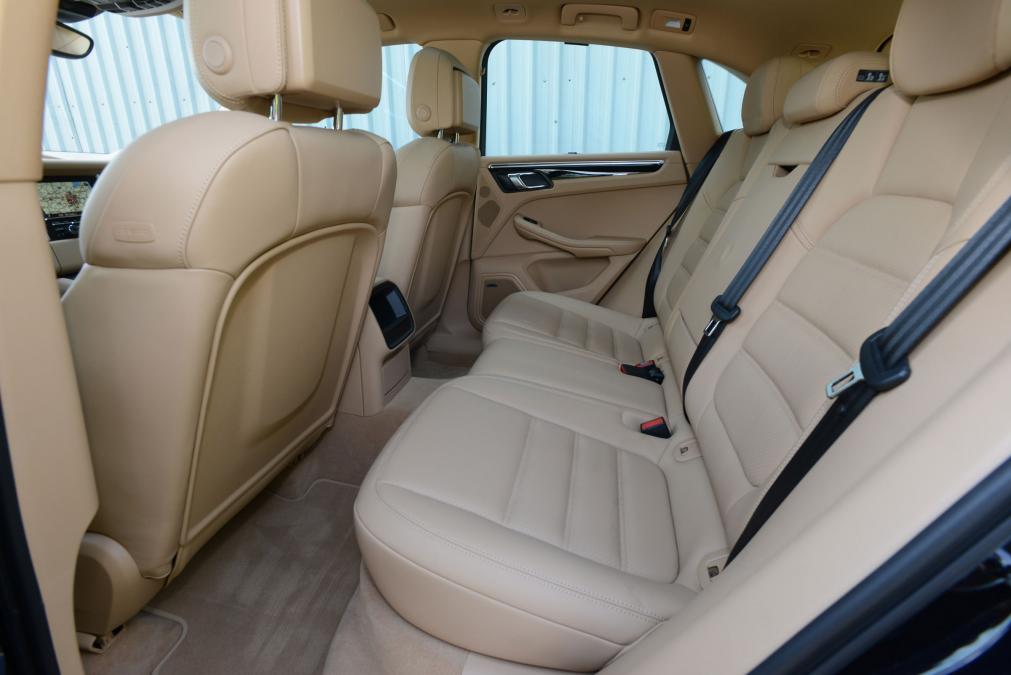
The Macan's boot is large enough to hold 500 litres of luggage while you've got the rear seats up, but you can fold them down to free up 1,500 litres of space. That means that despite its relatively sporty shape, the Macan is a genuinely spacious car, with room for a family and a large suitcase each.

Boosting its credentials is the fact that each and every Macan comes as standard with an electronically opening tailgate as well as front and rear parking sensors to help avoid any nasty scrapes.

Clearly there's not as much headroom as some of the more traditionally styled SUVs that the Macan is competing with but you'll have no trouble fitting five adults in to the cabin. There's a fair amount of knee room, too. Since you've got four-wheel drive as standard, you'll be well-equipped if there's a sudden cold snap or if you need to do a bit of light off-roading.


The Macan's boot is large enough to hold 500 litres of luggage while you've got the rear seats up, but you can fold them down to free up 1,500 litres of space. That means that despite its relatively sporty shape, the Macan is a genuinely spacious car, with room for a family and a large suitcase each.

Boosting its credentials is the fact that each and every Macan comes as standard with an electronically opening tailgate as well as front and rear parking sensors to help avoid any nasty scrapes.

Clearly there's not as much headroom as some of the more traditionally styled SUVs that the Macan is competing with but you'll have no trouble fitting five adults in to the cabin. There's a fair amount of knee room, too. Since you've got four-wheel drive as standard, you'll be well-equipped if there's a sudden cold snap or if you need to do a bit of light off-roading.


We tackled some slippery inclines and descents in the Macan, helped by pressing the 'off-road' button. This prepares the throttle response and relevant torque splits to help with off-road driving.

Those cars fitted with optional air suspension rise by 40mm for off-road work, taking maximum ground clearance to 230mm. There's a separate button for hill descent control, too, which will take charge of the brakes for you on a slippery descent, keeping the speed between 3 and 18mph and you in control of the car.

If you're planning on towing, then a reversing camera is fitted, which has functions to help hitch up the trailer, while the torquey engines offer lots of pulling power.

Porsche always fares well in our Driver Power satisfaction surveys, and this year it finished sixth. The Macan is loosely based on the Audi Q5, which is a relatively reliable 4x4. The Audi finished 92nd in our Top 200 cars to live with, so with Porsche’s solid dependability, the Macan shouldn’t give you many ownership headaches. If it does, the brand’s dealer network was voted the eighth best in the UK last year, so you should get good service.

The Macan performs well when it comes to safety. It’s the only Porsche on the market to have been crash tested by Euro NCAP, too, and was given a full five-star rating. The car is equipped with ESP and front collision warning sensors as standard. There’s also a rear side airbag option to further improve safety.

Kamis, 14 Januari 2016

Posted by Unknown | File under :

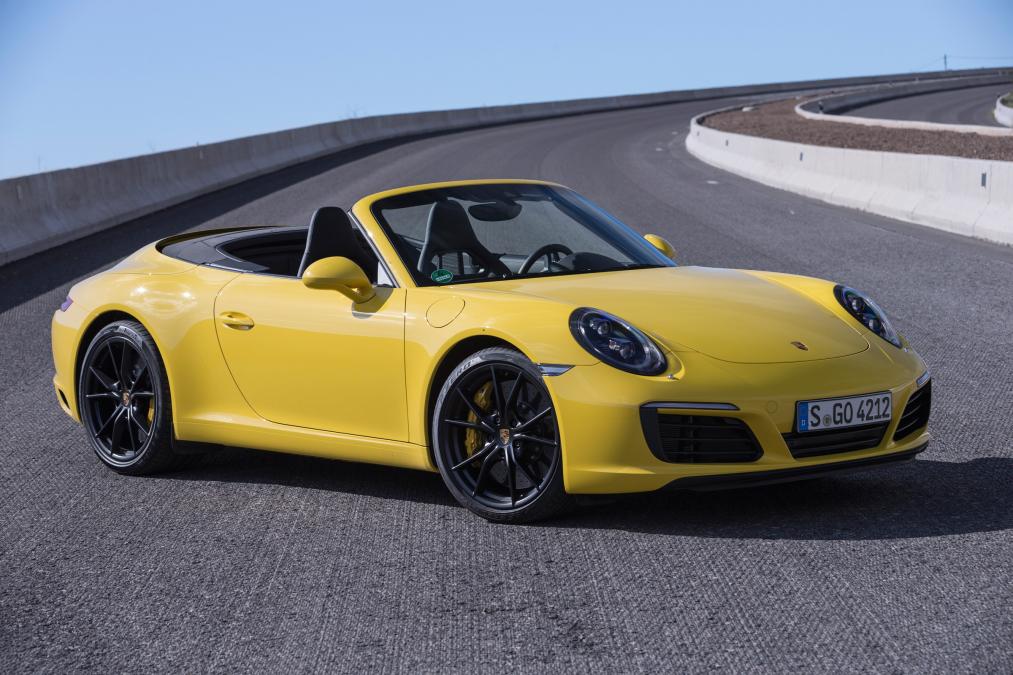
Like the new Carrera coupe, this 991.2-generation Porsche 911 Cabriolet is faster and more efficient than ever. It’s more usable, too, thanks to that new turbocharged engine, an improved chassis and some extra tech inside – but it’s not without its flaws.

Driving a convertible sports car should be an event. It’s about the theatre of stepping behind the wheel, lowering the roof to savour the atmosphere and firing up the engine to experience the noise. But what if that engine is now turbocharged?

That’s exactly what’s happened with the new 911. Like the coupe we tested, this facelifted 991 Cabriolet now uses a 3.0-litre flat-six turbocharged engine, rather than the larger naturally aspirated unit in the old car. But does that mean the days are numbered for the 911’s traditional bassy exhaust rasp? We jumped behind the wheel of the new entry-level £87,641 Carrera model with Porsche’s seven-speed PDK dual-clutch gearbox to find out.

The answer is mixed, as even with the optional £1,773 central-exit Sports exhaust, with the roof down the 911 doesn’t quite bark like you’d expect when you press the accelerator.


Driving a convertible sports car should be an event. It’s about the theatre of stepping behind the wheel, lowering the roof to savour the atmosphere and firing up the engine to experience the noise. But what if that engine is now turbocharged?

That’s exactly what’s happened with the new 911. Like the coupe we tested, this facelifted 991 Cabriolet now uses a 3.0-litre flat-six turbocharged engine, rather than the larger naturally aspirated unit in the old car. But does that mean the days are numbered for the 911’s traditional bassy exhaust rasp? We jumped behind the wheel of the new entry-level £87,641 Carrera model with Porsche’s seven-speed PDK dual-clutch gearbox to find out.

The answer is mixed, as even with the optional £1,773 central-exit Sports exhaust, with the roof down the 911 doesn’t quite bark like you’d expect when you press the accelerator.

What it does do is leap down the road at an incredible rate. That’s thanks to the new engine’s extra performance. There’s 365bhp on offer, and a massive 450Nm – that’s 20bhp and 60Nm more than its predecessor, and it really shows.


The extra torque is also available lower, from 1,700rpm to 5,000rpm, so the 0-62mph sprint is down to 4.4 seconds on this Sport Chrono equipped PDK car. The big benefit is you can now leave the 911 in gear and let it pull out of bends, whereas before you’d have to be wringing the engine’s neck to maximise performance.

Rev it to the lower 7,500rpm rev limiter and there’s still lots of fun to be had. However, the extra spine-tingling rasp from the old car, revving out that bit further, has gone. And with the breeze sucking the noise backwards away from the cabin on the move, it’s hard to hear the engine – the most noticeable sound is the sucking and whooshing of the turbos. It’s actually noisier with the roof up, as you hear the engine howling from the inside, punctuated by rapid-fire shifts on the swift and smooth PDK gearbox and a nice crackle when you lift off the accelerator.

Like the coupe, Porsche’s PASM adaptive dampers now come as standard, so while the ride height is 10mm lower than before, with Normal and Sport modes giving a wider breadth of capability, this 911 Cabriolet is even more comfortable and a better performer on the right road.


While it works in the coupe, chopping the roof off here means the 911 feels fidgety on bad roads. It’s a good cruiser, but the chassis wobbles when you push it harder in corners – as the grip and g forces build, you can feel the structure flex. It’s not the most reassuring feeling, and in Sport mode it’s even worse. The ride only settles down on smooth roads. At least with the wind deflector up there’s not much buffeting in the cabin, even at motorway speeds. In fact, put the roof up and it’s almost as refined as the hard top, with not much wind whistle from around the door seals either.

The basic cabin layout is very similar to before, but Porsche has added a new infotainment system with a new seven-inch touchscreen. It’s smarter, too, and works like a smartphone, recognising swipe gestures, for example.

It works in conjunction with Apple CarPlay and Porsche’s new Car Connect app that gives users the ability to check functions on their cars remotely, like remaining range. On top of this, real-time traffic info and online navigation is now standard on the 911.

Continuing the Porsche’s extra usability, the engine is now even more efficient, thanks to those turbos. If you’re in the market for a near £90,000 convertible, fuel economy might not be at the top of your wish list, but returning 37.7mpg and 172g/km CO2, it boasts respectable running costs.


Like the fixed-roof 911, then, the Cabriolet is faster, more efficient and more usable with a 145-litre boot underneath the low nose. But also like the coupe, this 911 Cabriolet has lost a little of its top-end thrill, replaced by explosive mid-range performance.
 
However, out-and-out driving matters less here. It’s about the experience in a soft top, and while the looks are still there – improved by some styling tweaks all over – the noise has been dampened down a few decibels, which might put a few traditional 911 Cabriolet buyers off.


Key specs

  • Price: £87,641
  • Engine: 3.0-litre flat-six
  • Power: 365bhp
  • Torque: 450Nm
  • Transmission: Seven-speed PDK dual-clutch auto, rear-wheel drive
  • 0-62mph: 4.4 secs
  • Top speed: 180mph
  • Economy: 37.3mpg
  • CO2: 172g/km

Jumat, 18 Desember 2015

Posted by Unknown | File under :

SIMPLY put, the Boxster Spyder is the ultimate version of one of the most intoxicating sports cars you can buy. Crucially, the Boxster’s accessible performance remains; despite being fitted with the 371bhp 3.8-litre engine from the 911 Carrera S. Its abilities are reflected in its price tag, but if it follows the path laid by its predecessor, which is appreciating in value, the Boxster Spyder will not only be a sound investment but a future classic, too

Over £60,000 for a Porsche Boxster seems an extravagant sum to fork out on a variant of Porsche’s entry-level model. After all you can pick up the already brilliant standard version for £37,000. But what we have here is no ordinary Boxster – far from it. This is the new Boxster Spyder and we’ve finally gotten our hands on it in the UK.

So what makes the Spyder so special? Well, behind the driver sits the same 3.8-litre flat-six engine from the new hardcore Cayman GT4. Here it’s 10bhp down on power developing 371bhp, but it’s still a substantial 46bhp more than you get in the Boxster GTS, which makes do with the 3.4-litre engine. That makes the Spyder the most power Boxster ever produced.


What further separates the Spyder from the rest of the Boxster lineup is the roof. Like its predecessor, it’s a folding fabric arrangement to help shed weight – saving 11kg – but here it no longer looks like a club scout’s poorly constructed tent. Its sleeker shape clings to the Boxster in all the right places, flaunting the car’s curves.

  
Removing it still requires some manual labour, though. A button on the centre console releases the roof latch and pops open the boot, then you simply unclip the catches at the rear and fold it behind the cabin into a compartment and close the boot. It’s a far less complex process than before and a refreshing change from the electric, origami metalwork we’ve become accustomed to.

And once it’s stowed, there are two reasons you won’t want to put it back up. Firstly, with the roof down, the Spyder could quite possibly be the prettiest car Porsche currently sells, with a whiff of 918 about its stance. Secondly, once you sink into the slim, carbon bucket seats, wrap your hands around the Alcantara steering wheel and bring the engine to life there’s no barrier between you and the guttural howl of the 3.8-litre flat-six. Dip the clutch – a six-speed manual gearbox is the only transmission option – punch the stubby gearstick into first and you’re off. Keep it pinned and 0-62mph will be done in 4.5 seconds and if the law allows, 180mph flat out – roof up or down.


It’s stunningly fast and the razor sharp throttle response means there’s instant shove in reserve. You have to hang on until 6,700rpm before you get all 371bhp which, because of the long gearing, means you’ll be spending most of you’re time in second and third if you want to keep hold of your license.

But what impresses more than the Spyder’s outright pace is just how responsive and tactile it feels above any other Boxster. The steering is marginally quicker than the standard model and responds to the minutest of inputs. And as for the gearchange, well it doesn’t get much better – the lever is stubby and the change short and firm.

Its setup is designed for those who prioritise driving above anything else, and that’s shown in the standard specification Porsche sells the car. Everything centres around saving weight. The door handles have been replaced with fabric pulls, while the radio and air con have also been sacrificed to cut the kilos – you can, however, spec both as a no cost option, which adds a rather indecipherable 15kg to the kerbweight.


Porsche’s Sports Chrono pack also comes as standard, chopping 20mm from the ride height so there’s a slight firmness to the ride but the damping is supple and effectively soaks up road imperfections. The Spyder doesn’t benefit from the same suspension setup as the Cayman GT4, instead using the passive sports suspension which is an option on the Boxster GTS.

But the Spyder is far more than a Boxster with a fancy roof and all the trimmings. It’s been engineered and honed to a level far beyond any other version in the lineup, but better still, unlike the Cayman GT4, the Spyder isn’t limited by numbers. So if you really want one, you can have one.


Key specs

  • Price: £60,459
  • Engine: 3.8-litre 6cyl
  • Transmission: Six-speed manual, rear-wheel drive
  • Power: 371bhp
  • 0-62mph/top speed: 4.5s/180mph
  • Economy/CO2: 28.5mpg/230g/km

Rabu, 15 Juli 2015

Posted by Unknown | File under :

Porsche has taken the already excellent Boxster roadster to new heights with the thrilling Boxster Spyder.

Once again Porsche has managed to identify and fill yet another a niche in the market that no one previously thought existed. Apart from its poor over the shoulder visibility with the hood up, the Spyder is hard to find fault with. And very, very easy to like. Clever car, is the Boxster Spyder, from an increasingly clever car company.

The car you are looking at, Porsche's new £60,459 Boxster Spyder, could well be the most exciting sports car we've driven this year.

Powered by the same sensational 3.8-litre flat six that you'll find in a Cayman GT4, and boasting the kind of sound track and performance that will make grown men go weak at the knees, the Spyder also happens to look 100% gorgeous in the metal. And on the road it is nothing less than brilliant to drive.

But it's not a car that will appeal to everyone, the Boxster Spyder, and nor is it intended to be. Its suspension is both lower and stiffer than that of a regular Boxster. There is just one transmission option; a six speed manual. And the roof must be raised or lowered using not merely your fingers, as per a regular Boxster, but your hands as well - because in the name of weight saving the hood is manual and takes a fair bit more effort to raise and lower than in the standard car.


The trade off comes, however, on the road. Tickling the scales at just 1315kg the Spyder is lighter, even, than the Cayman GT4. So although it isn't meant to be quite so focused as the bewinged coupe, in many ways it's the more desirable of the two to drive, with fractionally less weight to carry, providing it with even more agility than the GT4.

And then there's the not inconsiderable additional advantage of being able to lower the hood and enjoy the sunshine, which in turn allows you to listen to the machinations of the 3.8-litre flat six that much more readily, too.

The things you notice about the Spyder the most are its ride quality (surprisingly good beside that of Porsche's other sportier models), the clarity of response from its steering, the lovely feel underfoot from its brakes, and the extra shove that arrives courtesy of having an extra 400cc of engine capacity beneath your right foot. The Spyder's extra torque enables it to pull its long gearing a fair bit more effectively than in the 3.4-litre Boxster GTS. Yet at the same time it sounds and feels more energetic than ever up near the 7800rpm cut out.


Dynamically, you really do get the best of both worlds with the Boxster Spyder; greater ease of driving and more of a thrill factor at the top end to go with it.

And it's quick, the Spyder, no mistake about that. Zero to 62mph is quoted at 4.5sec with a top speed of 180mph, while at the other end of the scale emissions and economy are both significantly improved over the previous generation model at 230g/km and 28.5mpg combined.


It even has the same decent size front boot as the regular Boxster plus a slightly shallower affair at the back into which the remains of the roof get tucked away.

The only issue I had with the Spyder was its poor over-the-shoulder visibility with the roof up. And in the left hand drive version I drove it was quite some issue, especially when blending in to traffic coming from the right. But then you can solve this problem by dropping the hood, at which point visibility becomes the opposite; excellent all round.


Key specs
  • Price: £60,459
  • Engine: 3.8-litre flat six
  • Transmission: 6-speed manual, rear
  • Power/torque: 371bhp/420Nm
  • 0-62mph/top speed: 4.5s/180mph
  • Economy/CO2: 28.5mpg/230g/km
  • On sale: Now

Jumat, 10 Juli 2015

Posted by Unknown | File under :
Porsche's most hardcore, track-focused 911 is mighty machine. But is it a cut-price Ferrari 458 Speciale?

The 991 GT3 RS is a bigger step up from the GT3 than any other RS model that has gone before, managing to be more engaging but with a character of its own. Despite feeling even more of a track-focused machine the compromises for road use are few, but the Turbo-derived body does make it feel wide on tighter roads. To enjoy the greater performance levels you need to head to a track, but with the RS that’s kind of the point.

Racing improves the breed, and if there’s one firm that genuinely takes that mantra to the road then it’s Porsche. With its 911 GT3 it homologates its GT3 R race car, but it’s the GT3 RS that really blurs the boundaries between racetrack and road. It’s now here, and unlike previous RS models, it’s a lot more distinct from the standard GT3.

Firstly there’s more power, courtesy of the 3.8-litre flat six being enlarged to 4.0 litres. That is achieved with a longer stroke, via a different camshaft constructed from the same exotic repeatedly heat-treated, high-strength steel you’ll find in Porsche’s 919 WEC Le Mans prototype race car.

And the engine upgrades don’t stop there - there’s a redesigned dry-sump lubrication system, a lighter valve train with new valve springs, a revised camshaft, lightweight cylinder heads and a variable resonance induction system. The net result is more power and torque compared to the GT3, with a peak output of 493bhp, up 25bhp, torque up from 440Nm to 460Nm. Porsche’s GT Boss Andreas Preuinger adds that at maximum speed - 193mph - a 'ram-air' effect of the new induction system adds at least 10bhp to that.


Unlike its predecessor, the 4.0-litre engine in combination with the PDK paddle-shifted seven-speed transmission (there’s no manual option) is civilised at low speed, but fearsomely decisive and quick when you up the pace. And it’s difficult not to, the 4.0-litre’s huge flexibility makes it quick at low revs, and otherworldly as it chases the slightly lower, but still stratospheric, 8,800rpm redline - it reaches 62mph in 3.3 seconds and 100mph in 7.1 seconds.

Do that and the noise is incredible, the speed sensational and, when you find a corner, the turn-in immediate - helped in part by revised RS specific rear-axle steering settings. The front axle feels more tied-down than any other 911, allowing entry speeds as high as you dare, while the rear too offers huge grip. Despite all that rubber on the road the RS can be playful, but it happens at greater speeds than its GT3 relation, and requires quicker reactions.

With the GT3 RS borrowing its wider body from the 911 Turbo, induction air for the engine is channelled via the rear wing inlets rather than over roof and engine lid. Visually the GT3 RS wears its intent with more overt styling, and all of it is functional.


The front wings feature vented tops to improve airflow and downforce without any increase in drag, despite that massive high mounted rear wing. All the aerodynamic trickery allows the GT3 RS to deliver downforce of 345kg - equivalent to around 80 per cent of what Porsche achieves with its GT3 R racing car.

With aerodynamic tricks borrowed from the track, an engine with 919 components and materials and a wheel and tyre selection that’s the same as the Porsche’s 918 Spyder hypercar, the GT3 RS is a far more extreme evolution than even the fabled 997 RS 4.0.

Despite the weight of the wider Turbo-derived body and larger wheels and tyres fitted under it the RS sees an overall reduction of weight over the standard GT3 by around 20kg. That’s achieved by everything from the replacement of rear and side rear windows with polycarbonate, a new lightweight rear bumper, a bootlid and front wings constructed from carbon fibre, thinner door cards with strap door pulls, less sound deadening, to a lighter wiring harness and even a magnesium roof.


That roof is lighter than carbonfibre, and we’re told the 1mm thick panel is incredibly difficult to make. It’s worth the effort though, dropping 1kg at the RS’s highest point, to the benefit of the RS’s centre of gravity. Purists can opt for a lighter lithium ion battery for £1,538, while the £6,248 PCCB composite ceramic brakes are a must-have option for those taking it to the track.

And it’s inconceivable that a GT3 RS owner wouldn’t spend some time on track, yet for all its obvious focus it’s not overly compromised as a road car. The impossibly low nose can be lifted with an optional lifting kit - it’s needed - though despite the massive tyre and wheel package and lack of rubber bushing in much of the suspension the RS rides with remarkable composure - it’s taut, but it’s not unbearable for road use.

It’s a more demanding car to drive than a GT3, then, but so rewarding at the same time. The RS achieves its greatness without robbing itself of some of its day-to-day usability. At around £30,000 more than the GT3 it looks like a bargain, assuming that is, if you can get hold of one.


Key specs
  • Price: £131,296
  • Power/torque: 493bhp/460Nm
  • Transmission: Seven-speed PDK automatic, rear-wheel drive
  • 0-62mph: 3.3 seconds 
  • Top speed: 193mph
  • Economy/CO2: 22.2mpg/296g/km
  • On sale: Now

Kamis, 18 Juni 2015

Posted by Unknown | File under :
The long-running Porsche 911 sports car is faster and more comfortable than ever.

No other sports car can match the over half a century heritage of the Porsche 911. The rear-engined layout has hardly changed since the car was launched in 1963, but the latest car can rightly claim to be the most technically accomplished in its class. 

Over the past half-century, the rear-engined Porsche has evolved into one of the most complete and thrilling sports cars money can buy. The latest model was launched in 2011, and is faster and more composed than ever, yet it also boasts impressive efficiency and surprising practicality. 
 
Its powerful engine range and better chassis means it’s also faster and safer, too. Greater use of aluminium means the car is now lighter, while the new seven-speed manual gearbox is a world first. The 345bhp Carrera, 395bhp Carrera S, and 424bhp GTS in two and four-wheel drive, and Coupe and Cabriolet bodystyles are the mainstays of the range, but the 469bhp GT3 is the most focused offering, though it's now all sold out in the UK, while the Turbo and Turbo S are the range toppers. There's a retro-inspired Targa model, which sits somewhere between the Coupe and the Cabriolet, too.

Porsche has a long history of building race-bred 911s for the road. And one of the most established models in this thoroughbred stable is the GT3, which first appeared on our roads in 1999. Unlike its stripped-out predecessors, this new one is packed with hi-tech additions, including four-wheel steering, a heavily revised PDK twin-clutch gearbox and an all-new, direct-injection flat-six engine.

Our choice: 911 Carrera S.

 
With its round headlamps, arcing roof line and compact proportions, the basic shape of the Porsche 911 is familiar, but it has gone through a steady process of evolution and the latest 991 generation looks bang up to date. This time around, the most significant alterations include a 100mm longer wheelbase, a wider front track, larger 19-inch wheels, and a 20mm lower roof line. The windscreen is more steeply raked, the fog lamps are integrated into the front bumper and the rear lights are slimmer.

There’s no mistaking the GT3 for any other model in the 911 line-up. For starters, its bulging rear wheelarches are 44mm wider than a standard Carrera’s, while the huge spoiler on the engine cover helps generate downforce at high speeds.

Elsewhere you’ll spot the deeper front and rear bumpers, extra cooling vents cut into the bonnet and grille, and the eye-catching mirrors. Further clues to the car’s potential include the huge 20-inch forged aluminium wheels that hide the GT3’s massive, £6,248 optional carbon-ceramic disc brakes. Thanks to these changes, the Porsche looks every inch a racing car for the road – an impression that’s reinforced when you climb behind the wheel.

To fit wide tyres and forged 20-inch wheels, the rear wheelarches are 28mm wider than a Carrera 4’s, while the gaping air vents suck air into the mighty engine and the active rear wing rises in search of downforce. The Turbo S is also marked out by its full LED headlights. Yet for all this, park it next to the R8 and the Porsche still doesn’t look quite as glamorous.

All cars get 19-inch alloys, slim LED tail- lights and a powered rear spoiler that rises up to boost stability at speed, while Carrera S models are identified by their larger 20-inch rims and quad-exit exhausts.

There are nods to the past inside, such as the trademark five-dial layout that features a large, centrally mounted rev-counter. However, the rest of the cabin is up to date, with slick design, top-notch materials and impeccable build quality.

The low-slung driving position is supremely comfortable, visibility is excellent and the major controls are perfectly sited. Most of the robust-feeling switchgear is arranged along the wide transmission tunnel, while the standard touchscreen infotainment system is intuitive to use and features clear graphics.

A special 911 50 Edition was offered in late 2013 and early 2014, boasting a few retro touches from when the very first 911 was introduced in 1963. The Targa model takes a similar approach, boasting a silver roll-over hoop and wraparound rear windscreen just like the very first Targa.

Sitting between the S and the GT3 is the Porsche 911 GTS. For a £7,553 premium over the S it adds a raft of styling upgrades inside and out. These include centre-clocking black alloy wheels and smoked headlamps while even the rear-drive Carrera 2 GTS has the wide body of the Carrera 4 for a more purposeful stance. Inside the GTS adds sports seats with Alcantara inserts and that material also adorns the steering wheel.

Meanwhile the Cabriolet GTS model has a roofline which follows more closely that of the coupe, rather than the humped rear of the previous 997 version. There are changes for the Targa too. Previously it was nothing more than a glorified sunroof with sliding centre panel. Now the car harks back to the past with a central fabric plaque which electrically folds away behind the rear seats in a wonderful display of balletic engineering.

In all versions of the 911 there are nods to the past inside, such as the trademark five-dial layout that features a large, centrally mounted rev-counter. However, the rest of the cabin is up to date, with slick design, top-notch materials and impeccable build quality.


If you’re looking for driving thrills above all else, the 911 is still hard to beat. Decades of development have turned the once wayward rear-engined Porsche into one of the most poised and agile machines ever.

At the core of this is the new engine range. The biggest seller is the entry-level 345bhp 3.4-litre Carrera. Step up to the Carrera S and you get a  3.8-litre with 395bhp that delivers a staggering blend of power and response. That engine is reworked slightly and produces 424bhp in the GTS giving the car a even more frenetic top end rush. And when fitted with the optional PDK paddle shift gearbox that car can get from 0-60mph in just 3.8 seconds.

However, the 911's advanced chassis control systems also deserve special mention as they give the car incredible mid-corner stability.

A change to the 911’s steering set up means the car is much more comfortable on motorways. It's extremely refined, too - when cruising in seventh gear on a smooth surface, you can almost hear the ticking of the dash-mounted stopwatch that's offered as part of the Sport Chrono package. The Sport Chrono pack is optional on the Carrera and S models but standard on the GTS, which also comes with active engine mounts, sportier settings for the active suspension and a sports exhaust.

The manual gearbox did feel a little clunky at low-speed though Porsche has recently updated it by giving it a slightly smoother shift. Despite this, we would still opt for the fast and precise PDK automatic as its quicker than the manual and more relaxing too. The four-wheel drive models do command a hefty premium, so we'd only  recommend them if you really need their excellent all-weather ability.

The 911 Turbo S is a car that requires you to reboot your expectations of grip and acceleration. With variable-vane twin turbos and direct injection, the 3.8-litre flat-six engine produces 552bhp (36bhp up on the Turbo) and 700Nm of torque. Helped by launch control, it rockets from 0-60mph in just 2.8 seconds, but on the road it’s the staggering in-gear response that blows you away.

There’s a seemingly never-ending reserve of thrust on tap, regardless of your speed or revs. Few cars we’ve tested are as fast as the Turbo S, yet it doesn’t feel intimidating at all. In fact, you’ll need plenty of self control, especially since the engine sounds so good at the higher reaches of its rev range. In addition to more power, the S comes with ceramic brakes, Porsche Dynamic Chassis Control (PDCC), active roll bars and the Sport Chrono Pack Plus, which includes dynamic engine mounts. Plus, as with the standard Turbo, it has active rear steering, PASM adaptive damping and active aerodynamics.

In short, the Turbo S features every piece of performance technology that Porsche offers on the 911. And it shows.

Traction is amazing, thanks to the four-wheel drive and torque vectoring, while the active roll bars all but eliminate body roll. The active rear axle helps low-speed agility and stability at higher speeds, while the steering is fast and communicative.

The Turbo responds instantly and remains incredibly poised, planted and untroubled by even the most challenging of roads. Astonishing grip levels mean you’ll never get close to reaching this car’s limits on the road. Head to the test track, however, and put the dampers, throttle and PDK into their sportiest settings, and you’ll discover a whole new layer of ability.

Here, the razor-sharp turn-in, incredible high-speed stability and immense stopping power of the Turbo S really shine through. With PDCC, the near-absence of body roll takes some getting used to, but the 911 never feels artificial or inert. However, when the rear tyres finally lose grip you’ll need quick reactions, as all the inertia stored up by the PDCC releases to add weight to the slide.

Yet for all its on-the-limit prowess, the Turbo S is marked out by the fact it’s just as easy to live with as any other 911. The PDK gearbox is great and there’s none of the drivetrain shunt you find in the Nissan GT-R for example.

With PASM dampers the ride is decent, too, although the tyres generate a fair bit of roar. But for ultimate thrills the track-focused chassis, racy engine and optimised PDK of the GT3 take some beating.

The GT3 model's electrically assisted steering is quick and full of feel, there’s barely any body roll and, in the dry, virtually limitless grip. Better still, the optional ceramic brakes provide eye-popping stopping power.

The least sharp 911 has to be the Targa; it's 110kg heavier than a similar coupé and 40kg heavier than a 911 Cabriolet. Engineers have also set it up to be a little more comfortable than every other 911 so it feels a little bit softer in the bends, too.

The 911 that gives the best blend of performance, handling and value is the GTS - especially in Carrera 2 guise. It's sharper to drive and faster than the S, and gets close to the thrills of the GT3 - but it's still a well-rounded road car. Plus, the extra kit is well worth the comparatively moderate price hike.

For those who want wind in the hair thrills there is either the Cabriolet or Targa to choose from. The latter is not available as a Turbo and comes with all-wheel drive only. Both share the same underpinnings and are heavier than their coupe counterparts by up to 85kg due to extra bracing to counteract the loss in rigidity by chopping off the roof.

The Targa is the heaviest model and although its roll over hoop does add some extra structural rigidity over the Cabriolet, it does have slightly softer suspension settings. Overall, the 911 Coupes are the sharper drive but the drop-top models have been engineered so well that they deliver all the grip and handling you could ever exploit safely on the road.

Having said all that, the 911 which gives the best blend of performance, handling and value if the GTS - especially in Carrera 2 guise. It's shaper to drive and faster than the S on which its based and gets close to the thrills of the GT3 yet is a more rounded road car. Also, the added value of the extra kit is well worth the comparatively moderate price hike.


Porsche has a reputation for building durable cars, which is backed up by the brand’s top six finish in our Driver Power 2014 satisfaction survey. The current generation model has been around for three years, so any teething problems should have been ironed out.

The 911 hasn’t been subjected to the Euro NCAP crash test, but it comes with six airbags, stability control and tyre pressure monitoring as standard. However, the Porsche’s life-saving options are limited, with the only significant extras being the £1,578 adaptive cruise control and carbon ceramic brakes.

Thanks to the 100mm-longer wheelbase, the Porsche 911 is roomier inside than ever before. The rear seats offer space for two kids and double up as extra luggage space. The deep 115-litre front boot is a handy size, too.

Elsewhere in the cabin there’s a decent-sized glovebox and a couple of handy cup-holders hidden underneath a flap ahead of the front seat passenger. The 911’s not perfect, though. The door bins are narrow, while the cubby between the driver and passenger only has enough room for a smartphone.
Its relatively compact dimensions make it easy to park, and big windows ensure good visibility – although Porsche charges extra for a rear wiper.

Every 911 gets a tracker system, while the Turbo S comes with a DAB radio, sat-nav and Bluetooth. The GT3 model doesn’t get rear seats but there’s the option of a nose lifter to make it easier to enter car parks or steep driveways.


If you’re in the market for a a sports car like this, then running costs are not going to be a priority. Even so Both Carrera and Carrera S versions of the new Porsche 911 offer fuel economy of more than 30mpg and even the 911 Turbo is a more affordable option than some exotic rivals. Standard stop-start helps economy and lowers emissions to 227g/km on both the Turbo and Turbo S, while we averaged a very impressive 26.3mpg on a mixed urban and motorway run.

Servicing is expensive, The hi-tech 911 uses lots of high quality parts and consumables like tyres and brake pads, so it's likely the 911 will prove expensive to maintain. You can expect routine maintenance costs of around £1,000 per scheduled service. However, unlike most other manufacturers Porsche requires you to get your 911 serviced only every two years. Group 50 insurance means big premiums. Our experts have calculated that the standard Carrera will retain more than 50 per cent of its value over three years.

Minggu, 14 Juni 2015

Posted by Unknown | File under :
First test of open-top Porsche 911 Targa 4 GTS on incredible Targa Florio route.

The Porsche 911 Targa GTS is the ultimate version of the open-top sports car. Yes, it's very expensive - but for a little over £7,000 more than the S model the extra kit, power boost and handling improvements are worthwhile. The sports exhaust and Sport Chrono Package will be must have options for many buyers anyway, and the styling additions only serve to make the 911 Targa even more beautiful.

Porsche has given the 911 Targa 4 the GTS treatment, and Auto Express was given an exclusive test drive of the new model on the road race circuit that gave the car its name.

Started in 1906, the Targa Florio originally a 148km route through the Sicilian countryside, and with more than 2,000 curves to navigate it was the perfect location to test the Porsche 911 Targa GTS's updated chassis and engine.

As with other GTS models, Porsche Active Suspension Management is standard and the springs are lowered by 10mm. There are also changes to the 3.8-litre flat six engine's cylinder head and intake and exhaust manifolds, which boosts power by 30bhp to 424bhp. This extra performance is all at the top end, and only reduces the 0-62mph time by 0.1 seconds to 4.7 seconds. In all honesty you’d need a back-to-back test with a normal S model to notice it, and even then the difference in straight-line speed would be marginal.


However, the GTS upgrade also includes the Sport Chrono Package as standard. This adds a stopwatch on the dash, a more aggressive throttle map and a Sports Plus mode which gives a more playful setting to the Porsche Stability Management allowing for more slip before the electronics intervene. In the case of automatic models it also includes a launch control funtion, enabling the Targa GTS to get from 0-62mph in just 4.3 seconds. 

With manual models like out test car, however, it automatically blips the throttle on downshifts (for those who can't be bothered to heal and toe), but we found that this reduced the feeling of involvement, which is the whole point of having the manual in the first place.

On the switchback roads of the Targa Florio, a race which Porsche won 11 times, stirring the gears is a lot of fun - helped by the fact that Porsche has improved the action of the seven-speed manual. But while it is a pleasant to use, the final ratio does seem like a cog too many, sometimes leaving you confused as to which gear you're in.


All Targa models come with all-wheel-drive as standard and this lets you get on the power sooner when exiting hairpins - which proved useful on this twisty road route. On the flip side, having power sent through the front wheels does dilute the steering feel over rear-drive models. The active engine mounts, another GTS benefit, came into their own more than they would on a normal drive in the UK, too, by preventing that mass at the back moving about so much under lateral loads.

In fact, the course we drove was so technical that right until the last event was held in 1977 the maximum average speed during the Targa Floria never topped 80mph. We never got near that, but the Targa GTS still proved a lot of fun - especially with the bark from Porsche Sports Exhaust, standard on the GTS, reverberating off the mountainside.

 
The Targa is the least focused off all the 911s. It's the heaviest model - about 85kg over the similar Coupe 4 GTS - and has slightly softer suspension settings too. Though on the battered roads of the Targa Florio, which were in a particularly poor state of repair following recent landslides, it was amazing how comfy even the more focused GTS model felt. We have little doubt it will be easy to live with in the UK.

It’s far from a stripped-our racer inside, too. Cabin upgrades include the Alcantara trimmed steering wheel and sports seats. Outside, black exterior details, centre-locking alloys, more aggressive bumpers and GTS badging set the Targa GTS apart from lesser versions.

But there is a price to pay - at over £104,000 it's very expensive. And really if you want the best all-round 911 experience, the Coupe Carrera 2 GTS is the pick. But if you want the best wind-in-the-hair 911 experience, and you have the cash, get Targa GTS. You won't regret it, especially if you ever get the chance to drive the route that gave it its name. 

 
Key specs
  • Price: £104,385
  • Engine: 3.8-litre flat six
  • Transmission: Seven-speed manual, four-wheel drive
  • Power/torque: 424bhp/440Nm
  • 0-62mph: 4.7 seconds
  • Top speed: 188mph
  • Economy/CO2: 28.3mpg/237g/km
  • On sale: Now