Rabu, 06 Januari 2016

Posted by Unknown | File under :


With efficient engines and attractive design, the Audi A5 is a stylish two-door coupe to rival the new BMW 4 Series.


The stylish Audi A5 range offers drivers an extra dose of panache compared to the more practical A4 family car on which it’s based.

With a focus on sleek design, the A5 coupe and convertible are attractive two-door models that blend performance with a surprising amount of practicality; they’re credible rivals to the latest BMW 4 Series. There’s also plenty of efficiency or performance on offer depending on which model you go for.

If you need more space but don’t like the boxy looks of the A4 saloon or estate, the swoopy ‘fastback style’ four-door A5 Sportback is worth considering too.

The Audi A5 is available in three body styles – coupe, cabriolet and Sportback. All three variants use Audi’s tried and tested range of petrol and diesel engines, as well as plenty of other upmarket technology, as you’d expect from an Audi.

The entry-level cars have a longitudinal front engine/front-wheel drive layout, but, of course, the platform was developed with Audi’s full-time quattro four-wheel drive system firmly in mind. Quattro 4x4 is optional or standard on all but the 1.8-litre TFSI petrol version.

Alongside the sizeable engine line-up there are plenty of different trim levels to choose from, including SE, SE Technik (on the Sportback only), S line and Black Edition plus.

There’s also an Ultra model if you’re after extra economy – this gets a 161bhp 2.0-litre TDI engine that returns up to 67.3mpg combined, emitting 109g/km of CO2. It’s the most efficient powerplant in the range.

At the other end of the performance curve is the V8-powered RS5 Coupe with its muscular 444bhp 4.2-litre V8 – and a £60k price tag.

The standard A5 coupe is much more affordable, however, with prices starting at just over £29k for the 1.8 TFSI petrol SE model. The starting price for the Cabriolet is £3,120 more expensive, while the entry-level Sportback looks good value at under £27k.

All the A5 models have been built at Audi’s Ingolstadt plant in Germany since the model was first introduced in 2007. The car is the third – and least sporty – of Audi’s Coupe line-up behind the R8 and the TT. It competes head-on with BMW’s 4 Series range, and also the Mercedes C-Class coupe.

Audi had been absent from the segment for a while before the A5’s introduction, which, given the success of the 80 Coupe until its 1996 demise, could have been an oversight. Audi was then focussed on the first TT, which launched in 1998 but the A5 has been a sale success since its launch and we expect to see a new model with the platform and tech from the latest A4 before too long.


Originally launched in 2007, the A5 has been around for a while now, and with fresher rivals like the BMW 4 Series and a new Mercedes-Benz C-Class Coupe on the block, the Audi has plenty of competition.

The Audi A5 could never really compete with the old BMW 3 Series Coupe when it came to driving enjoyment, and the arrival of the 4 Series means the gap between Audi and BMW in this class has opened up even further.

The Audi doesn’t feel as sharp or responsive as the BMW, and its steering feedback is more artificial. Thanks to the quattro four-wheel drive, however, there's loads of grip and it's still fun to drive. Body control is excellent with minimal lean through the corners and even the basic front-wheel drive models are enjoyable enough when you’re behind the wheel. The ride and cabin noise levels are excellent at all times as long as you steer clear of the bigger wheels.

The dual-clutch S tronic automatic transmission serves up fast shifts and decent manual control via steering wheel paddles. The £375 Dynamic Steering that varies the electronic assistance and the £520 Adaptive Damping and Drive Select system that alters the suspension firmness and other parameters are also available – though neither really makes things hugely different.

Alongside its larger alloys, the top-spec Black Edition also gets stiffer suspension, which means the ride is pretty firm. On country roads you’ll notice bumps and potholes send shudders through the steering wheel. Still, Audi offers a softer setup as a no-cost optional extra.


The best engine to go for to combine performance and economy is the 2.0-litre TDI diesel – it's strong, quiet at idle and makes a pleasingly subdued hum higher in the rev range. With 173bhp it does 0-62mph in 8.2 seconds.

Even the tweaked 159bhp version in the A5 Ultra comes with no obvious eco-compromises in its quest for greater efficiency. It's smooth throughout the rev range, pulls strongly from low revs and rattles off 0-62mph in 8.3 seconds in two-wheel drive guise with a manual gearbox. Opt for the auto box with either 2wd or quattro 4x4 and that time drops to 7.8 seconds.

At the other end of the line-up Audi offers a performance-focused version of each A5 bodystyle. These versions use a snorting 3.0-litre V6 diesel engine producing 328bhp, as well as the firm’s quattro four-wheel drive system for extra grip. 0-62mph drops to 5.8 seconds, while top speed is limited to 155mph.

On the petrol side the range starts with the 168bhp 1.8-litre TFSI offering 0-62mph in 7.9 seconds, while the 219bhp 2.0-litre TFSI quattro does it in 6.4 seconds. Neither engine has the grunty feel of its diesel equivalent, and they’re less efficient too. You couldn’t say the 3.0 TFSI engine lacks grunt in S5-badged petrol quattro A5 though, offering as it does a 0-62mph time of 4.9 seconds with a maximum of 155mph.

You wouldn’t identify a lack of performance in the RS5 Coupe either, with its 444bhp 4.2-litre V8 and dual-clutch gearbox. It dispatches 0-62mph in 4.5 seconds on its way to a 174mph maximum.


The range-topping 3.0 TDI A5 quattro Black Edition with the S tronic gearbox sits in the 25 per cent Benefit in Kind tax bracket, but the manual front-wheel-drive SE, which emits 120g/km, cuts bills to lower than the equivalent BMW.

Go for Audi’s eco champion, the Ultra model, for the best mix of power and efficiency – it will cover 0-62mph in 8.3 seconds, but manages 67.3mpg on the combined cycle and 109g/km, which is significantly lower than the cleanest BMW 4 Series. With a 65 litre fuel tank – shared across the A5 line-up – that means you’re looking at a potential range of 950 miles on a tank, at least on the official figures. Even in real world driving, you won’t be stopping often at the pumps.

The 2.0 TDI with two-wheel-drive and manual gearbox will return 61.4mpg and 120g/km of CO2, so it just scrapes a D rating for £30 annual road tax. The BMW 420d is group E and costs £130 a year to tax – as does the Audi 2.0 TDI if you opt for the less efficient quattro automatic version, when economy also drops to 53.3mpg. The 293bhp 3.0 TDI quattro offers economy of 49.6mpg and moves up to tax bracket F.

On the petrol side, the entry-level 1.8-litre TFSI can only match the 3.0 diesel for economy, but it is a little cheaper to tax in bracket D. The 2.0 TFSI quattro can manage 42.2mpg but rises to tax bracket G, while the 3.0 TFSI S5 manages 36mpg and earns an I rating for tax.

You won’t be buying an RS5 for its economy, but just for the sake of comparison it can eke out 27mpg on the combined cycle and with 246g/km of CO2 you’ll be paying the big bucks each year in road tax.


In 2012 the A5 received a facelift to keep the styling looking fresh. The results worked well and the sharp design of the Audi helps it to stand out from the crowd (if not from the rest of the Audi range), with a crease running down the side of the car into the sleek headlights at the front.

How good the car looks can vary a lot depending on the trim level you go for, however. The standard 17-inch wheels look a bit too small, but move up to the S line model and the bigger rims, lower suspension and bold bodykit help things along.

Black Edition models add some extra visual appeal with huge 19-inch wheels, matt black exterior detailing and tinted windows, too. Inside, piano black trim, a flat-bottomed steering wheel and a Bang & Olufsen stereo mean it's a luxurious place to be.
By comparison, the efficient Ultra model flies under the radar with 17-inch wheels as standard and only a discreet Ultra badge on the boot to mark it out as the eco-focused model in the A5 line-up.

Across the range the materials used are all top-notch and feel solid, while the build quality is definitely up to the standards of the A5's premium rivals. Standard equipment from SE upwards includes climate control, Bluetooth, heated leather seats, cruise control, an auto-opening boot, an auto-dimming rear-view mirror, parking sensors and a DAB radio.


Together, the Audi A5 Coupe and Cabrio ranked as the 114th best car to own in the Auto Express Driver Power 2015 customer satisfaction survey. Although Audi finished 13th out of 33 in the manufacturer rankings – it snuck ahead of arch rival BMW by one spot and trailed Mercedes by two places. It was a disappointing result, but things improved for the A5 when the Sportback finished an excellent 26th overall.

However while it came 16th for build quality, the Sportback still only managed 57th for reliability which wasn’t a brilliant performance.

If you do encounter any reliability issues, Audi’s dealers weren’t rated especially highly – the network finished 26th in the Driver Power countdown, falling short of its competitors again. The result is surely not where the Audi brand wants to be, and is somewhat at odds with the premium image of the product and its advertising profile.

The Audi A5 has not been crash tested, but the car it's based on, the previous generation Audi A4, was awarded the full five stars from Euro NCAP when it was tested back in 2009. Standard safety features on the coupe include front, passenger and curtain airbags, as well as stability control. There’s also the option to add active safety kit like lane departure warning, blind spot warning and adaptive cruise control.


The Audi A5 comes with the brand’s standard three-year/60,000-mile cover which is some way behind industry leaders on the warranty front although pretty average for the premium sector. However you can extend cover to four years and 75,000 miles for £535, providing some extra peace of mind.

Audi does offer fixed-price servicing, but it’s not as cheap as BMW’s five-year/60,000-mile package. The A5's variable service intervals mean a check-up is needed every 9,000 to 19,000 miles depending on how the car is driven. 

Selasa, 05 Januari 2016

Posted by Unknown | File under :

The Vauxhall Insignia is a big family car that’s been around for a long while now. And while it’s beginning to show its age, a facelift and a new range of engines have kept it relatively fresh.

The latest ecoFLEX engines offer great efficiency and refinement, and the Insignia is a superb car for travelling long distances in. However, rivals like the Mazda 6, Volkswagen Passat and Skoda Superb have it beaten in terms of driver enjoyment.

It’s a practical choice, with plenty of space for driver and passengers, as well as their luggage, although its sleek roofline can make things tight for taller people in the back.
Standard equipment is generous and pricing is very competitive, especially as there are usually deals to be had. Just beware of plunging values over the course of ownership, which can have a big impact on overall costs.

With its Insignia range, Vauxhall offers a line-up of large and practical family cars that has lured many buyers away from established mainstream rivals such as the Ford Mondeo and Volkswagen Passat. Outstanding value for money has always been the trump card for this model, and it certainly follows in the company’s long history of creating big, spacious, well equipped cars.

The Insignia is feeling its age somewhat these days, having been launched way back in 2008 as the replacement for the old Vauxhall Vectra. A facelift breathed some new life into the Insignia range in 2013, and did a lot to align it with the brand’s updated image. Inside, the dash and centre console were tidied up, with more of the car’s functions now operated via the infotainment system and touchpad.

The 2013 update also brought tweaks to the chassis, including making the steering more direct and improving ride comfort. As a result, the Insignia feels a little fresher from behind the wheel, but it faces tough new competition in the form of recently renewed rivals like the Ford Mondeo, Volkswagen Passat and Skoda Superb.


A broad range of petrol and diesel engines is on offer, with diesels by far the more popular choice among buyers (who tend to be mostly business users).

The Insignia also comes with a whole host of trim options, starting with the entry-level Design. The mid-range Insignia SRi is very popular, with the Tech Line model adding extra equipment and the VX-Line a touch of sportiness.

The plush range-topping Elite comes packed with loads of kit, such as 18-inch alloys, leather trim and dual-zone climate control. There’s even a high performance VXR model.

But the variety doesn’t stop there. As well as hatchback and saloon versions, Vauxhall offers a practical Sports Tourer estate – although the rugged Insignia Country Tourer, designed to rival the likes of the Volkswagen Passat Alltrack and SEAT Leon ST X-Perience, was dropped from sale in 2015.

The Insignia is at its best as a comfortable, refined long-distance companion, but lacks the sharpness of more modern rivals
The latest Vauxhall Insignia is incredibly comfortable and will happily eat up long journeys with ease. Tweaks made to the suspension in 2013 filter out the biggest bumps to deliver a comfortable ride, while wind noise is minimal and the engines are generally quiet – although petrol cars are definitely more refined than diesels. As a long-distance cruiser, this Vauxhall can’t be faulted.

But while the car offers buckets of grip and decent turn-in, it doesn’t come close to the Mazda 6 for driver thrills. There’s not much in the way of feedback through the steering wheel, and the pay-off for that comfortable ride is a rather soft feel through corners.

The Insignia suffers more body roll than the class leaders, and the suspension can easily be unsettled by mid-corner bumps. The exception is the VXR model – its HiPerStrut front suspension system offers massive grip and extra feedback.


There’s a huge variety of engines available. The entry-level petrol unit is the 1.8i VVT, offering 138bhp, but this engine does feel a bit breathless.

Surprisingly, the small-capacity 1.4-litre turbocharged petrol engine has the same 138bhp power output, but it offers more torque, flexibility and performance. It’s smooth and quiet, although it still lacks oomph. If you want that, Vauxhall’s 246bhp 2.0T SIDI petrol engine is much more potent.

However, easily the strongest performer in the Insignia range is the VXR SuperSport model, with its mighty 320bhp 2.8-litre V6. This 168mph super saloon is one of the fastest cars on sale in the UK in its price bracket, taking just 5.6 seconds to sprint from 0-62mph.

As of summer 2015, there was big news for the Insignia on the diesel engine front. Vauxhall’s new 1.6-litre ‘Whisper Diesel’ engine replaced lower-powered versions of the 2.0 CDTi diesel. This new 134bhp 1.6-litre is impressively responsive and smooth, while remaining remarkably refined. In ecoFLEX form, the engine delivers a top speed of 130mph and 0-62mph in 10.9 seconds.

A 167bhp 2.0 CDTi diesel remains available, offering excellent acceleration and flexibility. The fastest diesel of all – the 192bhp 2.0 CDTi Bi-Turbo – was dropped from the range in 2015. Unfortunately there’s no hybrid Insignia, whereas other brands are increasingly offering this option.


Company fleets account for most Vauxhall Insignia sales, so by far the majority of cars on the market are diesels. The efficient ecoFLEX diesel engines make the most sense. Crucially for fleet managers and company car drivers, the 1.6 diesel model achieves 99g/km CO2 emissions when specified with 17-inch alloy wheels and low-rolling-resistance tyres, and claims 74.3mpg fuel economy. That’s very impressive for such a large car, even if it’s now been beaten by the new Ford Mondeo (which goes as low as 94g/km and 78.5mpg).

The most powerful current Insignia with ecoFLEX technology is the 2.0 CDTi model, which has CO2 emissions as low as 114g/km and fuel economy of 65.7mpg.

Among the petrol options in the Vauxhall Insignia range, the 1.8i isn’t a very economical choice (it claims 40.4mpg and 169g/km). The 1.4-litre turbo is much more attractive, with CO2 emissions of 123g/km and 54.3mpg economy – but again Ford beats this with its Mondeo 1.0 EcoBoost, which emits less than 120g/km of CO2.

As you’d expect, the 2.8-litre twin-turbo VXR SuperSport is a real gas guzzler, while the nippy 2.0-litre SIDI petrol Insignia is hardly the most efficient option, either, with 39.2mpg economy and emissions of 169g/km.

Like its Ford Mondeo, Volkswagen Passat and Skoda Superb rivals, the big Vauxhall is a firm favourite with fleet buyers, and Insignias are a common sight trawling the UK’s motorway network.

Compared to the Mondeo, which can appear bulky, the Insignia is one of the better-looking large cars out there, thanks to an arching roofline that tapers to a shallow rear screen and a raised tail.

What’s more, Vauxhall’s 2013 facelift improved on the original Insignia’s sharp design by adding a larger grille and revised LED headlights. Higher-spec cars also get a reprofiled chin spoiler with foglamps, and the hatchback model’s tail-lamps are joined by a thicker chrome bar across the tailgate. In fact, from some angles the Vauxhall Insignia is reminiscent of the Volkswagen CC.

The interior changes introduced in 2013 are equally subtle. The steering wheel is the same as the one fitted across the rest of the Vauxhall range and the curvy dashboard found on the first-generation Insignia is largely unchanged.


Vauxhall has reduced the number of buttons on the centre console, as all Insignias now get a touchscreen to navigate through the major functions.

Opt for a model equipped with sat-nav, and you also get a touchpad that’s used to work through the menus and write characters. This IntelliLink system features Apple CarPlay connectivity, so you can hook up your smartphone to access in-car entertainment apps for things like music and news. You can also use audio streaming, have text messages read aloud and play videos. The navigation system can be displayed two or three-dimensionally, and can be controlled by voice command.

All versions of the Insignia feature a digital radio as standard, with steering wheel-mounted controls. A Bose Premium sound system is optional, providing excellent clarity.

One of the most appealing extras Vauxhall offers for the Insignia is the eight-inch TFT instrument cluster. This costs around £400, and replaces the traditional analogue dials with a large screen that can show a range of information, from speed and revs to economy and driving efficiency. The system looks and feels very modern thanks to its clear, colourful display.

New to the Insignia from summer 2015 is OnStar, which provides in-car Wi-Fi, notifies the emergency services if the airbags are deployed and also includes a direct connection to call centre advisors. It’s standard on Elite, Limited Edition and VXR trim levels, and a £395 option on other models.


According to feedback from the Auto Express Driver Power 2015 satisfaction survey, the Vauxhall Insignia isn’t the most dependable car on the market. It ranked in a lowly 170th place in the reliability category of the poll.

The interior makes a decent impression, using good-quality materials. The upmarket feel is enhanced on higher-spec cars, which come with leather upholstery and plusher trim than on entry-level and mid-range versions. However, owners who have lived with the car for some time score it down for build quality (the Insignia ranked 159th in this category in Driver Power 2015).

As for safety, Vauxhall hasn’t scrimped on kit. The Insignia comes fitted with six airbags, ESP and two Isofix child seat mounts in the rear as standard. What's more, Euro NCAP awarded the car a score of 94 per cent for adult occupant protection in its independent crash tests, and gave it an overall rating of five stars.
However, it’s worth pointing out that the Insignia hasn’t been tested by Euro NCAP since 2009, so this doesn’t mean quite the same as the five-star rating achieved by the BMW 3 Series in 2012.
A raft of advanced safety kit is available on the Vauxhall options list. This includes a rear-view camera, plus a park-and-go technology pack with blind spot and rear traffic alerts.

Automatic lights and wipers can be added to lower-spec Insignias as extras, as can Vauxhall’s auto-park system and front and rear cameras. The front camera pack option includes lane departure warning, adaptive cruise control and forward collision alert. Optional OnStar also alerts the emergency services automatically if the airbag deploys.

While all this kit hikes the price, it keeps the Insignia among the best cars in its class for safety equipment. Even so, modern rivals like the latest Ford Mondeo have definitely caught up in this regard, and offer things like city braking, which Vauxhall does not.


Vauxhall used to supply a unique lifetime warranty, but that was scrapped for new cars as of January 2015. Instead, the company currently offers a three-year, 60,000-mile warranty that’s much more in line with industry averages. It’s still possible to extend the warranty, at extra cost, up to 100,000 miles. Brands offering more generous warranties include Toyota (five years), Hyundai (five years) and Kia (seven years).

The Insignia range benefits from 20,000-mile service intervals, which are longer than most cars, but to maintain the warranty you’ll still need to have a service carried out at least once a year. Optional service plans can spread the cost of dealer maintenance, and offer discounts on wear and tear items. 

Minggu, 27 Desember 2015

Posted by Unknown | File under :


Classy Audi A1 supermini packs good looks, a great-quality finish and top-notch refinement into a compact body.


Critics have accused the Audi A1 of being little more than a Volkswagen Polo in a posh party frock, but an engaging chassis and classy interior help to lift this small car above that.

It can become very expensive once you start adding optional extras, and the A1 can’t match its arch rival, the MINI, for fun behind the wheel. But the Audi is a lot easier on the eye than the baby Brit, and those classy, understated looks are likely to clinch the deal for many potential buyers.

Plus, the smallest petrol and diesel engines provide almost as much driving engagement overall as the range-topping, high-performance S1 quattro model.

The Audi A1 is the brand’s answer to the sporty MINI, and is based on the same platform and engines as the Volkswagen Polo, SEAT Ibiza and Skoda Yeti. So like the larger Audi A3, it does suffer a bit in direct comparison to its in-house rivals – the other cars may not be as posh, but they can do most of the same jobs just as well, and often for a lower price.

What helps to lift the A1 slightly above its VW Group cousins are sharp styling and a truly impressive interior. And the high-performance S1 brings some excitement to the range, taking the fight to the likes of the MINI John Cooper Works with its 228bhp 2.0-litre turbocharged engine and quattro four-wheel drive.

The styling is typical Audi, with a big, imposing grille, narrow, piercing headlights and an attractively creased and curved body. While the A1 is perhaps not as striking as a MINI or a DS 3, it’s certainly a very handsome and beautifully understated car.

There’s a choice of three-door and five-door Sportback bodystyles, and the latter is probably the more convincing choice visually – especially if you add contrasting silver roof lines and darker alloy wheels.


However, there are some more striking colour options available. Fluorescent yellow is offered, for example, if you’re feeling especially brave, while some buyers have chosen a colour scheme for their A1 that replicates the look of classic eighties Audi Quattro and Sport Quattro rally cars. It’s all a matter of taste – and, of course, budget.

While rivals such as the five-door MINI now provide a challenge in terms of cabin space, the Audi A1 remains the most practical choice on the premium small car market, with a decent-sized boot and reasonable space in the back seats. It is a bit limited by its styling, though – there’s no distinctive difference between the three and five-door versions, as there is with a MINI.

Plus, Audi doesn’t currently provide a drop-top option to match the MINI Convertible, which comes with a full soft-top, or the peel-back fabric roof designs offered by the DS 3 Cabrio or Fiat 500C. This seems like an opportunity missed.

The best of the A1’s engines is definitely the 1.0-litre TFSI petrol unit with 94bhp. It’s not exactly a powerhouse – 0-62mph takes 11.0 seconds – but it sounds good and loves to rev, so it’s fun to drive. And as this A1 weighs only 1,060kg, it doesn’t have to struggle.

The 1.6 TDI diesel engine claims some remarkable fuel economy figures, but it’s at least £1,000 more expensive to buy than the 1.0-litre petrol, so you need to do the sums to ensure you’ll cover the mileage to justify this. Audi also offers a more powerful 1.4 TFSI petrol engine, with 123bhp or 148bhp, but for most buyers, the little 1.0-litre will do the job nicely.

Unless you’ve tried the S1 quattro, that is. It features a 2.0-litre four-cylinder turbo delivering 228bhp, which is a lot of power in a car the size and weight of this. Add four-wheel-drive traction, and you have a recipe for bags of grip to go with the thrilling performance.


As it shares mechanicals with the Volkswagen Polo, the Audi A1 unsurprisingly errs on the side of sensible rather than exciting with its driving experience. Sport and S line models get lowered and stiffened suspension (although buyers can revert to the standard set-up before they take delivery at no extra cost), plus the steering is precise and well weighted, and there’s a decent amount of grip. But the A1 can’t match the engaging MINI or DS 3 for ultimate driving fun.

The ride is quite firm in any form, so if you decide to go for an S line model then it becomes quite uncomfortable. Unless you live somewhere with exceptionally smooth roads, we'd stick to the softer-riding SE versions – or select the standard suspension on range-topping models. Visibility is good in the Audi A1, and it's pretty easy to park, so it ticks the urban runabout boxes well.

Thanks to the low weight of its engine, the 1.0 TFSI petrol model has the best steering in the line-up, and ultimately delivers the best handling of any A1.

Having said that, both 1.4-litre models offer decent economy and a lower price than the diesel cars. The 148bhp TFSI won't upset the MINI Cooper S – it's quite quick, yet lacks involvement. The S1 is faster, but comes at quite a price premium.

All engines are smooth and refined, and most are hooked up to the slick six-speed manual gearbox. However, as of the 2015 facelift, all engines – including the 1.6-litre TDI – are available with the seven-speed dual-clutch S tronic auto.

Just like the petrol engines, the 1.6-litre diesel is quiet and smooth on the move, but it works best with the manual gearbox rather than the seven-speed auto as the manual adds a dose of much-needed fun.


Even though this is the smallest car in the range, the A1 upholds Audi’s reputation for producing classy interiors. In fact, it’s the style and the quality of the finish inside that lifts this model above the mechanically similar Volkswagen Polo. There’s no getting away from the fact that the Audi has the classier cabin.

Even so, it’s a slightly uncomfortable fact for Audi – and worth thinking about for potential buyers – that the Polo and its Skoda Fabia and SEAT Ibiza sister cars are more closely matched to the A1 in real quality terms than you might think.

Also, approach the options list with caution. Not only are some extras expensive, it’s easy to start specifying some features (like body-coloured air vent surrounds, for example) that can detract from the classy look of the cabin, and make it appear it a little gaudy.

Tech options include Audi Drive Select (which allows you to choose between Dynamic, Comfort and Efficiency driving modes), as well as keyless entry and ignition. There are also sundry driver aids such as parking, rain and light sensors. So although the A1 is a small car, there’s every opportunity to spec it up like a proper Audi.

By class standards, the Audi A1 has a pretty cutting-edge infotainment system. It can be specified with Audi Connect, which brings a Wi-Fi hotspot and can call up useful information such as the cheapest petrol stations nearby – although the set-up comes at a high price.

Buyers can also upgrade to a thumping Bose surround sound system, which is a considerable step up from the standard audio set-up. One slightly odd thing is that the central display screen in the A1 doesn’t slide electrically away as it does in the larger A3; instead you have to flip it up and down with your fingers. This seems a bit old-tech for such a hi-tech car.


The A1 is up there with the safest cars in the premium supermini class, as it comes with a long list of safety equipment as standard and has been awarded a five-star rating in Euro NCAP crash safety tests.

Yet despite Audi's upmarket image and strong reputation for quality, the A1 finished well down the rankings in the Auto Express Driver Power 2015 satisfaction survey. The car came 152nd overall, and was rated only 146th in the reliability category – both represent significant drops from its position in 2014.

Owners also criticised the A1’s uncomfortable ride, practicality issues and running costs, although they praised its ease of driving.

The interior feels sturdy and durable, though, and the engines have all been tried and tested in the rest of the VW Group’s range of cars – so we’d be surprised if you encounter any major mechanical difficulties.

A three-year warranty is supplied with the Audi A1 as standard. This covers unlimited mileage in the first two years, but only up to 60,000 miles in year three. For £235, you can extend the warranty to four years and 75,000 miles, or for £500 you can stretch it to five years and 95,000 miles, and the extended guarantees can be transferred between owners.

Audi offers a choice of servicing schedules to suit how you drive your A1. If you’re mostly in town and doing short journeys, it recommends you bring your car in to your local dealer workshop every 9,000 miles or once a year for an oil change, or every 19,000 miles or two years for an inspection and service.

Drivers racking up higher mileages should have an oil change, inspection and service carried out on their A1 every 19,000 miles or two years.
Posted by Unknown | File under :

The Toyota Aygo isn’t all that mechanically different from its predecessor, but its looks are refreshingly contemporary with a youthful slant.

There’s not much power or dynamic capability, and while improvements to the sound-deadening make the interior more refined at speed, it’s still some way short of the city car class leaders for motorway driving. Practicality also suffers thanks to the Aygo’s super-compact dimensions.

Yet the latest Aygo maintains the same sense of fun as before, and there are small but worthwhile technical improvements under the skin, including some significant advances in vehicle safety. Plus it’s super frugal, easy to personalise, and well-connected with the latest x-touch multimedia system. So it may only earn three stars from us, but if you like it - you’ll love it!

The original Aygo was a big hit for Toyota, with its compact dimensions, minuscule running costs and cheeky looks earning it strong sales across the UK. So the Japanese brand hasn’t messed too much with that winning formula, instead investing in striking looks and new tech.

There are three and five-door versions available and, as with the first Aygo, Toyota's second generation city car is a joint development project with Peugeot and Citroen. The French companies’ 108 and C1 models share the same lightweight platform and mechanicals, but whereas the Aygo is only available with one three-cylinder petrol engine, the others get a choice of two power units. All three city car siblings are built at the imaginatively-named TPCA (Toyota Peugeot Citroën Automobile) factory in the Czech Republic.

There’s little of the radical or innovative fuel saving tech that some rivals employ underneath the Aygo’s skin. There’s not even a stop-start system available in the UK.

The conventional front-wheel-drive platform features MacPherson strut front suspension with a torsion beam rear set-up. While you get ventilated discs brakes at the front, the back end is braked by drums. Steering is by electric-assist rack and pinion.

So the three models in the Aygo range are mechanically identical, starting with the entry-level x which features 14ins wheels, projector headlamps, LED DRLS, 2-speaker audio with USB connectivity and hill-start assist.


The mid-range x-play model highlights include piano black finish for that big ‘X’ styling graphic emblazoned over the front of the car, a 4-speaker audio system with Bluetooth, steering wheel controls for audio and phone, air-con, a rev-counter, height adjustable driver’s seat and 50:50 split rear seat.

The range-topping x-pression adds 15ins alloys, more piano black exterior trim parts, fog lights, part-leather sports seats, the x-touch multimedia system with DAB and a rear view camera.

There is a plethora of ‘personalisation’ options to choose from too, so it’s not surprising that Toyota has put together a trio of themed special editions to help encourage customers to make their minds up in the showroom. x-cite, x-pure and x-clusive editions all offer exterior colour, style and kit packages that reflect their respective labels.

Aside from the various styling and equipment packages, the only significant options are the choice of three or five door body, a full-length ‘x-wave’ fabric roof, and the ‘x-shift’ automated manual gearbox.


Owners of the previous-generation Aygo will feel at home behind the wheel of the new model. For starters, the 1.0-litre three-cylinder engine is carried over from the old car with small but significant tweaks. Overall refinement is improved, but the engine has the same thrummy soundtrack and eager nature.

You can hear it so clearly because Toyota has done a better job at dampening wind and road noise. It's better at motorway speeds, but still falls some way behind cars such as the Hyundai i10 and VW Up! for long-distance refinement and comfort. The Aygo x-wave also loses out a little bit in terms of wind noise thanks to the cloth roof, but it's better than you'd expect.

Steering that’s 14 per cent sharper makes the Aygo ideal for darting around town, although at higher speeds there’s significant body roll. The pay-off for that is a supple ride over bumpy roads.

The steering is light and accurate, the Aygo turns into corners keenly and there’s decent grip. Body movement is better controlled in some rivals, but the Aygo fared well during our braking tests. Letting the side down is the notchy and reluctant manual gearbox shift action, which oddly isn't as pleasant as the previous-gen Aygo's, even though it’s supposed to have been upgraded.


There may be only one petrol engine available to Aygo buyers, but luckily the 1.0-litre VVT-i unit is an enthusiastic performer that’s happy to rev, filling the cabin with a characterful three-cylinder noise. While some may find it intrusive, others will like the rorty tone. Indeed, Toyota engineers say positive customer feedback focused their minds on reducing road and wind noise, specifically so the engine – without getting any louder - could be heard better.

The pleasing tone is fortunate, as particularly long first and second gear ratios mean you need to rev the engine hard to produce power. But there’s plenty of performance for nipping around town and the revision in ratios means the engine does feel less strained at a sustained fast cruise, compared to its predecessor. The Aygo’s 69bhp is developed at 6,000rpm, and 95Nm of peak torque is delivered at 4,300rpm.

The x-shift automated manual has slightly shorter gear ratios, so feels as though it picks up speed quicker around town – it blips the throttle on downshifts, too. The official performance figures are pegged neck-and-neck for both transmissions though, as each version takes the Aygo from 0-62mph in 14.2secs. Maximum speed for both is 99mph.

Technical upgrades over previous versions of the 1.0 engine are focused on better combustion efficiency, reduced internal friction and exhaust gas flow optimisation. That means you get a new cylinder head with slightly higher compression, plus an exhaust gas recirculation system and freer-flowing catalytic converter among other detail changes.


Although the 1.0 VVT-i is fundamentally the same unit as used by the Toyota Aygo’s predecessor, it’s been re-engineered for the new model. A higher compression ratio of 11.5:1, a new low-friction timing chain and a cylinder head with built-in exhaust manifold to save weight have all helped to improve fuel efficiency and cut emissions.

The mods allow Toyota to boast of raising the engine’s thermal efficiency (the amount of the fuel’s energy it converts to power) to a class-leading 37 percent. That’s impressive, but it’s a cautionary thought that even in an economy-minded city car like this you’re losing 63 percent of the energy in your petrol tank to (mainly) waste heat and friction. And that’s in those rare moments when the engine is running at peak efficiency.

Still, the numbers look good. Fuel economy and CO2 emissions have improved by 3.3mpg to 69mpg and 4g/km to 95g/km of CO2 in the five-speed manual model, while the x-shift auto returns 67.3mpg and 97g/km.

Everything qualifies for free ‘road tax’ thanks to emissions that put the Aygo in VED band A. You can also take advantage of Toyota’s attractive finance plans that will get you behind the wheel for less than £100 a month.

Toyota has taken a bold approach with the Aygo, ditching the old car’s soft curves and rounded details in favour of sharp edges and eye-catching angles. Highlights include the swept-back headlamps, rising window line and tall tail-lights. The double-bubble roof panel is particularly eye-catching.

The car certainly looks more distinctive than the Skoda Citigo, SEAT Mii and VW up! but the Citroen C1 and Peugeot 108 are similar and their clean-cut lines will be more attractive to some.

The same youthful approach continues inside, where there’s a gloss black dash finish and a large touchscreen infotainment system, plus a circular steering column-mounted pod that houses the speedo plus digital fuel and rev readouts. Yet while it appears modern and is solidly screwed together, the hard plastics on the dash and doors look and feel fairly cheap. Those details are mainly noticeable because the cabin as a whole is so much more sophisticated than the old car's - the penny-pinching trim predictably stands out.

The big draw compared to rivals like the VW up! and Hyundai i10 is the funky design inside and out, and level of personalisation available on the Aygo. The Japanese hatch is emblazoned with a distinctive ‘X’ running from the A-pillars to the front grille – just one of a number of parts that can be swapped around in a variety of colours.

There’s the allure of that 'x-wave' retractable cloth roof for £850, and Toyota’s new x-touch smartphone-optimised infotainment system brings it bang up to date. Buyers can change the colour of the ‘X’, wheels and rear bumper, as well as a selection of snap-in interior parts. It’s a tactic designed to attract young, fashionable customers to the brand, and proves Toyota is trying to put an era of bland designs behind it.


A string of recalls has taken its toll on Toyota’s reputation for quality and durability. Yet while it slipped down to 17th place in our Driver Power 2014 satisfaction survey, owners rated its cars eighth for reliability in the 2015 poll.

On top of that, the Aygo feels robustly constructed, while the engine is based on the tried and tested unit used in the old car.

There was good news in the NCAP test results too, when the latest generation Aygo moved up – along with its Citroen C1 and Peugeot 108 siblings – to a four star rating from its previous three stars. Adult and child occupant safety were both rated at 80 percent in their relevant tests. The four star rating puts the Toyota in the top rank in the city car class – a class where financial restraints mean fewer active and electronic safety aids are typically deployed, limiting the scope for 5-star awards.

That said, all versions of the Aygo get four airbags, Isofix child seat mountings, stability control and tyre pressure monitoring, while you can spec-up on options like the range-topping x-clusiv special edition’s reversing camera and automatic lights.
Posted by Unknown | File under :

In essence, the Citroen C3 is designed to do most of what you'd want a modern supermini to do. It looks decent enough, has a varied and economical engine range, and offers plenty of space. But it's getting on in years now and feels it, lagging behind the class best in terms of handling, tech and cabin quality. It isn't particularly cheap either, which would have gone some way to making up for the shortcomings.

Those needing more space and practical features should look at the Citroen C3 Picasso, while the upmarket DS 3 supermini and DS 3 Cabrio convertible should satisfy buyers looking for more individuality, performance and a better drive.

Citroen's historic reputation has been based on its ability to do something a little bit different from the class norm. The C3 doesn’t take that off-beat approach, and instead aims to be a more conservative and competent rival to the Ford Fiesta, Vauxhall Corsa and Hyundai i20.

The Citroen C3 is also only available with a practical five door body. That’s because Citroen has developed the three-door DS 3 range separately to attract buyers looking for a more premium feel, extra character - and a more dynamic drive. The DS 3 shares the C3’s platform and certain components such as headlamps and bonnet.

The first C3 was introduced in 2002 when you could also get a convertible version called the Pluriel, but that option disappeared when the second generation C3 appeared in 2009. One of the new car’s key features is the wide and tall windscreen with its large quarter-lights and heavily curved profile.


The current model was given a light facelift in 2013 and is available with varied choice of engines. Three-cylinder 1.0-litre and 1.2-litre petrol units give a moderate turn of pace, and are supplemented by a pair of 1.6-litre BlueHDi diesels, giving great torque and economy but pushing the price up.

There are four trim levels to choose from in the latest C3 range.  Electric front windows, remote locking and a CD player are pretty much all you get in the basic VT specification, while the VTR+ (our choice) adds air-con, cruise control and a 'Zenith' windscreen, which extends even further back over the driver. Alloy wheels are included on most VTR+ models too. The range-topping Exclusive trim stands out with a full-length panoramic windscreen, climate control and Bluetooth.

If you’re looking for even more practicality than the C3 hatchback provides, it’s worth taking a look at the C3 Picasso model, which is a mini-MPV designed to take on the Vauxhall Meriva and Nissan Note.

High speeds and motorway driving are handled pretty easily in the C3. It’s a refined long-distance cruiser, with one of the most comfortable rides in the sector. It’s softly set-up approach also pays dividends around potholed urban roads. The firm knows this is a priority for its customers, and we commend them for not following the 'sportier' trend of superminis.

But the trade-off is evident when you start to push the C3 even moderately hard, as the handling leaves a lot to be desired. The compliant suspension setup means the C3 rolls around in corners and the steering is quite vague, meaning it's pretty far away from the Ford Fiesta in terms of driver appeal. Indeed, it’s fair to say that many more up-to-the-minute rivals nail the balance between ride and handling much better.

The C3's latest three-cylinder PureTech petrol engines use direct injection technology and are designed to reduce weight along with running costs.

The C3 gets an entry-level 1.0-litre, 67bhp unit which is willing but a little sluggish for a larger supermini like this.  It’s called the PureTech 68 and comes with a five-speed manual gearbox. 0-62mph takes 14.2 seconds and it’s flat out at 101mph.

Next up is the larger 1.2-litre PureTech 82 that boosts power to 81bhp and which also – in manual guise - offers 0-62mph in 14.2 seconds, but with a 108mph top speed. Its torque is higher than the 998cc unit though, so it has a little more grunt through the gears. The PureTech engine is also available with Stop & Start and an automated gearbox, but this makes little difference to the performance figures.


The most powerful petrol engine is the 109bhp PureTech 110 S&S, which only comes with five-speed manual gears and delivers 0-62mph in 10.6 seconds and a 118mph top speed.

The C3's diesel engines are impressively economical on fuel and give decent performance, but they’re considerably more expensive and we’d only recommended them for high mileage drivers. They're at least reasonably quiet units, however.

Both diesels are versions of the same turbocharged 1.6 litre engine, starting with the 74bhp BlueHDi 75, which does 0-62mph in 11.3 seconds and 106mph. The 98bhp BlueHDi 100 S&S has more grunt – 10.8 seconds and 117mph being its headline figures.

The C3 was never an unattractive car to begin with, but the 2013 facelift addition of LED daytime running lights, a body-coloured splitter in the lower air intake and a bold double chevron grille freshened up the car’s stylish design.

Updated reflectors and taillights have also been fitted to the car’s rear end and the C3 is available in several striking body colours including the bold Ink Blue. It all helps to keep the car looking modern, but it's difficult to escape the feeling that Citroen's supermini is nearing the end of its life.

Inside, it looks adequately up-to-date with deep-set dials and colourful dash trim, while a large windscreen and bright dashboard make it feel light and airy. The range-topping Exclusive grade offers the panoramic Zenith windscreen, which extends back over your head for more light and an even airier feel.

While top-spec models offer plenty of glossy material to make them appear upmarket, if you poke and prod at a lot of the touch points they feel a little flimsy. The plastics below the normal line-of-sight levels look quite cheap, too.

It’s possible to order a black leather interior on the Exclusive model, as well as luxuries like automatic lights and wipers and an auto-dimming mirror, but even without such goodies, equipment levels feel generally decent as long as you opt for more than the entry-level VT spec. It means the C3 tends not to feel like a bargain basement car – but the price reflects this, too.


The C3 finished a disappointing 163rd place in our 2015 Driver Power survey. Part of that is due to its advancing years, but handling and build quality were particularly marked out by owners as being less than adequate.

On reliability the C3 didn’t fare too badly, with a score that ranked it 98th out of 200 cars – so just sneaking into the top 50%. Other than some trim quality issues and electrical quirks, the C3 seems to have remained relatively trouble-free mechanically. However there have been a number of recalls over its life, with issues such as fault brake servos, handbrakes and battery earthing among the most serious.

Citroen did climb 6 places as a manufacturer to 20th in 2015, but this is more likely to be because of improvements across the board in models newer than the C3. In spite of those improvements, reliability remains one of the areas that drags the manufacturer’s overall score down so there’s still work to do.
The C3’s safety rating isn’t all it might be either, having received only a four-star crash test rating from Euro NCAP when it was tested back in 2009, scoring just 40% in the safety assist category.

This is because ESP isn’t standard in the Citroen C3 range and is only an optional extra in the VTR+ and Exclusive models. The pedestrian safety score was only 33 per cent too. Driver, passenger and side airbags are included in all versions though, so at least the basics are covered, and the C3 scored quite highly for adult occupant safety at 83%. Child occupant safety was a less impressive 74%.

Sabtu, 26 Desember 2015

Posted by Unknown | File under :

MINI, Audi and DS have all had great success in the supermini market in recent years, introducing premium-feeling, fun-to-drive models that have all majored heavily on style. Vauxhall entered this market with the Adam back in 2013, and so far the car has proven a big hit – it has clocked up more than 22,000 sales in the UK.

This small Vauxhall offers classy, distinctive looks backed up by a large range of customisation options, which allows owners to personalise their cars to their tastes – according to the company, there are more than 30,000 different combinations on offer.

However, while the compact proportions look good on the outside and bring obvious benefits when it comes to town driving, they make themselves known inside the Adam, too. There’s plenty of room up front, but passengers will find sitting in the back a very tight squeeze.

There’s less space in the Adam than there is in the MINI, for instance, and the rather cramped rear is matched to a tiny boot. When the back seats are in place, the car has a load capacity of just 170 litres, so prospective buyers shouldn’t expect to fit a lot of shopping in.

Another big contrast to the MINI is the driving experience. Sadly, the appealing looks do not add up to much involvement from behind the wheel, with the Adam suffering from light steering and a hard ride. Vauxhall has attempted to address this with the introduction of an Adam S – the range-topping ‘warm’ model has a great chassis, but as it’s fitted with 18-inch alloy wheels as standard, it still suffers from a firm ride.

So while the Adam has more flair than the other small cars in the company’s range, the Vauxhall Viva and Vauxhall Corsa, there are rivals in this class that offer a better ownership experience.


Due to its style, but also its compact size, the Vauxhall Adam can count as rivals everything from the retro Fiat 500 to the modern-looking Volkswagen up! and premium cars like the MINI, DS 3 and Audi A1.
Vauxhall offers some fun-sounding trim levels: Jam, Glam and Slam. The range grew in late 2014 with the arrival of the Adam Rocks and Adam Rocks Air – these are pumped-up SUV-style models, and the latter features a full-length fabric sunroof. Then, in early 2015, came the Adam Grand Slam: a performance version packing a 148bhp 1.4-litre turbocharged petrol engine.

However, Vauxhall has performed a U-turn on the naming policy for the top-spec Adam. In Europe, the Opel version was badged S, and while Vauxhall stuck with Grand Slam at launch (to fit in with the other trim names), S logos could still be seen on the car’s bodywork and in the interior. Accordingly, the fastest and most powerful Vauxhall Adam is now also known as the S. It’s also the most expensive model: while the Grand Slam started at £16,995, the Adam S is priced from around £250 more.

For the regular Adam range, there are three engine choices: a new and punchy 1.0-litre three-cylinder turbo, introduced first in the Adam Rocks and Adam Rocks Air, and two older 1.2 and 1.4-litre normally aspirated units. There are no diesel engines in the Adam line-up.

The 1.4i comes with a choice of 86bhp and 99bhp power outputs, while stop/start is an option on all engines bar the 86bhp 1.4i (where it isn’t available at all). The 1.0i comes with the fuel-saving feature as standard. The 1.4-litre turbo engine is only available in the Adam S.

All Adams are three-door hatchbacks, and all are also front-wheel drive. Despite their rough and ready appearance, the Adam Rocks and Adam Rocks Air are not available with four-wheel drive.

Transmission choices comprise a standard five-speed manual on the 1.2 and 1.4-litre normally aspirated engines, and a six-speed manual on the 1.0i and 1.4i turbos. There’s also a five-speed automated manual called Easytronic, although this is only an option on the 86bhp 1.4-litre engine.

The Adam is one of a trio of small cars from Vauxhall, alongside the big-selling Corsa supermini and the more recently introduced Viva city car. The focus is more on style with the Adam than in the other two models, although as a result it’s arguably less practical – both the Viva and Corsa are available in five-door format.


As with the latest Vauxhall Corsa, quick steering ensures the Adam feels keen and alert on winding roads. Turn-in is sharp and there’s lots of grip, plus the stiffer suspension in the top-specification Adam S helps reduce body roll. However, push harder and the car starts to lose its composure.

The combination of harsher sports suspension and large 17-inch alloys on the Adam Slam also has a negative impact on ride comfort, because the car thumps into potholes and fidgets over small bumps. With their softer springs and smaller 16-inch rims, the Adam Jam and Glam are much better suited to the UK’s poorly maintained roads. Yet the Adam Rocks and Adam Rocks Air deliver the best ride in the range, with their 15mm increase in ride height meaning longer-travel suspension.

Whichever model you go for, a City steering mode makes the wheel light around town for parking and then disengages at 30mph-plus to deliver a more natural feel. Combined with the Adam’s small dimensions, it ensures the car is a natural in the urban jungle. Even so, the blend of small rear windows and thick C-pillars means the optional parking sensors are worthwhile.

If fun behind the wheel is your priority, then the performance-biased Adam S will appeal to you most. It uses a 148bhp 1.4-litre turbo engine, sits on a VXR-tuned chassis and borrows the larger brakes from the Corsa VXR. It’s quick for a car of its size and engaging to drive, but the firmer set-up and 18-inch alloys can make it a little rough at slower speeds.


The Adam arrived with a choice of dated engines already seen in the previous-generation Corsa supermini, and these did little to help its appeal. Although they’re largely well proven in terms of reliability, on the performance front they don’t offer enough power and torque to make the most of the Adam’s light chassis.

First up is a 1.2-litre 16-valve four-cylinder engine that is normally aspirated. It delivers a paltry 69bhp at 5,600rpm and 115Nm of torque at 4,000rpm – resulting in a rather sluggish 14.9-second 0-62mph time and a top speed just the right side of 100mph.

Following on is the 1.4-litre normally aspirated four-cylinder, which has a choice of 86bhp or 99bhp outputs. Both develop peak power at 6,000rpm and deliver 130Nm of torque at 4,000rpm.

Neither model is quick, but the 99bhp Adam does 0-62mph in 11.5 seconds and goes on to 115mph, ahead of the 86bhp car’s 12.5 seconds and 109mph. Equip the 86bhp engine with the Easytronic auto, and the sprint time slumps to 13.9 seconds, although the box’s longer gearing improves the top speed marginally, to 111mph.

To get the best from any Adam, the engine under the bonnet needs to be turbocharged – and the real star is the 1.0-litre three-cylinder. With 113bhp and 170Nm of torque, it takes the car from 0-62mph in 9.9 seconds and on to a 121mph top speed. But this data doesn’t tell you how sweet, smooth and free-revving this unit really is. It’s one of the best of its type and something for Vauxhall to be really proud of.

The 1.4-litre turbo powers the hot Adam S, and delivers 148bhp from 4,900-5,500rpm, along with 220Nm of torque from 1,800-4,500rpm. It’s an impressive engine, and gives warm hatch performance: 0-62mph takes 8.5 seconds and the top speed is 130mph.

Engine choices are much more limited in the Adam Rocks and Adam Rocks Air. Buyers’ only options are the 1.2 or 1.4-litre engines without ecoFLEX technology, or the 1.0-litre three-cylinder. The latter is the obvious choice.


Just as the Vauxhall Adam trails the class leaders on performance and driving fun, it can’t quite match its rivals on efficiency and running costs. Most of the alternatives on sale offer tax-friendly, sub-100g/km models in their line-ups, but the best the Adam can manage on the CO2 emissions front is 112g/km.

If you’re considering the 69bhp 1.2-litre or 99bhp 1.4-litre models, it’s worth opting for the ecoFLEX versions, as they come with stop/start and other fuel-saving measures for a premium of only around £300. These tweaks cut emissions from 125g/km to 115g/km on the 1.2 and 118g/km on the 1.4, and bring the cars down into a lower road tax band – so you’ll save £80 a year on VED from year two onwards.

The Adam S comes with stop/start, but doesn’t benefit from a full suite of ecoFLEX technology, so its CO2 emissions are relatively high, at 139g/km. That means it’s the only Adam to incur a ‘showroom tax’ of VED in the first 12 months.

At the other end of the range, the greenest Adam is the 1.0i three-cylinder. It uses ecoFLEX tech to match the claimed fuel economy figure of the 1.2i ecoFLEX model, at 57.6mpg, but it has lower CO2 emissions of 112g/km. That’s not enough to improve its VED rating, so buyers will face the same annual road tax bill as those who choose the 1.2, but perhaps their conscience will be clearer.

All Adams claim official fuel economy in excess of 50mpg, with the exception of the Adam S (which returns 47.9mpg). Consumption figures range from 52.3mpg for the non-ecoFLEX, normally aspirated 1.4-litre model to 57.6mpg for the 1.2i ecoFLEX and 1.0i.

Fitting 17 or 18-inch alloys to models with smaller standard wheels can have a very minor detrimental impact on economy and emissions. Yet strangely, the Adam Rocks, which is 25kg heavier than a standard model with an equivalent engine and has at least 17-inch alloys, brings no penalty in terms of mpg or CO2.

Business users will be interested to hear that the non-ecoFLEX 1.2 and 1.4-litre models sit in the 20 per cent Benefit in Kind (BIK) company car tax bracket. The Adam S incurs BIK at 22 per cent, and 1.0i models on 16-inch wheels are taxed at 17 per cent. Every other Adam sits in the 18 per cent BIK bracket.


There seem to be two ways for the modern city car to go on the styling front: they either try to look modern or retro. In the modern camp, we have the likes of the Hyundai i10, as well as the near-identical Volkswagen up!, Skoda Citigo and SEAT Mii trio, while on the retro side there’s the Fiat 500.

The Adam takes the modern approach, featuring the latest Vauxhall front-end design language with a prominent Griffin badge. Having said that, the curves of the roofline and elsewhere on the bodywork do give the Adam something of the cute profile that marks out the Fiat 500.

As you’d expect, there’s huge scope to customise the car, with graphics, different wheels and various paint finishes. It’s easy to get carried away, though, and some additions can make the Adam look a little garish.

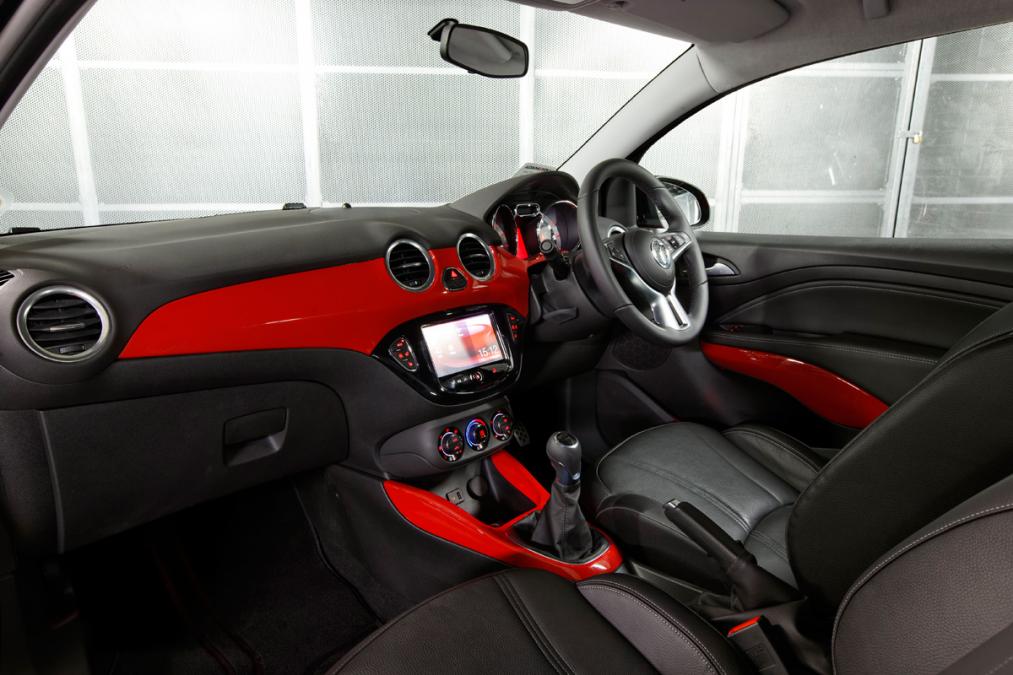
Climb aboard and it’s clear that Vauxhall has worked hard to create a classy atmosphere. From the slick dashboard to the high-quality materials, the Adam feels a cut above rivals like the DS 3. Highlights include the body-colour trim set into the dash, the chrome-ringed dials and the chunky leather steering wheel.

As with the exterior, the sky’s the limit when it comes to personalisation. There are 18 seat finishes to pick from, plus more than 20 trim insert colours and five options for the rooflining, including a ‘starlight’ version that uses 64 LEDs to create a sense of the sky at night.

Specs comprise Jam, Glam (for around £1,400 on top of the Jam) and Slam (which adds about £750 to the price of the Glam). The Adam Rocks is around £500 more than a Slam and has a broadly similar spec to that car, although climate control – standard from the Glam upwards – is an option. The Rocks comes as standard with manual air-conditioning, like the Jam.

As well as air-con, Jam models have a CD stereo with USB and aux-in connectivity, and controls mounted on the leather steering wheel, plus Bluetooth. They also get cruise control and a trip computer, plus ESP, ABS, a tyre pressure monitoring system, six airbags, 16-inch alloys and daytime running lights.

Glam trim builds on this with climate control, a fixed panoramic sunroof and DAB. Body-coloured door handles also set it apart, as does some chrome trim outside and on the door sills, while the daytime running lights and tail-lamps are upgraded to LED units.

Slam spec is mainly marked out by styling tweaks, with 17-inch alloys, sports suspension, a black roof and door mirrors, plus tinted rear windows. It also benefits from the Vauxhall OnStar connectivity package – this is featured on the Adam Rocks and Adam Rocks Air, too.

The higher-riding, crossover-style versions of the Adam get Morrocana seats and earthy interior trims, to hint at their rugged visual appeal on the outside. And the Adam Rocks Air is set apart from the Adam Rocks by its full-length fabric sunroof. The Air carries a premium of around £1,000 over the standard Rocks when specified with the 1.0 and 1.2-litre engines, but it isn’t quite so much extra with the 1.4-litre engine.

At the top of the range, the Adam S costs around £1,500 more than a 1.0i Adam Slam and has 18-inch wheels, a bodykit at the front, sides and rear, switchable ESP-plus and the brakes from a Corsa VXR. Buyers of this model can also specify figure-hugging Recaro sports seats.


You’ll have to pay extra for the IntelliLink seven-inch touchscreen infotainment system on all models. It’s not the most intuitive set-up, but it lets you upload various music and sat-nav apps, with the sort of swipe functionality you’d find on a smartphone.

Every Adam features a CD stereo with USB connectivity and an aux-in socket, but Glam models upwards get a six-speaker surround sound system with DAB radio. For the best in-car sound, an optional Infinity premium speaker set-up can be added to all versions.

Vauxhall hasn’t performed very well in the annual Auto Express Driver Power satisfaction survey in recent years. While it ranked an impressive 13th in the manufacturers’ chart in 2012, it’s since slid down the rankings. The brand was 26th in 2013, 29th in 2014 and 30th in 2015.

The Adam seemed to have gone against this trend initially, as it clearly impressed owners, ranking in an excellent 23rd place when it made its Driver Power debut in 2014. But it’s also endured a bit of a decline – in 2015, it finished in 90th place out of 200 cars.

Even so, the car achieved decent individual category scores for build quality (68th), handling (84th), ride (58th) and ease of driving (63rd), plus a superb 13th for in-car technology. What let it down was owners’ criticism of performance (167th) and practicality (179th).

The stylish Vauxhall shares most of its platform with the tried-and-tested Corsa, so buyers shouldn’t have to worry about durability.

A four-star Euro NCAP crash test rating will disappoint Vauxhall, but it was achieved during the much tougher 2013 tests, and the Adam beat the likes of the DS 3 with its individual percentage scores. All versions get six airbags, stability control and a speed limiter, although there’s no option to add safety technology such as autonomous emergency braking.
Posted by Unknown | File under :

The new Audi R8 represents a big improvement in most areas over a car that was already very good indeed. It’s lighter, faster, stiffer and more powerful than ever before. Yet at the same time it’s also more efficient and more economical, featuring one of the best cabins of any sports car, at any price. Shame it isn’t a touch more analogue in its responses, especially in the way it steers with the new Dynamic steering system fitted.

Lighter, stiffer, more powerful and faster than ever before, the new Audi R8 would appear – on paper at least – to be a much improved version of an already very good sports car.

There are two models that will hit UK roads at the end of this month, both featuring V10 engines – one with 532bhp, the other with 602bhp. The entry level version, known simply as the V10, costs £119,500, while the top notch V10 Plus model starts at £134,500.

Since its launch in 2007, the R8 has redefined what's possible in terms of dynamics and driver enjoyment while at the wheel of an Audi. Before the R8, fast Audis were always lacking somewhat in terms of emotion. In the eight years that have followed, however, Audis have got more exciting to drive across the board – the RS versions especially so. And this all-new R8 takes the game another big step in the right direction.

The headline advancements are many. The core chassis is stiffer and stronger thanks to its amalgam of carbon and aluminium. The four-wheel drive system is smarter and even more efficient, the engines produce more energy yet burn less fuel – despite the 5.2-litre block being fundamentally unchanged internally.

And then there's the new interior, complete with redesigned (and very excellent) digital dashboard featuring a new 12.3in TFT display. There’s a set of all-new seats, and an all-new Drive Select system, too.


Even the headlight mechanisms have been reengineered to incorporate Audi's optional laser light technology, meaning you will no longer be the brightest spark on the road if you specify the R8's standard LED lights (which happen to work quite brilliantly anyway).

There is no V8 model this time round, Audi instead choosing to distinguish between the top and mid level versions by giving the V10 Plus more kit as standard inside, more power and torque, and more flexibility on the move thanks to its new Performance Mode.

So, not only is there Dynamic Drive on both models, in which you can switch between Comfort, Auto, Dynamic and Individual, but in the Plus model the driver can also select between Wet, Dry and Snow settings to tailor the mapping of the engine, transmission and stability control depending on how confident they are feeling, or what the conditions are like underfoot.


There’s even a button that opens up the exhaust system which, when in sport mode, produces the requisite crackles and bangs on the overrun. To begin with, this seems like another fantastic new R8 feature, but once you realise that it emits the exact same burst of crackles, every time you back away from the throttle, it does feel a touch digitised.
 
The steering is electro-hydraulic on both models, but you can also opt for a new variable ratio Dynamic rack for an additional £1,200, which quickens the response as more lock is applied. The car we drove had this equipped, and to be honest we wished we’d been able to try a new R8 with regular steering. Actually, the steering was just about the only aspect of the car that didn't quite hit the bullseye.


There is accuracy and precision by the bucketload to the R8’s new Dynamic steering, but little in the way of feel. So you trust that the front tyres are going to go where you aim them purely by using your eyes. Your hands and fingertips, on the other hand, receive far less information, and for a car as fast and focused as this, that has to go down as a minor disappointment.

Elsewhere, the new R8 is hard – if not impossible to fault, even if it does lack the last tenth of raw excitement that other cars in this class now offer, most specifically the McLaren 570S. The engine is an absolute peach, a classic atmospheric V10 that revs all the way to 8,250rpm. It sounds delicious while doing so, and has an immediacy of response to its throttle that no turbocharged engine could ever replicate.


The seven-speed dual clutch gearbox also works quite brilliantly in conjunction with the V10 engine, delivering up or downshifts faster than you could ever manage manually, and with an increasing level of gusto depending on which drive mode you’ve selected.

And as for the handling, body control, grip and traction – the new R8 displays so much composure everywhere, wet or dry. In fact, it feels a lot like it’s on rails most of the time. On the road, its limits are way beyond what any sane driver would ever expect to reach. Which is either a very good thing if that’s what turns you on, or a touch beige if you want a bit more edge and excitement.


Key specs

  • Price: £119,500 (V10); £134,500. (V10 Plus)
  • Engine: 5.2-litre V10
  • Transmission: Seven-speed S tronic auto, four-wheel drive
  • Power/torque: 602bhp/560Nm
  • 0-62mph: 3.2 seconds
  • Top speed: 205mph
  • Economy/CO2: 23.0mpg/287g/km