Kamis, 10 Maret 2016

Posted by Unknown | File under :

Adding the 1.5-litre diesel to the Mazda 3 range delivers a mixed bag of results. It’s not very quick, but some buyers will be happy to sacrifice power for lower CO2 emissions. However, specifying an auto box undoes some of the engine’s good work, while it’s pricey in Sport Nav trim. This engine makes more sense with a manual gearbox, as it dips below the 100g/km emissions barrier.

Until now, the only diesel you could specify in the Mazda 3 was the powerful 2.2-litre borrowed from the larger 6 saloon. While that engine delivered decent punch and economy, CO2 emissions of over 100g/km put it at a disadvantage against rivals. Now, though, the diesel line-up has expanded to include the smaller 1.5-litre, which was first introduced in the Mazda 2 supermini.


The new unit is available across the range, including in the well equipped Sport Nav flagship model tested here. The only visual clue to the smaller engine is that one of the holes in the rear bumper has been blanked off as there’s only one exhaust pipe; the 2.2 has a twin-exhaust set-up.

Fire it up, and while there’s a familiar diesel rattle, it’s well isolated from the cabin – and when the engine’s warm, you could easily mistake it for a petrol. It gets a bit more vocal under hard revs, but there’s enough sound insulation to ensure it’s never intrusive. With 104bhp, the 1.5 is slightly down on power compared to rivals like the Vauxhall Astra 1.6 CDTi and VW Golf 1.6 TDI (both with 109bhp), but it does have 270Nm of torque to help it along.


Combine this with the Japanese brand’s weight-saving measures, and the 3 is a reasonable performer off the line. However, the six-speed automatic box in our car is rather sluggish on upshifts, which blunts performance somewhat. It’s quicker to change down. And while there are steering wheel-mounted paddles, the crisp-shifting manual gearbox is far nicer to use.

One obvious difference between the 1.5-litre diesel and the 2.2 is the smaller unit’s lack of in-gear punch. It’s not great for overtaking, yet the reduced power means you can revel in trying to maintain momentum by carrying as much speed in corners as the Mazda’s agile chassis will allow.


Of course, you’ll save money with the smaller engine, but adding the auto box cancels out some of the benefits, as it bumps CO2 emissions up from 99g/km to 114g/km. That places the car in the 20 per cent Benefit in Kind band for business users, which is only three per cent behind the better 2.2-litre auto. If you need a  self-shifter, that’s the one we’d go for.


Key specs

  • Model: Mazda 3 1.5D Sport Nav auto
  • Price: £23,145
  • Engine: 1.5-litre 4cyl diesel
  • Power: 104bhp
  • Transmission: Six-speed auto, front-wheel drive
  • 0-62mph: 11.6 seconds
  • Top speed: 113mph
  • Economy/CO2: 64.2mpg/114g/km

Rabu, 09 Maret 2016

Posted by Unknown | File under :

The new Infiniti Q30 can’t match competitors such as the Audi A3 for quality, driving dynamics or low emissions, but it’s certainly worth a second look. The bold styling allows it to stand out from the crowd, while a supple ride and decent refinement make it extremely easy to live with. This all-wheel-drive model is expensive to buy, but the lower-specification, two-wheel-drive SE and Premium versions are cheaper and represent decent value.

Infiniti’s currently a bit player in the UK, but it’s hoping to hit the big time with its latest arrival, the Q30. Pitched squarely at the lucrative premium compact hatch class, the newcomer aims to blend style, quality and low running costs into one desirable, British-built package.

Yet while this is Infiniti’s first attempt at a family hatch, it won’t be a complete leap into the unknown. That’s because the Q30 uses Mercedes A-Class underpinnings. We’ve tried the car on European roads, but now we’ve driven a 2.2d Premium Tech AWD DCT to see how it measures up in the UK.


While the Q30 is a Mercedes under the skin, externally it’s pure Infiniti. Featuring a bold mix of curves and creases, plus a subtly raised height, it looks like nothing else in the class. Its daring design won’t be to all tastes, but it attracts plenty of attention.

Inside, the Q30 is far more conventional, and it doesn’t take long before you spot the Mercedes hand-me-downs. The steering wheel, dials, ventilation controls and minor switchgear are all A-Class, as is the key. And while most materials are of a high quality, the cabin doesn’t look or feel as upmarket as an Audi A3’s. Still, there’s decent space and a roomy 430-litre luggage area.

Mercedes’ help extends to the use of its tried-and-tested 2.1-litre diesel. Excellent insulation and sound-cancellation software that uses the car’s stereo speakers mean the four-cylinder unit is subdued at idle and doesn’t intrude when extended.


With 168bhp on tap, performance is brisk (Infiniti claims 0-62mph in 8.5 seconds), but the Q30 trails rivals such as the BMW 120d. However, the combination of 350Nm of torque and a seamless seven-speed twin-clutch gearbox (a first for Infiniti) means the newcomer covers ground deceptively fast.

Even so, this refined car is at its best when taking it easy. The suspension has been tuned for comfort, so the Q30 does a good job of soaking up bumps, with only the occasional pothole upsetting its composure. Wind and road noise is well suppressed, too, while the engine settles down to a barely audible hum at a cruise.


The Q30 also makes a decent fist of corners. Its steering lacks any real feel, but it’s precise and the Infiniti clings on gamely through bends, thanks in part to this model’s electronically controlled four-wheel-drive system. It’s not as engaging as a BMW 1 Series, but it’s composed and capable.

At £31,180, our Premium Tech trim test car isn’t cheap, while its CO2 emissions trail those of the class leaders. On the plus side, it’s well equipped; you get powered and heated seats, climate control, lane-departure warning and a reversing camera as standard. Opt for the two-wheel-drive version to save £1,550 and cut CO2 emissions to 116g/km.


Key specs

  • Model: Infiniti Q30 2.2d Premium Tech AWD DCT
  • Price: £31,180
  • Engine: 2.2-litre 4cyl turbodiesel
  • Power: 168bhp
  • Torque: 350Nm
  • Transmission: Seven-speed twin-clutch auto, four-wheel drive
  • 0-62mph: 8.5 seconds
  • Top speed: 134mph
  • Economy: 57.6mpg
  • CO2: 127g/km
Posted by Unknown | File under :

The facelifted SEAT Ibiza is stylish and good to drive. It also shares its mechanicals with the excellent Volkswagen Polo. The SEAT Ibiza has always been one of the most fun choices in the supermini market, and the latest version upholds this reputation by delivering a more engaging driving experience than its small car cousins from the VW Group, the Volkswagen Polo and the Skoda Fabia.

In terms of price, the Ibiza sits between the Fabia and Polo, and it offers lots of standard equipment for the money. Add those stylish looks, as well as nimble handling, and the car makes lots of sense in the showroom.

The Ibiza isn’t quite as practical as the best models in this class, largely thanks to the rakish roofline, while there are some question marks over its reliability record. But it’s still an appealing supermini choice.

The SEAT Ibiza shares its underpinnings with the Volkswagen Polo, so it carries over most of its mechanical parts from one of the best superminis currently on sale. As part of a recent facelift, the company has tweaked the suspension and dampers, while also carrying out big changes inside, bringing the car bang up to date.

What SEAT hasn’t done is change the exterior styling much, so where the Polo has gone for subtle, classy looks, the Ibiza still provides a dash of Latin flair – after all, it was designed by the former head of design at Lamborghini.

The hatchback is a rival to the likes of the Peugeot 208 and Ford Fiesta, and is available as a five-door or a three-door. The latter is a more stylish choice, and SEAT prefers to refer to it as a ‘sports coupe’, so it’s badged the Ibiza SC. Meanwhile, if you need more room than the five-door hatch provides, there’s also a spacious ST estate version.

SEAT offers six trim levels across the Ibiza range, kicking off with the basic E, which is a three-door SC with a single engine option. From there, buyers can move up through S A/C to mid-range SE spec, and the Vista and Connect versions.

There’s a sporty FR model, although buyers wanting even more performance have the option of the 178bhp Ibiza Cupra, which is available as either a three or five-door.


The entry-level SEAT Ibiza E does without features such as alloy wheels, but you do get a five-inch (black and white) touchscreen, a USB port and four-speaker stereo. Move up to an S A/C, and alloys remain on the options list, but air-conditioning and a DAB radio are welcome additions, while you also get steering wheel controls for the stereo and Bluetooth streaming.

Alloy wheels arrive with SE spec, as does an upgraded colour touchscreen system. Connect editions bring Internet connectivity, MirrorLink and Apple CarPlay among a feast of infotainment upgrades. The FR package adds sports suspension and a wealth of racy trim enhancements inside and out.

As well as head-turning looks and good value, the latest SEAT Ibiza comes with a new line-up of petrol and diesel engines sourced from the wider VW Group. A new batch of 1.0-litre three-cylinder petrol engines has been added, while the 1.4-litre diesels now claim even stronger efficiency.

Although it is so closely related to the Volkswagen Polo, the Ibiza is built at SEAT’s own factory in Martorell, near Barcelona.

While it's not as sharp as the Ford Fiesta, the SEAT Ibiza is more engaging to drive than the Volkswagen Polo on which it’s based. It's nimble around town and equally capable on the open road.

Some buyers will find the suspension a little harsh, but SEAT tweaked it as part of the update to the range in 2015 in a bid to take the edge off. Even so, buyers who prefer a softer ride may be better to opt for the Polo.

The driving position in the SEAT Ibiza is excellent, adding to the sense of involvement behind the wheel. And no matter which model you go for, there's not much body roll in corners, while the steering is quick. If only it provided a little more feedback.

The Ibiza comes with a five or six-speed manual gearbox, depending on the engine size. There’s also an automatic option, in the shape of the seven-speed twin-clutch DSG system sourced from Volkswagen.


The biggest change to the way the latest Ibiza feels on the road is what's under the bonnet. And the 94bhp EcoTSI turbo version of the new 1.0-litre three-cylinder petrol engine offers the best compromise in terms of performance and economy.

The combination of the refined engine and softer suspension means the SEAT supermini covers ground with far more poise than it did before. The five-speed manual gearbox is short and snappy, while power from the engine builds progressively. With a useful 160Nm of torque, it delivers a 0-62mph time of 10.4 seconds and a 119mph top speed.

Kicking off the petrol range is a 74bhp 1.0-litre, which claims 0-62mph in 14.3 seconds and a top speed of 107mph. Sporty FR models can be specced with a 109bhp version of the same engine, but here it delivers 200Nm of torque and is hooked up to the DSG gearbox. The result is 0-62mph in 9.3 seconds and a 122mph maximum.

Next up is the four-cylinder petrol 1.2-litre. It’s available with 89bhp or 109bhp in the FR model, and claims 0-62mph in 10.7 seconds or 9.1 seconds respectively, as well as top speeds of 114mph or 122mph.

If you want a petrol model that goes faster, you need the four-cylinder 1.4-litre EcoTSI FR. This offers 148bhp and 250Nm of torque, which is enough for a 7.6-second 0-62mph time and a 137mph top speed.

There’s only a single diesel engine in the Ibiza, but the 1.4-litre TDI is offered with 74bhp, 89bhp or 104bhp. The entry-level version is available in standard or Ecomotive guise, with the latter tuned for fuel economy rather than pace – it takes 13 seconds to cover 0-62mph. The most powerful TDI powers the fastest diesel Ibiza FR, delivers 250Nm of torque and promises 0-62mph in 9.9 seconds and a 119mph top speed.


SEAT has a reputation for building good-value cars, and the Ibiza is no exception. It comes with a decent level of kit, and all the engines should prove easy on the wallet, too.

The new 74bhp three-cylinder 1.4-litre TDI Ecomotive diesel is the most efficient model in the Ibiza range, as it claims 83.1mpg fuel economy, as well as CO2 emissions of 88g/km. The same engine is also available with 89bhp – albeit exclusively linked to a DSG automatic box in the FR version of the Ibiza ST estate – and 104bhp, and both versions promise decent fuel returns of 76mpg-plus. The higher-powered diesels’ respective 99g/km and 95g/km emissions mean free road tax, too.

With petrol power, the Ibiza isn’t as efficient, but fuel economy is still very good, and the new three-cylinder engines make the car far more enjoyable to drive. The 94bhp 1.0-litre EcoTSI claims 68.9mpg and is the only petrol Ibiza to be exempt from road tax, thanks to its 94g/km emissions.

The lesser 74bhp 1.0-litre 12V has official figures of 54.3mpg and 118g/km, while the 109bhp 1.0-litre EcoTSI DSG in the FR claims 64.2mpg and 102g/km.

The four-cylinder 1.2-litre TSI promises 57.6mpg in 89bhp guise and 54.3mpg with 109bhp. CO2 emissions mean both versions sit in VED band C, so owners will pay £30 a year for road tax.

The fastest 148bhp 1.4-litre EcoTSI petrol still claims decent 58.9mpg fuel economy, along with moderate 110g/km emissions, so it sits in VED band B (£20 a year).


The SEAT Ibiza was already a sharp-looking supermini, so the revamp to the range carried out in 2015 – which brought LED daytime running lights and more personalisation options – is enough to keep it up to date. Thanks to its short overhangs, subtle body creases and angular headlamps, this is still one of the most stylish superminis around, despite its age.

Not surprisingly for a VW Group car, the SEAT Ibiza is well screwed together inside, with decent-quality plastics used throughout. But still, the interior was one of the areas SEAT focused on with the update.

The layout is now modern and clean, with a new colour touchscreen replacing the previous model’s array of buttons and dials. The instrument display is also attractive and clear, with white-on-black dials, and the round vents help to give the cabin a sporty feel.

SEAT has a tradition of allowing customers to make a bold style statement through vivid colour and trim choices, and the latest Ibiza doesn’t disappoint. New Colour Packs bring ‘colour-coded’ shades such as purple, blue, red or grey to the radiator grille rim and wing mirror housings, as well as to the interior vent bezels and detailing on the steering wheel and gearlever. You can even specify twin-colour 16-inch or 17-inch alloy wheels.

In the new Ibiza, SEAT has fitted the second generation of its Easy Connect infotainment set-up. With the MediaSystem plus, you can upgrade to MirrorLink and integrate your smartphone; the technology is compatible with Android Auto and Apple CarPlay.

DAB radio is available, and you can play music via USB or Bluetooth connections. MediaSystem plus also adds voice control.

In addition, there’s the chance to upgrade to the SEAT Sound System; in the Ibiza, this brings six speakers, a bass box in the boot and an extra amplifier.


Despite the addition of two extra doors, there isn't much difference in terms of space between the three-door SEAT Ibiza SC and the standard five-door Ibiza hatch. But if you need more room, the Ibiza ST estate is a practical option that retains its sense of style.

Space up front for the driver and passenger is decent, but the Ibiza is not one of the class leaders on the practicality front – even the glovebox and door pockets seem a little on the cramped side.

The dimensions tell you a lot about why the SEAT Ibiza trails some rivals on interior space. Perhaps surprisingly, at 4,061mm it’s longer than its Skoda Fabia sister car. It’s a little narrower than the Fabia and the Hyundai i20, but it’s the height that really gives the game away. The sleek-looking SEAT has a roof height of 1,445mm, while the Hyundai and Skoda stand taller at 1,474mm and 1,467mm respectively. 

There’s a price to be paid for the Ibiza’s rakish roofline. Even in five-door guise, adults will find the back seats cramped, so if you really need to carry passengers any significant distance, you’ll be better off looking at cars like the Hyundai i20 or the Skoda Fabia.

The problem is exacerbated in the three-door SC because it’s pretty awkward to get into the back seats in the first place. Once you’re there, the main issue is the limited headroom, so this criticism will be less relevant to those with young families. Isofix child seat mountings are standard.

With the rear seats in place, the SEAT Ibiza SC has a boot capacity of 284 litres, which is only marginally less than the 292 litres in the five-door. When you fold the seats, as both versions serve up the same 847-litre maximum space.

This is about average for the supermini class, and will be fine for day-to-day tasks. But if you want even more room, the Ibiza ST estate offers 430 litres of space with its rear bench in place, and 1,164 litres when it’s folded.


The SEAT Ibiza scored the maximum five stars when it was crash tested by the experts at Euro NCAP in 2011, and it features an array of standard safety kit, including front and side airbags (six in total), as well as stability control.

Options include city brake assist and lane-keeping assist, and the recent facelift has also seen the introduction of a Tiredness Recognition System designed to spot the signs if drivers are nodding off at the wheel and sound an alarm. Another new addition is Multi-Collision Brake, which automatically slows the car following an impact serious enough to activate the airbag – it works by setting the ESP system to apply the brakes.

In our Driver Power 2015 satisfaction survey, SEAT can at least say it’s on an upward journey. It finished 15th out of 32 manufacturers, which is a definite step in the right direction from its 24th place in 2014 and disappointing 27th in 2013. There’s still room for improvement considering sister company Skoda came third in 2015, but by the same token Volkswagen slipped to 22nd.

Judged on reliability alone, the SEAT brand fared less well – owners ranked the brand in 19th place, while Skoda came seventh and Volkswagen 27th. The latest Ibiza hasn’t been included in the results, as it was too new when the survey closed. But the improvements are no doubt down to the radical overhaul SEAT has carried out to its product line-up in recent years, and the supermini should be one of its stronger performers going forward.

SEAT’s standard three-year/60,000-mile factory warranty doesn’t look all that generous when compared with the seven-year/100,000-mile package offered on the Kia Rio or the five-year/unlimited mileage warranty that comes with the Hyundai i20. You can extend the Ibiza’s warranty to five years and 90,000 miles, but it will cost you.

SEAT still insists on 10,000-mile service intervals for the Ibiza, although a fixed-price maintenance package is available. This provides two or three years of cover for a fixed monthly charge of £19.99. 

Minggu, 06 Maret 2016

Posted by Unknown | File under :

Even with this refresh, the Toyota RAV4 remains a car you’d buy with your head rather than your heart. It’s competent, efficient, spacious and better looking than before, but unlike the engaging Mazda CX-5 and distinctive Renault Kadjar, this SUV leaves you slightly cold thanks to its uninspiring cabin and merely average dynamics. Still, it will continue to appeal as a sensible, reliable and roomy choice in this class.

Toyota’s venerable RAV4 has been revamped for 2016, and the range now includes a petrol-electric model. We tested the hybrid SUV, but what’s life like with a more conventional diesel?

The brand has chucked out the gruff old 2.2-litre D-4D engine and bumped up the power of the existing 2.0-litre diesel from 124bhp to 141bhp. It’s not much, but it’s enough to match the 2.2’s 0-62mph sprint time of 9.6 seconds. The engine has adequate low-down grunt; it just never feels fast. Revving doesn’t add much pace and it becomes vocal.


It’s better at a cruise, but a Mazda CX-5 diesel is a lot more refined, smoother and quicker. At least the Toyota’s official economy figure of 60.1mpg is competitive – and over 10mpg better than the 2.2-litre’s.

The RAV4 is decent to drive. Although the ride is firm in town, there’s plenty of grip and body roll is kept in check. It’s capable enough, but a CX-5 is more involving and a Renault Kadjar more cosseting. Wind noise is noticeable at motorway speeds, too.

The fresh exterior look – in particular the sharp front end – helps the Toyota appear less generic than before. However, it’s best described as ‘functional’ inside; while everything is solid to the touch, it’s dark and uninspiring to look at. Our mid-spec Icon model has smart metal-effect trim and a leather-look dash panel, although it’s not going to win any awards for design.


You get lots of kit as standard, including sat-nav, LED headlights, dual-zone climate control and an electric bootlid. Buyers will also appreciate the space on offer, as the RAV4 is one of the biggest cars in its class. There’s loads of room for four adults and five at a push, while the boot is big enough and has a very low loading lip.


Key specs

  • Model: Toyota RAV4 2.0 D-4D Icon
  • Price: £26,995
  • Engine: 2.0-litre 4cyl diesel
  • Power: 141bhp
  • Transmission: Six-speed manual, front wheel drive
  • 0-62mph: 9.6 seconds
  • Top speed: 121mph
  • Economy: 60.1mpg
  • CO2: 124g/km
 

Sabtu, 05 Maret 2016

Posted by Unknown | File under :

Does the car world need another premium brand? Hyundai seems to think so, having announced late last year that Genesis would become a go-it-alone marque to mirror, for example, Lexus’ relationship with Toyota.

Six new models are planned by 2020, and the first of these is the G90, ostensibly an alternative to the Mercedes S-Class that will be sold in markets such as the US, Russia, China and the Middle East.

So what can we expect from the newly conceived Genesis? We got our first early taste in a brief drive of a Korean-spec G90 on the roads around the South Korean capital, Seoul.

From the outside, the car cuts quite an imposing figure. A large hexagonal grille dominates the front end, while a long bonnet, tall shoulder line and beefy rear haunches give it a look that blends a degree of elegance with a suggestion of athleticism.

The new brand’s winged badge sits atop the grille; from a distance you’d be forgiven for thinking it had taken some ‘inspiration’ from Aston Martin’s.


At 5,205mm, the G90 is longer than the Mercedes S-Class (5,116mm in short-wheelbase form), and it’s wider too (1,915mm vs 1,899mm). Both are the same height (1,496mm). It’s a properly large car, then, but it carries its size well, and certainly in a less gaudy fashion than its Hyundai Equus predecessor.

Inside, it’s upped its game, too – it’s certainly the most convincing ‘posh’ cabin from Hyundai yet. It’s impeccably built and features a mixture of leather trim with contrast stitching, real wood and polished aluminium inserts. There is undoubtedly more of a genuine premium feel than in some of the wannabe interiors we have seen on previous ‘upmarket’ Korean cars.


A 12.3 inch high-definition touchscreen dominates the dashboard, while at the rear there is more passenger space than in the Equus it replaces thanks to a 4.5-inch increase in the wheelbase. Rear occupants are also well catered for with individual screens and reclining seats.

There’s all the equipment you could feasibly want, although Hyundai R and D chief  Woong-chul Yang told us all Genesis cars will be “honestly” specced to keep costs down. He explained: “On some premium cars, manufacturers include unnecessary tech. Some things are put in that are never used. We won’t put stuff in that is expensive simply because it is a premium car”.

Three engines are available – a  307bhp 3.8-litre V6, a 360bhp twin-turbo 3.3-litre V6, and a 414bhp direct-injection 5.0 V8. It was the V8 we tried on our brief drive, paired with an eight-speed automatic gearbox and the optional H-Trac all-wheel drive.


As you would expect, the overriding impression is of refinement. The Genesis makes swift, comfortable progress although occasionally there was a hint of engine and wind noise filtering into the cabin.

0-60mph is a claimed 5.7 seconds with the V8, and it certainly felt capable of that, although flooring the throttle saw the gearbox occasionally struggling to keep up.

Four driving modes are available – Sport, Eco, Smart and Individual – although Sport is the only one where there’s a discernible difference. The steering weights up and the soft-ish ride got noticeably firmer, with imperfections on the road surface much more obvious.


We only got a limited opportunity to give the Genesis a workout on back roads. While it was clear the all-wheel drive gave decent grip, there was noticeable body roll in corners – although that’s unlikely to be too much of a concern for the G90’s target buyers.

Judging by the amount of Equus and Genesis drivers we saw in Seoul, there’s a big appetite for the comfort and kit these models deliver – and the G90 offers more of the same in a superior all-round package that’s moving ever closer to what European rivals can offer. Whether that translates into European sales success for the brand in future remains to be seen. 

Jumat, 04 Maret 2016

Posted by Unknown | File under :

The Mercedes S-Class is the ultimate luxury limo and a fantastic showcase for cutting-edge technology. There are fewer relaxing experiences than driving an S-Class - the only thing that can top it is if you're in the back seat, being chauffeured. Vibrations through the pedals and steering wheel are non-existent, and even at motorway speeds you won’t hear any wind or tyre roar.

All the engines are fantastic, but it’s amazing that Mercedes can offer a diesel-electric hybrid offering more than 60mpg, and even the standard V6 diesel returns 50mpg. For the ultimate in speed there are high-performance S63 V8 or S65 V12 AMG versions, or if you want an S-Class that emits less CO2 than a Toyota Prius there’s the S500 Plug-in Hybrid.

In short, the Mercedes S-Class has set the standard for luxury and cutting-edge technology for over 40 years - and the latest sixth-generation car is the best yet.

Our Choice: 
Mercedes S350d L AMG Line.
Until the mid-1990s it was famously the case that money was no object when Mercedes engineers developed successive generations of its flagship S-Class saloon.

Even after Daimler and Chrysler amalgamated in the late-1990s and the bean-counters reigned in their ‘over-spending’ engineers, the flagship Mercedes S-Class has remained at the pinnacle of automotive engineering technology. Each new model has introduced ground-breaking systems that have cascaded down into lesser models as they become more affordable.

The tech highlights of this latest model include Magic Body Control that uses cameras to scan the road ahead for undulations and potholes, then adjusts the suspension to suit. There’s also a new high-definition TFT display as part of the instrument cluster, and a highly advanced Driving Assistance package that keeps the car in its lane and in train with the vehicle ahead when in cruise control mode.

While the latest S-Class continues to showcase the brand’s hi-tech developments, sleek new looks means the Mercedes S-Class is more desirable than ever, plus it has benefitted from a completely overhauled cabin design.

With a range of powertrains, options and finishes, it’s a package that competes with cars such as the Audi A8 and BMW 7 Series at one end of the scale, and the Rolls-Royce Ghost at the other.
Under the bonnet, the S-Class is available with 3-litre V6 diesel power in the S350, or a 5.0-litre V8 petrol engine in the S500.

There's also a trio of greener options, namely the S300 which is a 2.2-litre 4-cylinder diesel hybrid with a small electric motor, the S400 h which is the 3.5-litre petrol-powered hybrid equivalent, and the S500 e which is a 3.0 V6 petrol-powered ‘plug-in’ hybrid.


The 6.0-litre V12 of the S 600 is also available if you’re feeling particularly plutocratic, while the Mercedes-AMG S63 and S65 models are monstrously powerful 5.5-litre V8 and 6.0-litre V12 machines honed by Merc’s motorsports division.

Trim levels are relatively straightforward, including an SE ‘standard’ spec and a more dynamic-looking AMG Line. There’s an Executive spec package bringing more luxury features for rear passengers, along with a host of additional upgrades and bespoke trim options as befits a flagship Mercedes model.

Even ‘standard’ SE models are pretty lavishly equipped though, with LED headlights, air suspension, sat-nav and full leather upholstery all included. AMG Line cars get more aggressive body kits and larger 19-inch alloy wheels outside, and alloy pedals and AMG logos among the highlights inside.

Despite its focus on luxury and refinement, the S-Class is still one of the most engaging executive limousines on the market. Standard air suspension gives a wonderfully cushioned ride, while buyers wanting even sharper driving dynamics can opt for the £4,340 Magic Body Control system, which reads the road ahead and adjusts the car's set-up accordingly.

There’s barely any wind or road noise, while the standard air-suspension effortlessly smooths out bumps – although the 19-inch wheels can crash into potholes.

Yet this comfort doesn’t come at the expense of agility. The steering is quick and well weighted, plus there’s lots of grip. Selecting Sport mode stiffens the standard adaptive dampers to reduce body roll.
On the road, the new S-Class doesn’t feel as urgent as the Audi A8, but it still packs plenty of overtaking punch across the spectrum of powertrains. The brakes are strong, too, with a positive and progressive pedal feel.

Charge it up for two hours through a household socket, and driving the S500 Plug-in on electric power is one of the quietest and most refined experiences anywhere. But flex your right foot and the V6 engine wakes up to deliver effortless overtaking power when you need it.

The high-power AMG models give this limo supercar-rivalling performance. They come in long-wheelbase form only, and while they're not the last word in sharp handling, you'll be surprised by how well they corner considering the car's sheer size.

The S350 diesel will make up the majority of S-Class sales, and it's our pick of the range, thanks to its super smooth and quiet engine combined with seriously quick in-gear acceleration that proves refinement doesn’t come at the expense of performance.

Despite a hefty 1,975kg weight and the seamless seven-speed automatic box’s lengthy gears, 0-60mph takes just 6.8 seconds for the S350 but it genuinely feels much faster than that.

The other diesel option is the S300 BlueTEC hybrid, which combines a frugal four-cylinder diesel and electric motor to blend the effortless performance limousine buyers expect with supermini running costs.


The S300 hybrid nudges just over 2,000kg due to the added weight of the battery but performance is still brisk, hitting 0-62mph in 7.6 seconds. While its real-world performance is impressively punchy, the S300’s hybrid system can’t run in electric-only mode for long, and even a small squeeze on the throttle pedal will cause the diesel engine to rumble into life.

If you can stretch to it, the S500 Plug-in is a remarkable machine, letting you travel up to 20 miles on electric power alone before the 3.0-litre twin-turbo V6 cuts in. With both power sources working together, performance is almost on a par with the V8-powered S500. The hybrid does 0-62mph in 5.2 seconds, while the V8 powered car knocks it off in 4.8.

If you want a limousine with real supercar credentials, the AMG S63 has a twin-turbo V8 and can manage 0-62mph in 4.4 seconds, while the V12 twin-turbo S65 is a tenth of a second faster.

With prices starting in excess of £65,000, the S-Class isn’t exactly cheap to buy and if you get a bit friendly with the options list, the price can rise to well over £100,000. However, despite the price tag the S-Class won’t cost you the earth to run.

The S300 BlueTEC Hybrid boasts fuel economy of 61.4mpg and CO2 emissions of 120g/km. However, the frugal diesel hybrid plays second-fiddle to the S500 Plug-in Hybrid, which returns 100.9mpg and 65g/km under the official testing regime.

Depending on how you use it, of course, those figures could be much higher – or indeed lower. For example if your commute is less than 20 miles and you’ve somewhere to charge the car at either end, you can get to work and back without needing a drop of fuel. Use it for longer journeys though and the economy will plummet, especially if you delve into the available performance.

Offering the best blend of economy, performance and price is the S350 BlueTEC, which feels seriously quick while still emitting just 146g/km. The new S63 AMG is more efficient than ever, but still only manages a meagre 27mpg combined as a consequence of its enormous power and two-tonne bulk, even though it does have a carbonfibre boot liner as a nod to weight-saving.


Externally, the S-Class benefits from imposing styling with neat design details. Yet despite its vast external dimensions, the Mercedes disguises its bulk well thanks to its sweeping roofline and carefully sculpted lines cut into the flanks.

A bold grille, topped by the brand’s trademark three-pointed star, swept-back all-LED headlamps and tastefully applied chrome trim add a dash of glamour, while AMG Line trim brings racy looking 19-inch alloy wheels and a subtle bodykit.

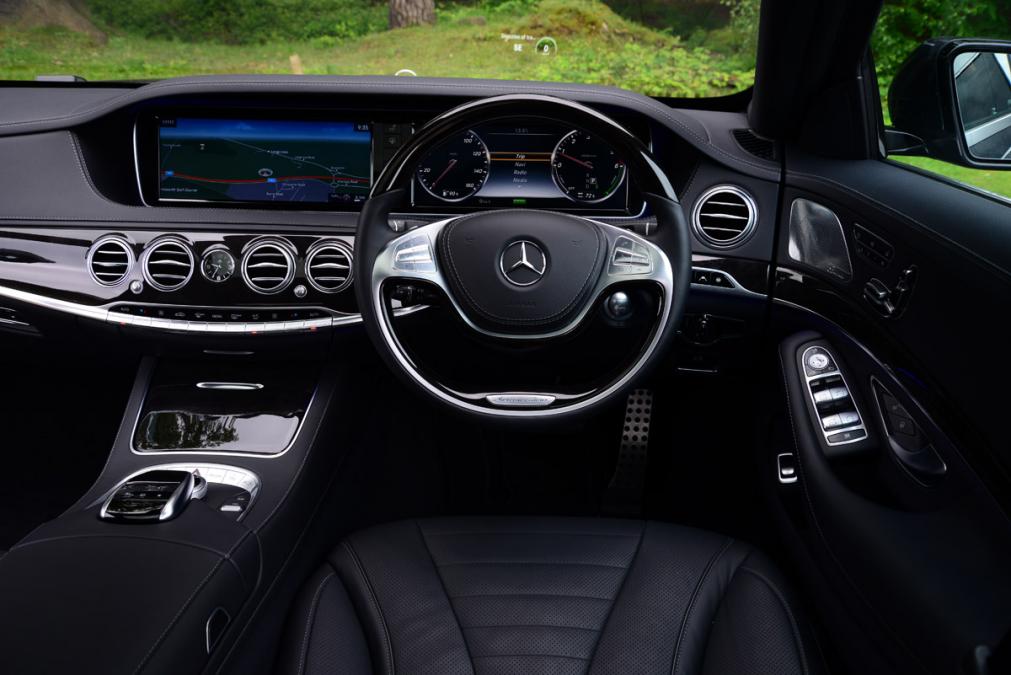
The Mercedes’ interior is even more impressive as it’s beautifully built, supremely comfortable and plushly appointed. The wide dashboard features a pair of 12.3-inch TFT screens – one for the sat-nav, infotainment and energy use, the other for the speedo, rev counter, trip computer and optional night vision display.

Other highlights include the metal-finish eyeball vents for the air-conditioning, the precise action of the switchgear and the intuitive COMAND rotary controller.

As you’d expect, the fit and finish is flawless, while the materials are all top-notch. Lustrous Black Poplar wood trim covers the dashboard, centre console, door trims and steering wheel, plus there's a £1,740 soft Nappa leather trim option for lower spec cars.

As you’d expect, quality is the watchword for the S-Class infotainment systems.

All models come with the 12.3-inch high definition screen, sat-nav, digital radio and single CD/DVD drive as part of the COMAND Online system.

You also get Bluetooth and a WLAN hotspot facility, but if you want to use Facebook and various on-board apps via the Connect Me package you’ll need to tick an option box. Other options include a rear seat entertainment system with a pair of 10-inch screens, and of course a TV tuner.

If you really want to push the boat out on the audio front, try the Burmester high-end 3D Surround Sound System which has 24 speakers, a 24 channel amplifier and a total output of 1,540 watts.

It’s hard to imagine a car that’s actually more comfortable than a Mercedes S-Class, although more rarefied brands like Rolls-Royce and Bentley can provide a more genuinely bespoke luxury feel.

But for comfort the big Merc is near peerless, with superlative on-road refinement, a silken ride quality, a living-room-sized cabin with superlative seats that will even massage you if required, plus fabulous entertainment systems and internet connectivity so driver and passengers want for nothing.

If you have to drive it yourself, then an array of sensors and cameras take care of close quarter manoeuvres in town, while out on the road you can let the clever cruise control and other aids share the load.

The S-Class in standard length is 5,116mm long, but there’s a long-wheelbase version with a 13cms extension in the rear passenger compartment. That said, unless you’re after the best-selling S350d you can’t pick and choose, so which body you get depends on the model. Apart from the S350d, only the AMG S63 and S65 come with the shorter body, so all the other versions come in the L guise.

In case you are compelled to have the biggest car in the car park, it’s worth noting that the S-Class in standard length is 15cms shorter than an Audi A8, and 28cms shorter than a Rolls-Royce Ghost. It beats the BMW 7-Series by 4cms though.

Given the S-Class’s luxury car status, it’s no surprise to find most of the space in the cabin is reserved for rear seat passengers. There’s a trio of three-point belts for the rear bench, but most buyers will treat this car as a four-seater, and Mercedes offers an optional two-seater rear seating set-up for even more luxury.

Rear head and legroom is generous, while the £4,335 Executive Rear Package adds a reclining function, powered blinds for the side and rear windows and ventilation for the seats. There’s also plenty of storage space, including the fold-down rear armrest that includes a pair of cup-holders and neat lidded cubby, while fold-out tables make the car the perfect office space.

The Mercedes features a useful 510-litre boot – although the optional £1,130 fridge compartment reduces capacity by 40 litres. Without it, the Merc’s luggage space is a little bigger than the Rolls’ and BMW’s, and matches the Audi’s exactly.


Mercedes has forged a strong reputation for building durable cars, and this is backed by an impressive 11th place in our Driver Power 2015 satisfaction survey, although the brand has dropped a place since 2014.

More worryingly perhaps, at least as part of a bigger picture, is the manufacturer’s score for reliability alone, which is rumbling along at 26th out of 30-odd contenders.

For build quality, the Mercedes brand is rated 10th. Not bad, but worth noting Lexus, Jaguar, Porsche, Audi, BMW and Volvo are all luxury or premium brands that do better. Skoda, Honda and Subaru are not luxury brands, and they score better too.

It’s the lesser Mercs that seem to be letting the side down though, so we’d be amazed to hear of anyone picking fault with the build quality of an S-Class.

The latest S-Class hasn’t been tested by EuroNCAP, but the last one scored a maximum five stars and we’d be amazed if Merc’s technology flagship failed to do the business this time around.

As you’d expect, there's plenty of standard safety kit, including eight airbags, a traffic sign recognition camera, a driver drowsiness monitor and a stability control system which incorporates Curve Dynamic Assist and Crosswind Assist.

The S-Class can also be fitted with the £2,300 Driving Assistance Package, which adds blind spot monitoring, lane keep assist and adaptive cruise control, plus a £2,250 night-vision camera and novel £1,230 rear seatbelts that feature integrated airbags. If you want unbeatable safety – and can afford to pick up the bill – then the big Merc has it covered.

The standard Mercedes warranty applies to the S-Class, which means three years cover and no mileage cap.

Mercedes’ Service Care pack guarantees the cost of routine maintenance for up to four services. The plan is flexible depending on mileage, but if you drive between 15,000 and 30,000 miles a year Mercedes will cover you for £55 a month – including 4 services over three years.

If you simply want an annual service once a year for two, three or four years, there’s another monthly plan that costs £41. Either way, it’s not a bad deal considering the price of the car, especially when you consider a three-year deal for the smallest Mercedes A-Class is £32 per month.

Kamis, 03 Maret 2016

Posted by Unknown | File under :

New 911 Turbo S packs traditional recipe of monster punch with surprising practicality – and improved connectivity tech. The 911 Turbo S is still a stupefyingly fast supercar. This next evolution of the breed ensures the future of Porsche’s high-performance luxury coupe is protected. With alternative offerings from Audi and McLaren, the choice at this level is tantalising – but if the idea of an iconic force-fed 911 resonates, the new Turbo S won’t disappoint.

With the emergence of a new Audi R8 and McLaren’s fantastic 570S, the Porsche 911 Turbo could be in danger of losing its place as the everyday supercar stalwart. And now that even the standard 911 Carrera features a turbocharged engine, this flagship model’s position is in danger of being eroded from beneath.

We took the £145,773 top-spec Turbo S for a spin around the Kyalami circuit in South Africa, and got a brief taste on-road to see if it can still cut it next to ultra modern rivals.
Headline figures of 572bhp (20bhp more than before) and a colossal 750Nm of torque produced from 2,250rpm mean the 3.8-litre twin-turbo flat-six engine delivers the goods. It’s not as effervescent in the engine bay as its rivals, but wind up the 911’s motor and the sustained surge is intoxicating.

Officially, 0-62mph comes up in a conservative 2.9 seconds courtesy of launch control and a seven-speed PDK dual-clutch gearbox. But even Porsche’s engineers claim 2.6 seconds is the quickest they’ve seen in testing. It’ll romp on to a top speed of 205mph, with gear changes hardly affecting the engine’s rampant acceleration. Speed isn’t everything, though.


While torque isn’t actually increased over the outgoing Turbo S, Porsche has added a new Dynamic Boost feature. This keeps the throttle open and the turbos spinning even when you lift off the accelerator, improving response when you get back on the gas.

The difference from the driver’s seat is marginal compared to its predecessor, but the pick-up is eager, with minimal turbo lag and an instant hit of acceleration. However, those variable geometry turbos (the only petrol engine in the world to feature them) – helping to harness as much energy as possible – do affect the noise. Unlike the new Carrera, which still barks when fitted with the sports exhaust, the Turbo S has a more muted rasp as it howls its way round to the rev limiter.


It’s devastatingly effective, though, matched by a reassuring chassis that finds an incredible amount of grip. Huge 20-inch wheels with wide tyres help, but Porsche has also revised the four-wheel drive system so it now distributes power to the corners that need it most, with even more accuracy.

As you’d expect, the range-topping Turbo S gets plenty of sophisticated chassis technology as standard, with Porsche Adaptive Suspension Management adjusting the dampers between Normal and Sport. Normal is better balanced for everyday driving, but in this setting the chassis feels like an evolution of what went before, with velvet suspension movement and solid body control.

Turn things up in Sport mode and you feel road imperfections more, but it ties down the 911’s 1,600kg chassis with greater composure – albeit at the expense of ride comfort – for higher speed, sportier driving.

Roll is controlled with an iron fist if you prod the PDDC Porsche Dynamic Chassis Control button, which stops the Turbo S leaning as much in the bends. However, on the road it feels more fluid with the system disconnected, as marginally more lean helps load the tyres, keying them into the road harder.

With torque vectoring and rear-wheel steering carried over from the previous car, there’s plenty of agility and the Turbo S responds keenly to quick direction changes.

It’s helped by the narrower 360mm steering wheel, which makes a big difference, too. But this is still a big car, so throw it around and you can feel the Porsche’s masses subtly moving underneath you. This gives you options to choose your cornering line, while the huge stability makes deploying the Turbo S’s prodigious power simple.


Porsche’s Sport Chrono pack is also standard, so a rotary dial mounted on the new wheel allows the driver to switch between driving modes, while a Sport Response button in the middle primes the powertrain for a maximum burst of acceleration, downshifting to the right gear.

Massive ceramic brakes mean there’s huge stopping power to rein it all in if everything starts moving too quickly, adding extra safety. It’s supported by a new post-collision braking feature to reduce secondary impacts in a crash, as well as a lane departure warning option, but with a new, more relaxed Sport mode for the stability control, there’s still plenty of fun on offer.

The Turbo has always had a joker up its sleeve when it comes to usability, and with a decent amount of luggage space and new options like a 40mm front axle lift to easily navigate troublesome bumps, this facelifted model is no different.

The cabin layout is functional, the two small rear seats gives the 911 a big advantage over its two-seat rivals, and 31.0mpg and 212g/km CO2 are impressive claims – even if low 20s is a reality day-to-day.


On top of that, the new Porsche Communication Management infotainment system has been carried over from the Carrera, so features like gesture control for the seven-inch touchscreen and online navigation are all on offer, plus Apple CarPlay.

These small changes inside have been matched by some visual tweaks, including new LED headlights, revised front and rear bumpers, and a subtly different engine cover featuring a new intake design and an Active Aerodynamics rear wing that deploys to add extra grip. The Turbo also gets a front splitter that, Porsche claims, gives similar levels of downforce to the hardcore GT3 RS.


Key specs
  • Model: Porsche 911 Turbo S
  • Price: £145,773
  • Engine: 3.8-litre twin-turbo, flat-six
  • Power/torque: 572bhp/750Nm
  • Transmission: Seven-speed dual-clutch auto, four-wheel drive 
  • 0-62mph: 2.9 seconds
  • Top speed: 205mph
  • Economy: 31mpg
  • CO2: 212g/km

Rabu, 02 Maret 2016

Posted by Unknown | File under :

The fourth-generation Toyota RAV4 is bigger and more practical than ever, but it's not great to drive.
The Toyota RAV4 is bigger than ever, and a recent facelift means it looks handsome, too. A new hybrid model will be attractive to company car buyers thanks to its low CO2 emissions, but there are also diesel and petrol models available in the range. There's lots of standard equipment, too.

Unfortunately the RAV4 isn't as good to drive as rivals such as the Mazda CX-5 and Renault Kadjar, and those models don't compromise too much on practicality or economy, either.
Our Choice: 
Toyota RAV4 2.0 D-4D Icon.
When the Toyota RAV4 first went on sale back in 1994, it was one of the first cars to move towards the crossover SUV formula that is so popular today. Available with a choice of three or five doors and two or four-wheel drive, the RAV4 offered buyers the space and style of a 4x4, with the manoeuvrability and fuel economy of a supermini.

Today, the RAV4 has bloated somewhat, and instead of rivalling cars like the Ford Fiesta – or even the Volkswagen Golf – direct competitors now come in the shape of Honda's CR-V, the Renault Kadjar and the Mazda CX-5.

The range starts off with the Active model with a 2.0-litre diesel engine, moving up to the Business Edition with the same engine but adding Toyota's 'Go' sat-nav, air-conditioning and auto lights and wipers. Business Edition Plus is the cheapest hybrid model available, featuring LED lights, keyless go and a powered tailgate.

Icon trim is available with the diesel, 2.5-litre hybrid and 2.0-litre petrol engines, and equipment includes 18-inch alloy wheels, part-leather upholstery, an electric driver's seat and heated seats - but sat-nav is an optional extra. Top-spec Excel models can also be bought with any of the three engines, and get roof rails, parking sensors and full leather upholstery.

Engines include a 2.0-litre diesel, a 2.0-litre petrol and a petrol-electric hybrid. Certain models are available with four-wheel drive.

Rivals include the VW Tiguan, Ford Kuga and Honda CR-V - among many others. The crossover segment that the RAV4 competes in is very competitive - so make sure you know your options before you buy.


Where the original Toyota RAV4 was quirky and fun, this grown-up modern-day model is unfortunately rather dull to drive. The steering is a little too light, and doesn't communicate what the front wheels are doing back to you very well. There's a good view of the road from the high driving position, but thanks to the soft suspension set-up there's quite a bit of body roll as well.

The Mazda CX-5 proves that crossovers can be fun to drive, and the RAV4 can't match it on a twisty road. It's much more suited to motorway driving, and thanks to the large cabin passengers will stay happy for the whole journey, too. Although it's been set up for comfort, bumps in the road are still rather noticeable, and over potholes the ride starts to feel stiff.

The hybrid version of the Toyota RAV4 is a great choice for driving in town, as there's absolutely no noise while crawling through traffic - the electric motors provide the power, with the engine completely off. Even when the motor does start up it's well insulated, although the CVT gearbox means that when you put your foot down there's a loud droning noise.

The brakes are strong and on hybrid models are used to partially recharge the batteries - you can even hear the generator when you stop from high speed.

There are two gearboxes, each paired with a different engine: a manual and a CVT automatic. The manual in the diesel model has a fairly long throw and feels notchy, and the CVT is noisy while accelerating, but on the motorway and in town it's pleasant and smooth.

Sport mode features on four-wheel drive models and adds weight to the steering and automatically sends 10 per cent of the to the rear axle in an effort to combat understeer. However, even in this set-up the RAV4 lacks the grip, composure and precision of rivals such as the Mazda CX-5 and Ford Kuga.


The Toyota RAV4 Hybrid uses a 2.5-litre petrol engine and either one or two electric motors depending on whether you go for four-wheel drive or not. On the AWD model the second motor powers the back wheels - but there's no more power available. There's plenty of it, however, with 195bhp in total - so it's good at overtaking on the motorway. It's well insulated too, as long as you keep your right foot off the floor.

Toyota has dropped the 2.2-litre D-4D diesel option, leaving just the 2.0-litre model. It’s been updated with an extra 19bhp to allow it to be just as fast from 0-62mph as the old 2.2 (9.6 seconds).

Its performance is adequate enough and almost on par with the Mazda CX-5 diesel, on paper at least - but it doesn’t feel quite as energetic on the road. It’s subdued enough at a cruise, but it lags behind some of the best in class overall for noise and vibration, especially at low speed. The hybrid is much smoother in this regard.

The most economical Toyota RAV4 is the 2.0-litre D-4D diesel mode, which returns 60.1mpg and emits 123g/km of CO2. That's true whichever model you go for, with larger wheels making no difference to the economy (though they do raise CO2 emissions by 1g/km).

Go for the hybrid and you'll find lower CO2 emissions and therefore lower VED and company car tax costs - but not by much, as the FWD model emits 115g/km and the AWD model emits 118g/km. Economy figures are just behind the diesel too, with the FWD returning 57.6mpg and the AWD returning 55.4mpg.

The most expensive model to run will be the 2.0-litre petrol, which emits 152g/km and returns 43.5mpg. We'd steer clear of this model in most cases - it's not even cheaper to buy than the more efficient diesel.

The Mazda CX-5's 2.2-litre diesel returns 61mpg, which just about beats the RAV4, but the lower-powered Renault Kadjar diesel returns 74.3mpg. Even the higher-powered Renault returns 65.7mpg - so there are better choices in the crossover class if fuel economy is important to you.


A recent update to the Toyota RAV4 meant the front of the car is significantly better looking than before, but overall the design is sadly rather plain - the Mazda CX-5 and Renault Kadjar prove that cars in this class can look good, and the RAV4 falls far behind them.

The facelift got rid of the previous car's 'nostrils' and moved the grille upwards, integrating new headlights and a larger badge. It's smart, and gives the car a more modern look at the front. The rear wasn't changed much at all, and now looks outdated next to the refreshed nose.

The RAV4's mix of creases and curves lacks the cohesion of rivals like the Ford Kuga, particularly at the bluff rear end. One bonus is the top-hinged tailgate, with Toyota scrapping the old side-hinged setup that made the RAV4 hard to use in tight car parks. As a result, the latest-gen car is much better in this respect.

The interior quality has been improved recently as well, and while the RAV's cabin lacks charm it does feel well built. Standard kit includes a touchscreen display, DAB radio, a reversing camera, cruise control, 17-inch alloy wheels, air-conditioning and tinted windows. Higher trim levels get sat-nav, auto lights and wipers, a powered tailgate, leather seats and a full set of parking sensors.


Sat-nav comes as standard on Business Edition and Business Edition Plus models, and it's available as an optional extra on other specifications. Toyota calls it 'Go' or 'Go Plus depending on which version it is (Go Plus gets 3D effects, text-to-speech functions and voice controls), and it's served up pin a 7-inch touchscreen display in the dashboard.

The sat-nav looks a bit dated, with chunky graphics and a low-resolution screen meaning rival systems are easier to use. There are few buttons, which clears up the dashboard, but the awkward touchscreen controls can get frustrating. The nav does give clear, cons ice directions, however.

Smartphone connectivity will be a boon for some drivers, and the display screen comes as standard. There's even a Google Street View function on certain models.

The RAV4 has grown in size with each new generation. This time, the Toyota is 30mm wider and 205mm longer than its predecessor. It also has a 100mm longer wheelbase, at 2,760mm, giving impressive interior space, particularly in the rear which features a totally flat floor and excellent head and legroom for all three passengers.

The boot is now accessed by a top-hinged tailgate, rather than one that opens like a door. Boot space has increased by 51 litres, to 547 litres, thanks to the fact that there’s a 100-litre storage area under the boot floor. However, this means there's no spare tyre.

There are plenty of deep cupholders throughout the interior, too, while the sports seats fitted on Icon models and above are comfortable.

The RAV4 is around 4.6 metres long and 1.8 metres wide, which is on the large side for a crossover. It's bigger than the Nissan Qashqai, Skoda Yeti and even the Mazda CX-5, and the boxy shape means it makes good use of that size, with plenty of room inside.


Thanks to a flat floor there's enough room for three passengers in the back, and none will be wanting for legroom, even with a tall driver or front-seat passenger. There's lots of headroom for the out seats, but the middle seat does start to feel cramped as it's much higher up. Getting in and out is easy as the RAV4 doesn't ride that high, even on the larger 18-inch alloy wheels.

With a boot capacity of 547 litres with the seats up, there's lots of luggage space in the Toyota. That's reduced to 501 litres in the hybrid version, but that's still comparable to the Mazda CX-5, which has 503 litres. The Honda CR-V's 589-litre space beats both significantly though.

Fold the rear seats down and you'll open up 1,735 litres of space, but the floor isn't completely flat. There's a useful storage net that goes across the boot, though, which means you can slot in longer items underneath and store things like backpacks and coats in the net for easy access. There's an under-floor storage area too.

The RAV4 can tow up to 1,650kg in AWD hybrid form, but the towing capacity varies greatly depending on which engine you go for - the petrol manages 1,500kg, but the FWD hybrid only 800kg.


All models in the RAV4 range are available with a Safety Sense pack, which adds a pre-collision detection system (to warn the driver of a collision and automatically brake if needed), adaptive cruise control, lane departure alert, road sign assist, automatic high beams and trailer sway control.

Euro NCAP hasn't tested the very latest model but the RAV4 previously scored five stars in the crash tests - with stability control and seven airbags as standard.

Our 2015 Driver Power customer satisfaction survey ranked Toyota as a brand to be the third most reliable manufacturer, and the RAV4 came in 29th overall. It scored a seventh place finish for reliability and 15th place for build quality too, which is a strong indication that the car will be one of the most dependable on the road.

Toyota's reliability score in our survey is backed up by the manufacturer warranty of five years of 100,000 miles. It shows the confidence Toyota has in its cars and compares favourably to Nissan and Mazda's 3-year policies. The Kia Sportage has a seven-year warranty though.

Fixed-price servicing is available from £149 for the RAV4, which compares well with Nissan and Mazda. Servicing for the diesel model is every 10,000 miles, which is a bit more often than rival models. 

Selasa, 01 Maret 2016

Posted by Unknown | File under :

An early drive of the Kia Sportage compact crossover reveals a promising car that we look forward to driving in UK spec. Kia is continuing its convincing charge upmarket. The new Sportage takes the successful recipe from the seven-seat Sorento and scales it down into a smart, high-quality and spacious compact crossover. The news isn't all positive, because prices have risen slightly, but for the relatively small increase, you're actually getting a much more talented and capable car. This early drive showed that the Sportage has great promise, so we look forward to driving it in UK spec very soon.

The previous Kia Sportage stormed the crossover sector, stealing sales from other brand's offerings thanks to its chunky looks and solid stance. Instantly, it turned Kia into a genuine contender against rivals such as Ford, Mazda and Nissan.

It was a massive leap in terms of quality and refinement, too. Kia promises that the new car will refine the formula to the next level, even though it admits at as it has moved into the mainstream, teh gains on each subsequent model won't be so great. We headed to the brand's testing centre at the Nurburging in Germany to get a taste of what it's like to drive.

The answer is good. We sampled both the 1.6-litre T-GDI turbo petrol, which had Kia's latest seven-speed dual-clutch auto, as well as the 2.0-litre turbodiesel with a six-speed manual, and it's the latter we're focusing on here.


It's eager to whisk the Sportage along on a smoothly delivered surge of torque, so there's lots of accessible performance. Autobahn overtakes were easy, thanks to the decent in-gear performance, and on country roads the flexible engine kept everything relaxed. Wind, engine and road noise were all nicely filtered out, too.

The Sportage's high-riding chassis doesn't exactly devour corners, but it provides a comfortable trade-off between sportiness and comfort. It's one of the better drivers' cars in the crossover class, with sweet steering, a light but positive manual gearshift that matches the engine's calm power delivery and decent pace.

There's a good amount of grip, and the intelligent four-wheel-drive system fitted to our test car means you won't have to worry too much when the conditions become slippery. It doesn't hit efficiency too hard either, as most of the time the transmission sends power to only the front wheels. It'll divert up to 40 per cent to the rear axle when it senses extra traction is needed.


We drove a GT Line model that was loaded with kit, and while UK equipment specifications haven't yet been confirmed (the range will include KX-1 to KX-4 trim levels, as well as the new GT Line version we tried), features such as sat-nav, heated seats and steering wheel, autonomous braking, connected services, leather and a reversing camera are all on offer, depending on the model.

The Sportage effectively takes the seven-seat Sorento's formula and downsizes it for the mid-size market - and it's just as good, with an interior that scores on comfort, quality and space.


It's only slightly longer than before, but a longer wheelbase gives more space inside. Legroom in the back is good, while the boot is bigger and more practical than the old car's - plus the awkward loading lip has been reduced.

The smarter cabin, better performance, stronger efficiency and extra practicality over its predecessor all come at a price, though - the entry level Sportage now costs £17,995, or around £500 more than before. However, it still comes with Kia's seven-year warranty, which gives it a real edge.

Key specs

  • Model: Kia Sportage 2.0 CRDi GT Line AWD
  • Price: £17,995
  • Engine: 2.0-litre 4cyl turbodiesel
  • Power: 180bhp
  • Transmission: Six-speed manual, four-wheel drive
  • 0-60mph/Top speed: 9.5s/121mph
  • Economy: 40mpg