Rabu, 17 Juni 2015

Posted by Unknown | File under :
VW Golf GTD channels the GTI with strong performance, but with affordable fuel bills to boot.

When the VW Golf GTD made its UK debut in 2009, its blend of hot hatch performance and fuel-sipping efficiency made it an instant hit. Now an all-new version, based on the latest MkVII model, aims to continue the success story.

Following a policy of evolution rather than revolution, the GTD doesn’t look much different from its predecessor, yet under the skin there have been major changes. It uses VW’s lightweight MQB platform, a punchy 181bhp 2.0-litre turbodiesel and an uprated, all-independent suspension.

Like the VW Golf GTI, there’s also the choice of a precise six-speed manual gearbox or the slick DSG twin-clutch tested here. Yet despite its performance-car credentials, the GTD promises supermini-rivalling running costs, with a CO2 output of just 109g/km for the manual and claimed fuel economy of up to 67.3mpg.

As with the standard Golf, VW now offers the GTD as an estate model for a £695 premium over the hatchback. The same 181bhp engine and gearbox options remain with only a slight knock-on affect in performance figures due to the added 100kg of weight.


It’s not as visually aggressive as its GTI cousin, but the GTD’s performance potential is quite obvious. A deeper front bumper, honeycomb grille with discreet GTD badge, tailgate spoiler and 18-inch Nogaro wheels help this car stand out, as do twin-exit exhausts and the bi-xenon headlamps that come as standard.
It doesn’t get the GTI’s head-turning red trim, but the GTD has bags more kerb appeal than the slightly dowdy Vauxhall Astra BiTurbo, for example.

It’s a similar story inside, where racy hot hatch styling cues are blended with upmarket luxury. There are just enough performance-focused touches to make it feel special, including the check-patterned upholstery, gloss-black plastic inserts and brushed-metal detailing, while the top-notch materials and first-rate fit and finish rival more expensive executive saloons. As you’d expect, the switchgear operates with precision, and the major controls are perfectly laid out.


Three driving modes are available in the GTD. Normal, Eco and Sport. It’s in this latter setting where the GTD really comes alive. The 2.0-litre turbodiesel isn’t quite as potent as the Ford Focus ST diesel, but it revs smoothly and with incredible linearity. It’s connected to a six-speed manual gearbox, which goads you into revving the engine.

The GTD’s power unit does sound a touch grumbly lower down the rev range, but has a nice rasp higher up, and the chassis is so capable that you feel like you can use all of the engine’s performance.

Steering is accurate in the Volkswagen, which means you can drive the car with precision, even if it’s not overflowing with feedback. This does make the GTD feel a touch lifeless, but the refinement and long-distance cruising ability it brings means the car is nicely balanced.

It treads the line perfectly between a fast hatch and usable, comfortable family transport. The suspension is firm, with a plush edge to the ride even in Sport mode, and although bumps never feel harsh in the GTD, the car’s body control adds to its agility.

It’s helped by the XDS+ system, which brakes individual wheels to help turn-in and reduce understeer. Traction and grip are good and the technology works well and makes the Golf feel reactive and alert.
Jump in the GTD Estate from the hatchback and you'll be hard pressed to notice any immediate differences from behind the wheel. Acceleration is just as sharp, turn in just as crisp and the ride equally impressive despite the weight gain.


Despite its solid image, Volkswagen didn’t perform too well in our Driver Power 2014 satisfaction survey for reliability, coming in at 25th place. It’s even worse for the brand when it comes to dealer service, as it came second from last – not quite what you’d expect from a premium maker.

However, the Golf in all its forms has been on sale for three years now and in production in the millions, so initial niggles should have been solved.

The GTD comes as standard with seven airbags and a host of electronic safety systems, including VW’s city emergency braking, Front Assist and automatic post-collision braking systems to help avoid or reduce the impacts of a crash. This technology means the GTD performed well in Euro NCAP’s tests, scoring a maximum five-star rating.


Open the Golf GTD’s boot, and you’ll instantly see its advantage as a family hatch. At 380 litres, the luggage space is not only large, but also a usable shape. There’s a square opening, no load lip and the rear wheelarches don’t intrude much. The roomier estate version boasts a 605 litre boot, making it the obvious choice for any growing family.

Legroom in the back is adequate and the rear bench feels pleasantly wide, with plenty of room for three adults. Thanks to the Golf’s square roofline, there’s lots of headroom in the back, too. It has an open and roomy air about it as a result, helped by its bigger glass area, which provides great rearward visibility.

There’s plenty of useful storage, too, with a false boot floor, good-sized glovebox and big door bins – the GTD gets front and rear parking sensors as standard, too.


The Golf GTD isn’t cheap to buy, particularly when fitted with the DSG box, which pushes the price of our five-door up to a whopping £27,355. Yet stick with the standard manual box, and this drops to £25,900 – just £1,800 more than the much less well equipped Astra BiTurbo. Go for the more practical estate and it'll cost you an additional £695, which is great value considering the obvious benefits.

Adding to the car’s premium appeal is a comprehensive haul of kit, including adaptive cruise control, dual-zone climate control and DAB radio. It also has all the essentials, such as Bluetooth, an iPod connection and multi-function controls for the steering wheel. And it’s not just extra kit that helps the Golf justify its price.

It also benefits from excellent residuals – retaining 47.7 per cent of its value over three years. Another financial incentive is an excellent pre-paid service pack that takes care of three years of maintenance for £299. The six-speed manual car has CO2 emissions of just 109g/km, meaning that it’s a more cost-effective company car choice than the Astra, while in our hands the GTD returned a respectable 46.6mpg.

Senin, 15 Juni 2015

Posted by Unknown | File under :

Sleek styling and hatchback practicality set the Audi A7 Sportback apart from the usual executive saloon car suspects.


The Audi A7 Sportback arrived as part of the four-door coupe boom that saw cars like the Mercedes-Benz CLS steal sales from more conventional saloon models thanks to sleek styling – and the A7 blends this with strong practicality and fair prices.

With more flowing lines than its A6 sibling, there’s lots of tech on offer – and plenty of performance, too. However, the largest Sportback model in the range doesn’t feature as wide a choice of power units as smaller four-door coupe models from Audi, such as the A5 Sportback.

There are four 3.0-litre engines to choose from, including three turbodiesels and one petrol. All offer decent power, and with quattro four-wheel drive, great grip. If it’s efficiency you’re after, there’s also a two-wheel drive Ultra model that maximises mpg.


Despite its sloping roofline, practicality is good and there’s lots of room inside. If you choose wisely the list of standard equipment is respectable, too. The trim line-up is compact and includes SE Executive, S line and Black Edition models. Even the £45,915 SE Executive model gets a good amount of standard kit, including 19-inch alloy wheels, Audi’s drive select system, LED headlights, sat-nav, Bluetooth, DAB, cruise and four-zone climate control, keyless go and parking sensors all round.

S line adds larger 20-inch wheels, sports suspension and seats, Matrix LED headlights and an S line body kit. The top of the range Black Edition gets 21-inch alloys, an even lower ride height, Audi’s black styling pack and a BOSE hi-fi.
Although this is quite a lot of money, the A7 undercuts the Mercedes CLS by around £500 – and for your money you only get a 2.1-litre 175bhp four-cylinder turbodiesel engine in the Merc.

Our choice: A7 3.0 TDI (272) quattro SE Executive.


The Audi A7 is characterised by large dimensions and a low-slung body combined with a muscular front end. The bonnet is defined by V-shaped lines, which eventually lead to Audi's trademark single-frame grille and LED headlights. The style follows through to the back of the car, where the distinctive, tapered rear end borrows its retractable spoiler from the Audi TT coupe, making the A7 sporty as well as attractive.

The A7 received a mid-life refresh in 2014, too. The five-door coupe has always had a sense of style, and it’s undoubtedly one of the best-looking models in the brand’s line-up. Even so, the designers have still managed to improve the car’s styling.

For starters, the revised A7 benefits from Audi’s latest grille treatment, while the bumpers have been re-sculpted to give a more aggressive appearance. The LED indicators at the front and rear now have a neat ‘scrolling’ function, so they flash in the direction you’re turning in, which looks cool.


Plus, Audi’s dynamic Matrix LED headlights not only improve visibility, but they also have 24 individual bulbs that automatically dim when their sensors detect oncoming traffic so as not to dazzle other drivers.
As with the exterior, the interior changes have been equally low key, but just as effective. The layout hasn’t changed and still has the feel of wraparound luxury.

The slick dashboard design is one of the best in the business and, as you’d expect, everything feels well built from the highest quality materials, while there are lots of options on offer to improve the spec and customise the car. Everything about the dashboard is logically laid out and all the surfaces feel luxurious.


The sporty S line and Black Edition models are treated to racy side sill extensions and lowered suspension – 10 and 20mm lower than the standard car respectively, although S line buyers can choose to have normal suspension put back on the car at no cost.

If you prefer your car to be soft and comfortable, it’s worth considering, as the sportier suspension setups give a crashy ride on rough, potholed roads. There's also hi-tech optional kit, such as the £1,350 Comfort pack, which includes a reversing camera, and Audi’s Technology pack advanced that gets adaptive cruise and lane assist.

Engine choice is limited to high-powered 3.0-litre V6 engines, with both petrol and diesel models available. The 3.0 TFSI petrol pushes out a healthy 328bhp, while the entry-level 3.0 TDI offers 215bhp. There’s also a 268bhp version, as well as a high-efficiency Ultra model that comes with the lower-powered diesel unit.

At the top of the range sit Audi’s 444bhp S7 and incredibly rapid 552bhp 4.0-litre twin-turbo V8 RS7, but the performance king of the regular line-up is actually the beefy 316bhp 3.0 BiTDI twin-turbo V6 diesel.


Audi’s Quattro four-wheel drive system is fitted across the range – except if you go for the Ultra model, which sacrifices ultimate grip for extra efficiency. All A7s also come equipped with Audi’s seven-speed S tronic dual-clutch gearbox as standard, although the BiTDI uses an eight-speed automatic instead.

While these all-wheel drive quattro versions promise superb grip, the A7 isn't as much fun to drive as the Mercedes CLS. However, in all models there’s ample power on offer and incredible refinement, too.

The punchier 3.0-litre BiTDI quattro tiptronic model is not as economical as the regular TDI, but it’ll cover 0-62mph in 5.2 seconds, 0.1 seconds faster than the TFSI petrol. The A7 Sportback is a fine cruiser, with precise steering and a quiet cabin thanks to an acoustic windscreen and refined engines. However, standard versions are not the most engaging to drive, so if fun is more important than comfort, we'd recommend the S line or Black Edition models. Audi Drive Select is featured across all models, allowing the driver to fine-tune the suspension, steering and accelerator response to their preference.


The A7 Sportback’s underpinnings are the same as the Audi A6 saloon’s, so there shouldn’t be any major problems with reliability. The A6 came a respectable 54th out of 200 in Driver Power 2015, and it earned a score of 81 per cent for overall reliability. However, Audi didn’t score favourably in the dealer survey, with a very disappointing finish of 26th out of 32 last year.

The A7 hasn’t been crash tested by Euro NCAP yet, but the A6 achieved five stars and has an impressive 91 per cent score for adult occupant protection. We’d expect a similar performance from the A7, which gets six airbags, stability control and LED headlamps.

It’s also available with a host of extras, such as night vision cameras, head-up display, side assist and adaptive cruise control with low-speed stop and go function. Be careful when adding these extras, though, because the Audi’s price can soon skyrocket.
The Audi A7 has a hatchback-style boot providing good access to a 535-litre load bay. This turns into a 1,350-litre space with the rear seats folded flat, meaning there's plenty of room for luggage. While the boot is a little shallow, it makes up for it by being long and wide.

Rear legroom in the A7 is generous and there's even enough room for three adults to sit in relative comfort in the back, with plenty of headroom as well thanks to the low seating position.


The A7's dashboard is similar to the latest A6's, with simple-to-use controls featuring the latest version of Audi's MMI (Multi-Media Interface). iPod compatibility, a DAB radio and Bluetooth are offered, while further options include Google Earth on the sat-nav, massaging seats and an auto-parking system.

One drawback of that roofline is that visibility isn't great, so it's worth paying extra for the optional rear-view camera. Alternatively, buyers can choose to have the centre headrest and seatbelt removed at no extra cost.


Audi has decided not to offer the efficient 2.0-litre TDI diesel engine with the A7 Sportback, which means the next best thing is the two-wheel-drive 3.0-litre TDI Ultra model. It emits 124g/km of CO2 and returns a claimed 58.9mpg.

An A7 costs a few thousand pounds more than an A6 with the same engine, but Audi compensates for this by throwing in lots of standard kit, including dual-zone air-conditioning, sat-nav, xenon headlamps and leather upholstery. But bear in mind that S line trim costs £2,790 more than SE Executive, and the Black Edition is £2,350 more again (it’s not available in Ultra guise).

We expect used values to be reasonably strong, with most examples retaining just under 50 per cent of their new price after three years and 36,000 miles. All-inclusive servicing plans and extended warranties should help to keep running costs down, but showroom deals will probably be limited.


Minggu, 14 Juni 2015

Posted by Unknown | File under :
First test of open-top Porsche 911 Targa 4 GTS on incredible Targa Florio route.

The Porsche 911 Targa GTS is the ultimate version of the open-top sports car. Yes, it's very expensive - but for a little over £7,000 more than the S model the extra kit, power boost and handling improvements are worthwhile. The sports exhaust and Sport Chrono Package will be must have options for many buyers anyway, and the styling additions only serve to make the 911 Targa even more beautiful.

Porsche has given the 911 Targa 4 the GTS treatment, and Auto Express was given an exclusive test drive of the new model on the road race circuit that gave the car its name.

Started in 1906, the Targa Florio originally a 148km route through the Sicilian countryside, and with more than 2,000 curves to navigate it was the perfect location to test the Porsche 911 Targa GTS's updated chassis and engine.

As with other GTS models, Porsche Active Suspension Management is standard and the springs are lowered by 10mm. There are also changes to the 3.8-litre flat six engine's cylinder head and intake and exhaust manifolds, which boosts power by 30bhp to 424bhp. This extra performance is all at the top end, and only reduces the 0-62mph time by 0.1 seconds to 4.7 seconds. In all honesty you’d need a back-to-back test with a normal S model to notice it, and even then the difference in straight-line speed would be marginal.


However, the GTS upgrade also includes the Sport Chrono Package as standard. This adds a stopwatch on the dash, a more aggressive throttle map and a Sports Plus mode which gives a more playful setting to the Porsche Stability Management allowing for more slip before the electronics intervene. In the case of automatic models it also includes a launch control funtion, enabling the Targa GTS to get from 0-62mph in just 4.3 seconds. 

With manual models like out test car, however, it automatically blips the throttle on downshifts (for those who can't be bothered to heal and toe), but we found that this reduced the feeling of involvement, which is the whole point of having the manual in the first place.

On the switchback roads of the Targa Florio, a race which Porsche won 11 times, stirring the gears is a lot of fun - helped by the fact that Porsche has improved the action of the seven-speed manual. But while it is a pleasant to use, the final ratio does seem like a cog too many, sometimes leaving you confused as to which gear you're in.


All Targa models come with all-wheel-drive as standard and this lets you get on the power sooner when exiting hairpins - which proved useful on this twisty road route. On the flip side, having power sent through the front wheels does dilute the steering feel over rear-drive models. The active engine mounts, another GTS benefit, came into their own more than they would on a normal drive in the UK, too, by preventing that mass at the back moving about so much under lateral loads.

In fact, the course we drove was so technical that right until the last event was held in 1977 the maximum average speed during the Targa Floria never topped 80mph. We never got near that, but the Targa GTS still proved a lot of fun - especially with the bark from Porsche Sports Exhaust, standard on the GTS, reverberating off the mountainside.

 
The Targa is the least focused off all the 911s. It's the heaviest model - about 85kg over the similar Coupe 4 GTS - and has slightly softer suspension settings too. Though on the battered roads of the Targa Florio, which were in a particularly poor state of repair following recent landslides, it was amazing how comfy even the more focused GTS model felt. We have little doubt it will be easy to live with in the UK.

It’s far from a stripped-our racer inside, too. Cabin upgrades include the Alcantara trimmed steering wheel and sports seats. Outside, black exterior details, centre-locking alloys, more aggressive bumpers and GTS badging set the Targa GTS apart from lesser versions.

But there is a price to pay - at over £104,000 it's very expensive. And really if you want the best all-round 911 experience, the Coupe Carrera 2 GTS is the pick. But if you want the best wind-in-the-hair 911 experience, and you have the cash, get Targa GTS. You won't regret it, especially if you ever get the chance to drive the route that gave it its name. 

 
Key specs
  • Price: £104,385
  • Engine: 3.8-litre flat six
  • Transmission: Seven-speed manual, four-wheel drive
  • Power/torque: 424bhp/440Nm
  • 0-62mph: 4.7 seconds
  • Top speed: 188mph
  • Economy/CO2: 28.3mpg/237g/km
  • On sale: Now

Jumat, 12 Juni 2015

Posted by Unknown | File under :
Rugged appearance and 4WD will attract buyers to the SEAT Leon X-Perience, but the price is high.

As a means of nudging the SEAT brand upmarket, and preparing customers for a future three-strong SUV range, the X-Perience is a success. It’s rugged, raised and four-wheel drive formula is nothing new, but for expanding families who need modest off-road abilities it fits the bill perfectly. Make sure you really need the extra abilities over the regular Leon ST, though, otherwise the higher price is hard to justify.

SEAT is on a roll. Leon sales jumped by 50 per cent in Britain last year thanks to the hot Cupra models and a practical ST estate joining the ranks, taking total sales to 53,500. The future looks secure too – SEAT is finally ready to jump onto the SUV bandwagon with a range of three SUVs coming over the next few years. Before those SUVs arrive though, the new Leon X-Perience has arrived in the UK.

The suspension has been raised by 15mm over the standard car, while black sills, wheelarch extensions and lower bumpers give it a more rugged look. There are front and rear pseudo skid plates, while you get a choice of 17 or 18-inch alloy wheels depending on which model you go for. The SE Technology version tested here comes with the latter, and the chunky, five-spoke design looks smart. It also debuts SEAT’s new four-wheel drive system called.


From the outside it bears a striking resemblance to a Skoda Octavia Scout but with much sharper creases. And underneath they’re pretty much identical, using the same VW Group MQB platform, gearboxes and engines so there’s the choice of two 2.0-litre diesels, with either 148bhp or 181bhp, and a choice of six-speed manual or six-speed DSG auto.

The X-Perience also shares the Scout’s clever fifth-generation Haldex clutch system. For the majority of the time, the car runs in two-wheel drive mode just like the normal Leon ST estate, but if the car is packed with heavy luggage or if it detects a slippery surface, the 4Drive system will push 50 per cent of the power to the rear axle. The traction control system then works out which wheel needs the power to boost grip. On a short off-road course during our test, the 4Drive worked seamlessly and allowed the X-Perience to carry on where most two-wheel drive cars would struggle.


We got behind the wheel of the predicted bestseller – the mid-range SE Technology powered by the 148bhp 2.0-litre TDI with the six-speed manual ’box. Like many other VW Group cars powered by the same engine, the four-cylinder diesel is flexible and punchy but suffers from being rather noisy. Despite this, it’ll return 57.6mpg on the combined cycle and emit 129g/km –giving the car a respectable BIK rating of 23 per cent from this year onwards.

This SE Technology model comes in at £26,370 and features full-LED lights, sat nav, 18-inch wheels and front sports seats trimmed in alcantara and simulation leather. SEAT’s Drive Profile – which alters the car’s driving characteristics – also features and on DSG-equipped cars there’s also Dynamic Chassis control which alters the damper settings. SEAT has also used the X-Perience’s arrival to debut new tech like a panoramic sunroof, adaptive cruise control and a new 6.5-inch colour touchscreen.


For most of the time the X-Perience feels just like the Leon ST to drive – albeit with a higher driving position. Scream around a corner and the extra ride height means extra body roll compared to the standard ST estate, the XDS electronic diff combines with the four-wheel drive system to deliver sharp cornering and plenty of grip.

While the X-Perience is 4WD, don’t expect it to perform many off-road heroics. It’s not a permanent system, and there are no specific modes to choose from – there isn’t even hill descent control. The raised ride height is only useful for light field work, and if you venture any further, you’re likely to be stopped by the shallow approach and departure angles of the bodywork.

Roof rails come as standard and the boot space is a roomy 587 litres – this can be enlarged to 687 litres when the boot-floor is lowered and 1,470 when the rear seats are folded. Elsewhere in the cabin, the Leon features standard part-leather upholstery, with the SE Tech model here getting Alcantara where standard SE gets cloth on the seat inserts and doors.


Back seat space is similar to the Skoda Octavia's, and both cars feature rear air vents. Up front, there’s plenty of wheel and seat adjustment to get comfortable, while storage is pretty good, too. There’s a deep bin behind the gearlever, a big glovebox where the USB socket resides, a large armrest cubby and deep door bins.

With prices kicking off at £24,385 the X-Perience is a pricey addition to the Leon range, but it actually undercuts the Skoda Octavia Scout by over £1,000. But you really have to value the added right height and four-wheel drive as a similarly-specced Leon ST costs around £3,000 less.


Key specs
  • Price: £28,870
  • Engine: 2.0-litre 4cyl turbodiesel
  • Power: 148bhp
  • Transmission: Six-speed manual, all-wheel drive
  • 0-62mph: 8.7 seconds
  • Top speed: 129mph
  • Economy/CO2: 57.6mpg/129g/km
  • On sale: Now

Kamis, 21 Mei 2015

Posted by Unknown | File under :
Mercedes extends its line of super sports estates with the new C63 by AMG. Can it out muscle the BMW and Audi alternatives?

It's the driving experience that counts most in a car like this, and in just about every dimension you can think of, the C63 estate doesn't disappoint. It's a sensational car to drive that just so happens to boast a huge dose of practicality into the bargain. If ever a car could be worth sixty thousand pounds, this is it.

The estate version we try here costs £61,260 before a single option has been specified. By comparison the equivalent RS4 costs £56,595 while the saloon C63 is also several grand more than the M3 at £60,060.

The good news is; the C63 backs up its lofty price tag with a fairly dazzling array of not just on-paper appeal but on-road ability as well. Its new 3982cc twin-turbo petrol engine produces more power and torque than any of its closest rivals - 469bhp and 649Nm, or 504bhp and 700Nm if you opt for the pricier S version.


But the even better news is that, despite being turbocharged, this new V8 engine is still bursting with personality and suffers from virtually no lag whatsoever - to a point where if you weren't told that it is turbocharged, you probably wouldn't guess. And the ride quality, indeed the entire chassis, steering and suspension system, also works beautifully back here in the UK as well.

It's also fast with a capital F, the new C63, Mercedes quoting a 0-62mph time of just 4.2sec even for the regular estate model. Go for the S saloon and that drops to 4sec dead with zero to 100mph coming up in well below 10sec. All versions are restricted to the inevitable 155mph top speed.

This estate model is big on practicality, too. With 490 litres of space with the seats up, it matches its Audi RS4 Avant rival - but fold the rear seats down and that expands to an Audi-beating 1,510 litres.

As you'd expect from any new AMG, there are numerous different set up alternatives that can be selected manually via the car's dynamic drive program. But in this instance you can tailor the programs individually to suit your needs, or the terrain beneath. So you can select any combination you fancy when it comes to the car's throttle, steering, gear change and ESP system responses. No two C63's will be the same, in theory, when on the move.


The gearbox is an uprated version of the previous C63's not-so-brilliant 7-speed MCT (multi clutch transmission), and in this instance it has been much improved, with sharper downshifts and creamy smooth upshifts (or thumping hard ones if you select Sport +. Either way, it works far better than before.

One slight disappointment is the car's kerb weight. At 1785kg for the estate model you see here, or 1715kg for the saloon, the C63 is almost 200kg heavier than a BMW M3. This has obvious knock-on effects not only when it comes to pure agility - the C63 definitely feels like a bigger machine to muscle about on a UK road - but also on emissions, fuel consumption and even tyre wear in the fullness of time.

Then again, the C63 does feel like a bigger and more grown up kind of car compared with the latest M3, period. Its cabin is both richly appointed, especially so for a Mercedes, and has an extra whiff of maturity to it beside the racier-feeling M3. The moment you climb inside the C63, you know where your money is being spent.


Key specs
  • Price: £61,260
  • Engine: 4.0-litre V8, twin-turbo
  • Transmission: 7-speed auto, rear wheel drive
  • Power: 469bhp
  • 0-62mph/top speed: 4.2s/155mph
  • Economy/CO2: 33.6mpg/196g/km
  • On sale: Now

Senin, 18 Mei 2015

Posted by Unknown | File under :
 
Pick-up trucks are growing in popularity in the UK – cars like the Nissan Navara provide an appealing alternative to a van if you need space to store work equipment, carry heavy loads but seat passengers in relative comfort. 

The Navara is Nissan’s double cab pick-up version of its Pathfinder seven-seater, and carries over many of that car’s plus points. However, as pick-ups have entered onto the radar of commercial vehicle buyers and those looking for a lifestyle vehicle, more manufacturers have jumped on the bandwagon. As a result, the Navara has to face up to rivals like the Mitsubishi L200, Ford Ranger and our favourite – the Volkswagen Amarok.

Pick-ups have created a popular niche, with enough off-road ability to venture far from the beaten track and surprisingly comfortable interiors at a decent price.


Nissan offers four different trim levels on the Navara: Visia, Acenta, Tekna and Outlaw V6. Prices for the entry-level Visia model start at an affordable £21,995, while the Acenta model will cost £23,995. There’s also a two-door, £22,495 King Cab version available in Acenta spec. Equipment levels on the entry-level Visia trim are fair, with the highlights being air conditioning and Bluetooth.

Acenta spec adds climate control, cruise control and USB connectivity. Add £3,100 for the Tekna model, and although this is quite a jump it brings with it automatic headlights and wipers, steering wheel controls, a 7.0-inch touchscreen with sat-nav, a rear-view camera and heated, leather front seats.

The top-spec Outlaw V6 model is only available with – as the name suggests – a 228bhp 3.0-litre V6 mated to a seven-speed automatic gearbox. At £37,140 it’s quite pricey.

The rest of the range is available with a 2.5-litre turbodiesel producing 187bhp – except in Visia guise where the engine is de-tuned to 142bhp. A six-speed manual comes as standard, and while there is a five-speed auto option, it’s only available on Tekna cars.

Our choice: Navara 2.5 dCi Tekna manual


The Nissan Navara looks identical to the Pathfinder from the nose all the way back to the trailing edge of the rear doors. Then, instead of more bodywork, there's a large, flat pick-up bed. It's a chunky looking machine, and certainly doesn't do anything to hide its sheer size.

All models get 17-inch alloy wheels (18s on the Outlaw V6) and side steps, while Tekna trim adds roof bars to improve practicality and chrome mirrors for an extra dash of style. Inside, the dashboard looks good, but is made from hardwearing plastics, which will stand up well to knocks and scrapes as the Navara will often be used as a working vehicle. 

It’s far removed from the utilitarian, unrefined pick-ups of old, not least thanks to the Navara’s very powerful 187bhp 2.5-litre turbodiesel. This takes it from 0-62mph in 11.1 seconds, and has loads of pulling power thanks to a torque figure of 450Nm. Produced low-down at 2,000rpm it’ll pull you out of most sticky situations, but it’s useful if you want to tow a trailer, too.

The engine is smooth running and relatively refined, while the six-speed gearbox is easy to use. If you need more power, opt for 3.0-litre V6 diesel in top-spec Outlaw trim, which has 550Nm of torque at its disposal. This means it’s the fastest Navara on sale, sprinting from 0-62mph in 9.3 seconds.

As for ride and handling, the underpinnings include selectable four-wheel-drive which gives this Nissan Land Rover-like ability off road. This inevitably leads to compromises on the tarmac, but double wishbone suspension means it’s still surprisingly competent and comfortable when cruising around on-road. The Navara’s chassis does fidget around a little, and once you’ve got used to the slow steering, the handling isn’t bad. 


The Nissan Navara has been on sale for a while now, and as it's designed to deal with the rough and tumble of a working life, you can be sure that any problems would've highlighted themselves by now. 

Nissan finished 22nd in our 2014 Driver Power satisfaction survey, but given what the Navara will be used for, we’d expect it to stand up to the challenge of a hard life.

Safety is a slight negative for the Navara, though. It scored just three stars in the Euro NCAP crash tests, which is off the pace compared to newer models like the four-star VW Amarok and impressively safe five-star Ford Ranger. However, all models get electronic stability control as well as a whole host of airbags as standard and child ISOFIX seat tethers.

Navara owners benefit from the widest and deepest load bed in the sector, and the largest load area. There’s no doubting the Nissan’s practicality here, though naturally, as it’s uncovered, those seeking added security will do well to invest in an optional hard top for the rear bay.


Plenty can be carried there, and up to 2.7 tonnes can be towed. Four doors provide ample room for five passengers, and the car-like driving position and excellent quality are welcome, too.

However, due to the Navara’s strong practicality it’s a vast machine, so can be hard to manoeuvre or park in tight spaces due to limited rearward visibility – if you opt for Tekna model the rear camera helps massively here. 

Competitive prices make the Nissan Navara a good-value choice, and retained values are strong, too. The 2.5-litre diesel engine officially averages around 29mpg but expect closer to 25mpg in every-day use.

Service intervals are stretched to an impressive 18,000 miles, which will be beneficial to those using the Navara for commercial purposes. 


Sabtu, 16 Mei 2015

Posted by Unknown | File under :

The BMW X1 is a small crossover that rivals the Audi Q3 and offers more practicality than a 1 Series.


The BMW X1 was the brand’s third addition to its X car range when it went on sale in 2009, slotting beneath the bigger X3 and X5. While in theory it represents a more practical, more rugged version of the BMW 1 Series, it is in fact built on the same platform as the previous-generation 3 Series Touring.
Designed the rival cars like the MINI Countryman, Mercedes GLA and Audi Q3 in the premium crossover market, the X1 is available with rear or four-wheel drive as well as a choice of petrol or diesel engines.

Buyers can opt for SE, Sport, xLine or M Sport trims, as well as frugal EfficientDynamics and EfficientDynamics Business specs on the rear-wheel-drive 20d model. All the diesels will manage nearly 50mpg, while the ED versions are capable of 62.8mpg. Most models are available with manual or automatic gearboxes.

Standard equipment is pretty good, with all cars getting alloy wheels, Bluetooth, DAB radio and automatic air conditioning. Roof rails, foglights, parking sensors and tyre pressure monitoring all help with the X1’s practicality.


The BMW X1 has always been a bit of a Marmite car. It’s instantly recognisable as a baby BMW, but can’t compete with the Mercedes GLA or Audi Q3 for clean, upmarket lines.

The sleek headlights and LED daytime running lights give the front of the car a boost, while the interior's clear layout and high quality materials mean it feels higher quality than non-premium rivals like the Skoda Yeti. It's showing its age a bit now though, and doesn’t come close to more modern models like the 3 or 4 Series.

As with all X models, the suspension has been raised – but don’t expect to venture too far off the beaten track, this is a crossover rather than a full-blown SUV.

All of the trim levels – SE, Sport, xLine and M Sport – beefed-up body cladding and alloy wheels as standard, with xLine models adding 18-inch alloys, sportier exterior styling with new bits of trim, as well as unique colour choices and ‘X’ embossed seats.

Sport versions get bigger bumpers and side skirts, plus red-trimmed sports seats, red detailing on the leather gearshift and different alloy wheel styles.


The BMW X1 is much better on the road than off of it – despite the SUV looks - but that's almost expected of this type of car. Many crossover SUVs at least give a commanding view of the road but the BMW doesn't as a result of the low, car-like driving position.

There's lots of grip, especially on four-wheel drive models, and body roll is minimal. Early models suffered from very heavy steering, but from 2013, the standard-fit Servotronic setup improved things, making low speed manoeuvres much easier.

Avoid the M Sport versions if you want comfort, as the large alloy wheels mean the ride gets worse and the car crashes over bumps and potholes. SE cars are well cushioned though, and actually offer decent long-distance refinement.

The standard six-speed manual gearbox works well but the eight-speed auto is better still. It matches up well with the 2.0-litre diesel engine in the 25d – making overtaking easy. There is a 20i petrol engine available, but it's no faster than the 20d model and economy is worse.


Euro NCAP awarded the BMW X1 five out of five stars for safety, thanks in part to ESP, seatbelt reminders, Isofix child-seat fixings and a full complement of airbags as standard on all models. An 87 per cent rating for adult protection shows how safe the car is for driver and passenger. You can also add a reversing camera and adaptive headlights for added safety.

It's worth noting that entry-level sDrive models are rear-wheel drive, so they won't be much good when the weather turns icy. If you value year-round grip you’ll need to opt for one of the pricier xDrive versions.

BMW placed 10th in the 2014 Driver Power customer satisfaction survey, two places shy of Mercedes, but just above Audi. The BMW X1 placed 100th out of 150 cars, a drop from 58th in the 2013 poll – but that probably has something to do with the amount of time it has now been on sale.


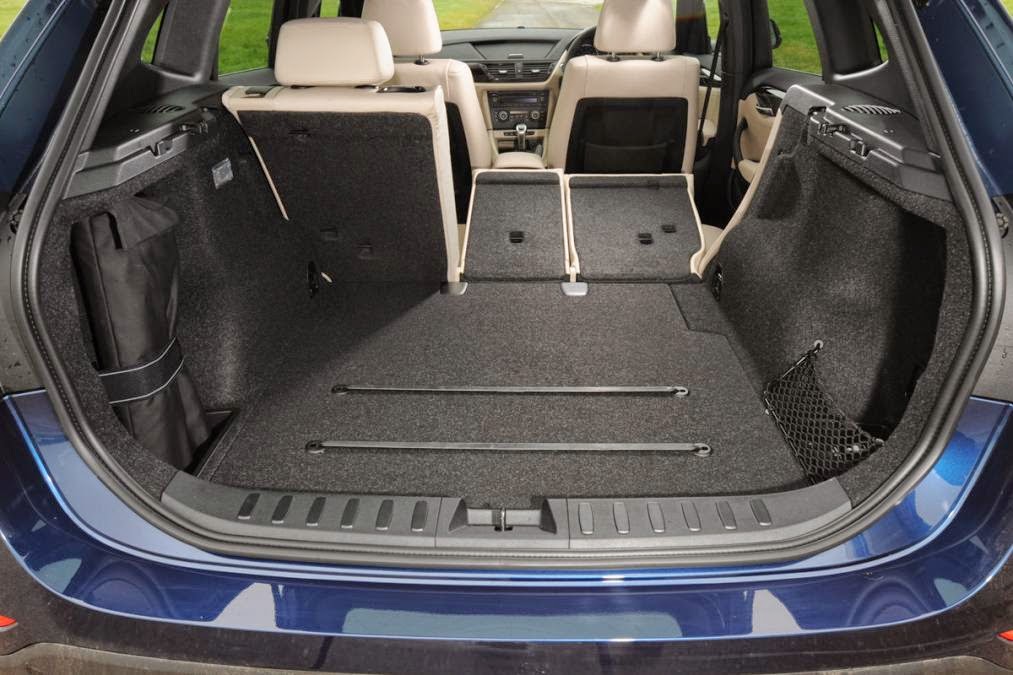
The BMW X1's 420-litre boot is 40 litres smaller than the Audi Q3's, and a full 155 litres less than the Range Rover Evoque's. Fold the rear seats down and you get a large 1,350-litre load area, however, which is only 15 litres less than the Q3.

There's plenty of space around the interior to store bits and pieces, including a large bin in the dashboard – but that's taken up by a CD drive for the sat-nav if you specify that option.

It's a comfortable place to sit too, but visibility is not great thanks to large pillars, and parking in town isn't very easy. The small rear doors make access a chore, but there's actually decent legroom in the back once you're in and two adults will fit in the seats without much trouble.


The BMW X1 is the smallest SUV in the line-up, so it's the lightest - and that means fuel economy is good for a 4x4.

The entry-level 16d and 18d models both return 57.6mpg and produce CO2 emissions of 128g/km, which are strong figures for a car like this. However, for the best economy go for the 20d EfficientDynamics, which returns average mpg of 62.8 and emits 119g/km of CO2.

The petrol models are much less efficient than the diesels with the four-wheel-drive 20i managing just 37.7mpg and a hefty 176g/km of CO2.

Standard equipment is pretty good, but be careful of adding too many options, as it can get expensive. A range of fixed-price servicing deals should help to keep running costs in check, but the X1 can’t match the Audi Q3 for residual values.

Kamis, 14 Mei 2015

Posted by Unknown | File under :

The amount of investment, man power and resources Jaguar has poured into the development of the XE meant it owed a lot for the British brand. The minor issues that niggled the pre-production models have been thoroughly resolved, it’s effortless on the move, forever composed and sharp to drive. Throw in a beautifully crafted cabin, best in class efficiency and there’s little reason why the XE isn’t the compact exec to have.

BMW 3 Series, competing with the swish Mercedes C-Class and fending off what will be a brand-new Audi A4 next year.

We drove the Jaguar XE back in January, but this isn’t a case of déjà vu. That car was an early, pre-production prototype designed to give us a brief insight into what we could expect from Jag’s new compact exec. It showed real promise, yet wasn’t quite the finished article.However, there are no excuses this time, as the XE we’re testing here is the very model that will arrive in showrooms in May, so promise and potential won’t cut it.

Referring to the Jag as ‘new’ doesn’t even begin to do it justice – it’s new in almost every sense of the word. From its aluminium architecture to the new factory that builds the engines in Wolverhampton, West Midlands, it’s all part of a near-£2billion investment from Jaguar Land Rover.


There may be 450Nm of torque at your disposal from 1,750rpm, but jabbing the accelerator doesn’t provide the savage surge of acceleration you’d expect; instead, there’s a far more cultured sense of power delivery. Only when extended beyond 4,000rpm does the traditional diesel din make itself known, but it’s a notch up in terms of refinement when compared to the equivalent diesel-powered C-Class.

You can spec the 178bhp engine with an eight-speed ZF auto gearbox for £1,750. We think that’s a worthy outlay, as fuel economy doesn’t suffer; the auto returns the same 67.3mpg and CO2 emissions of 109g/km as the manual. The lesser-powered 163bhp diesel will please the tax man even further, emitting only 99g/km of CO2.

On the move, the XE remains unflustered and composed at all speeds. The adoption of the lightweight aluminium architecture allowed Jaguar to fit heavier yet more sophisticated front and rear suspension, meaning the XE is able to glide with the composure of a C-Class while covering ground at the pace and precision of a 3 Series. It’s exactly where Jaguar aimed to position the car, and it has nailed it.

The passive ‘comfort’ set-up of the chassis offered a real tailored blend of forgiveness without upsetting its natural composure in bends. Adaptive dampers can also be added for around £800, which constantly manipulate the car to keep it in tune with the road surface. The chassis is so well resolved, though, that it’s an unnecessary option.


Steering is light yet consistent and incredibly direct, with a front end that responds with plenty of grip. The manual gearbox lets the side down a little with a long throw and a stubby lever that’s too short for comfortable shifts. The auto may have eight-ratios to deal with, but changes are swift and well timed, if a touch lethargic on the downshift. The more delicate you are with throttle inputs, the cleaner the changes.

Interior fit and finish is also up there with the best in class. The cabin is far more pleasing on the eye than the 3 Series’, with fewer gloss-black plastics than you’ll find in the C-Class. The new infotainment system isn’t the most intuitive, yet becomes more familiar the longer you spend with it and is a major upgrade from the systems used in Jaguars of old. But BMW’s iDrive set-up is still the far more accomplished system.

Those in the front will have little to complain about in terms of space, thanks to the superbly crafted and supportive seats, back seat occupants may not be so cheery. The swooping roof looks great, but it impacts on passenger space. Two adults in the back will have sufficient legroom, although headroom will be a tight for six-footers.

 
Key specs
  • Price: £33,675
  • Engine: 2.0-litre 4cyl diesel
  • Transmission: Six-speed manual, rear-wheel drive
  • Power: 178bhp
  • 0-62mph: 7.8 seconds
  • Top speed: 140mph
  • Economy/CO2: 67.3mpg/109g/km
  • On sale: Now

Senin, 11 Mei 2015

Posted by Unknown | File under :
Top of the range Peugeot 308 GT is comfortable and well equipped, but it's no GTi.

If pure driving thrills are top of your wishlist, you’ll need to look elsewhere. There’s still lots to like about the 308 GT, though – namely its high quality interior, low running costs and long kit list. It is good to drive too, and if this is a hint of what the upcoming GTi will be capable of, it certainly bodes well.

If you’re in the market for a fast family hatchback you really are spoilt for choice. Among others, there’s the Ford Focus ST, VW Golf GTI and Renault Megane RS – as well as our current top pick, the SEAT Leon Cupra. However, if the relatively high running costs and hefty tax bills put you off, Peugeot has an alternative: the 308 GT.

Granted, the GT is more of a warm hatch than a hot one, but until the 270bhp GTi arrives later this year, this will sit at the top of the 308 range. Having already driven the diesel estate, this was our first chance to try the 202bhp petrol in the UK.

At just over £24,000, it is expensive. But this aside, first impressions are good. Take a seat inside and the 308’s interior oozes quality, with the same sleek, minimalist cabin and upmarket materials as the rest of the range, as well as the familiar downsized steering wheel and high-mounted dials. Our car came with the optional £1,200 heated leather seats, but the standard half-Alcantara versions should suit most buyers.

All GT cars also boast keyless entry and go, dynamic cruise control, GT style badging and aluminium pedals. Outside you’ll notice a set of fabulous 18-inch alloy wheels, twin exhausts and rear diffuser, tinted windows and LED front indicators. The ride height has been lowered by 7mm at the front and 10mm at back for a sportier stance.


Push the starter button and the quiet tickover sounds much like any other petrol-engined 308. However, depress the standard-fit Sport button on the centre console and you’ll get a synthesised yet pleasing sound emitted through the car’s speakers. It also turns the dials red, tightens up the steering and sharpens the throttle response – helping the GT feel slightly more involving on a twisting country road.

It doesn’t affect the car’s dampers, but the lowered suspension actually makes the car more compliant – feeling comfortable over long distances yet communicative when you want to push on.
While the 1.6-litre turbocharged petrol engine will never set your pants on fire, it offers a plentiful rush of torque from just 1,750rpm. It feels suitably quick in a straight line, but there’s no avoiding the fact that this GT is a full second slower to 62mph than many of its similarly-priced rivals.


It has a real tendency to understeer, too, and overenthusiastic drivers will spend their lives staring at the intrusive traction control light flickering on the dash.

That said, it is surprisingly economical, with Peugeot claiming 50.4mpg and just 130g/km of CO2. For comparison, the Ford Focus ST returns 41.5mpg and will cost more to tax, while its closest rival, the Kia Cee’d GT, will only manage 38.2mpg. The diesel we tested last month is better still, but given the petrol’s improved refinement and peppier engine, this remains the GT of choice.

 
Key specs
  • Price: £24,095
  • Engine: 1.6-litre 4cyl petrol turbo
  • Transmission: Six-speed manual, front-wheel drive
  • Power: 202bh
  • 0-62mph: 7.5 seconds
  • Top speed: 146mph
  • Economy/CO2: 50.4mpg/130g/km
  • On sale: Now